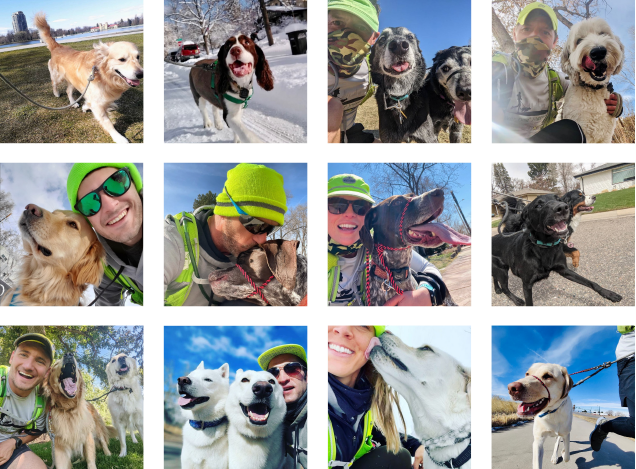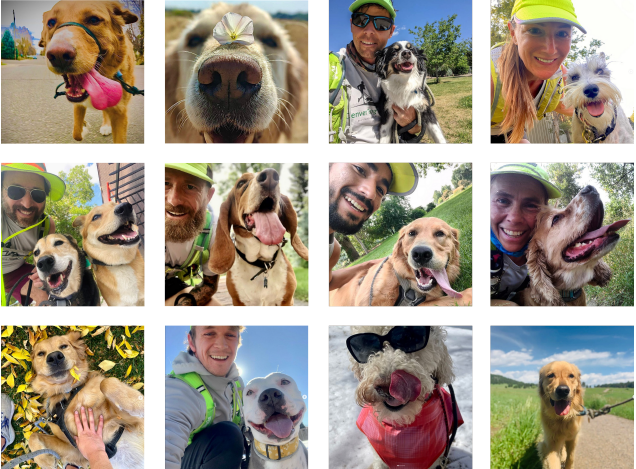
Mental stimulation for dogs is cognitive enrichment , which means training, scent work, puzzle feeding, novel-object exploration, and other activities that engage problem-solving and give a dog some control over the environment. It's not just fun, it's a way to support learning, calm behavior, and brain health.
On a Denver weekday, that difference is easy to see when a dog paces by the door after the keys come out, circles the couch, then crashes and sighs. The body looks tired, but the brain still needs work.
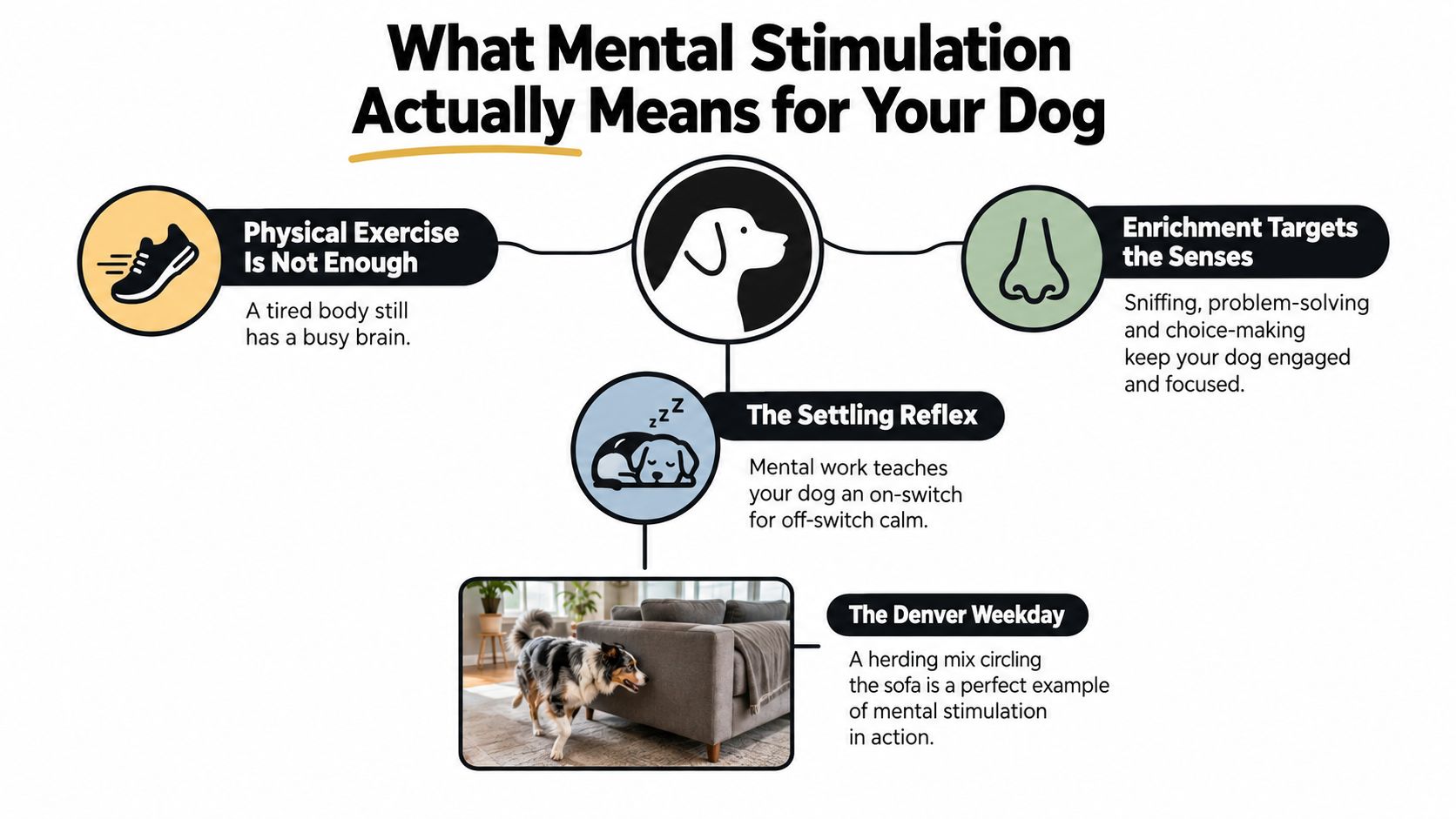
What Mental Stimulation Actually Means for Your Dog
A herding mix in a Denver apartment can look physically worn out and still be mentally restless. The owner leaves for work, the dog paces, checks the window, circles the sofa, and settles only after burning off a little chaos. That pattern usually isn't a “bad dog” problem, it's a brain-needs-work problem.
Mental work is not the same as motion
Mental stimulation means activities that ask a dog to solve problems, use the nose, make decisions, or handle novelty. That includes training sessions , puzzle feeders , sniffing games , and new terrain . The key idea is that the dog isn't just moving, the dog is thinking.
A treadmill-style mile in the same yard can take energy out of the body without fully engaging the brain. A trail, by contrast, changes scent layers, footing, and social information with every turn. That's why a walk or hike can feel richer to the dog than a repeated loop around the block.
Practical rule: if an activity only tires the legs, it's exercise. If it changes how the dog thinks, it's enrichment.
Why that definition matters in real life
The science behind enrichment points to more than entertainment. In aged dogs, structured cognitive enrichment has been associated with preserved learning ability, fewer failures in discrimination and reversal tasks, and reduced hippocampal neuron loss when combined with other interventions, which suggests a real connection between mental work and brain health PMC review on cognitive enrichment. That's why boredom can't be brushed off as harmless.
If you're looking for a practical starting point, this guide to enrichment activities for dogs fits the same idea into everyday routines. The goal isn't constant stimulation, it's the right kind of stimulation, repeated often enough to matter.
Mental enrichment should feel like a daily need, not a bonus feature. Once you see it that way, a leash walk in nature starts to make more sense as part of the solution, not just a way to burn calories.
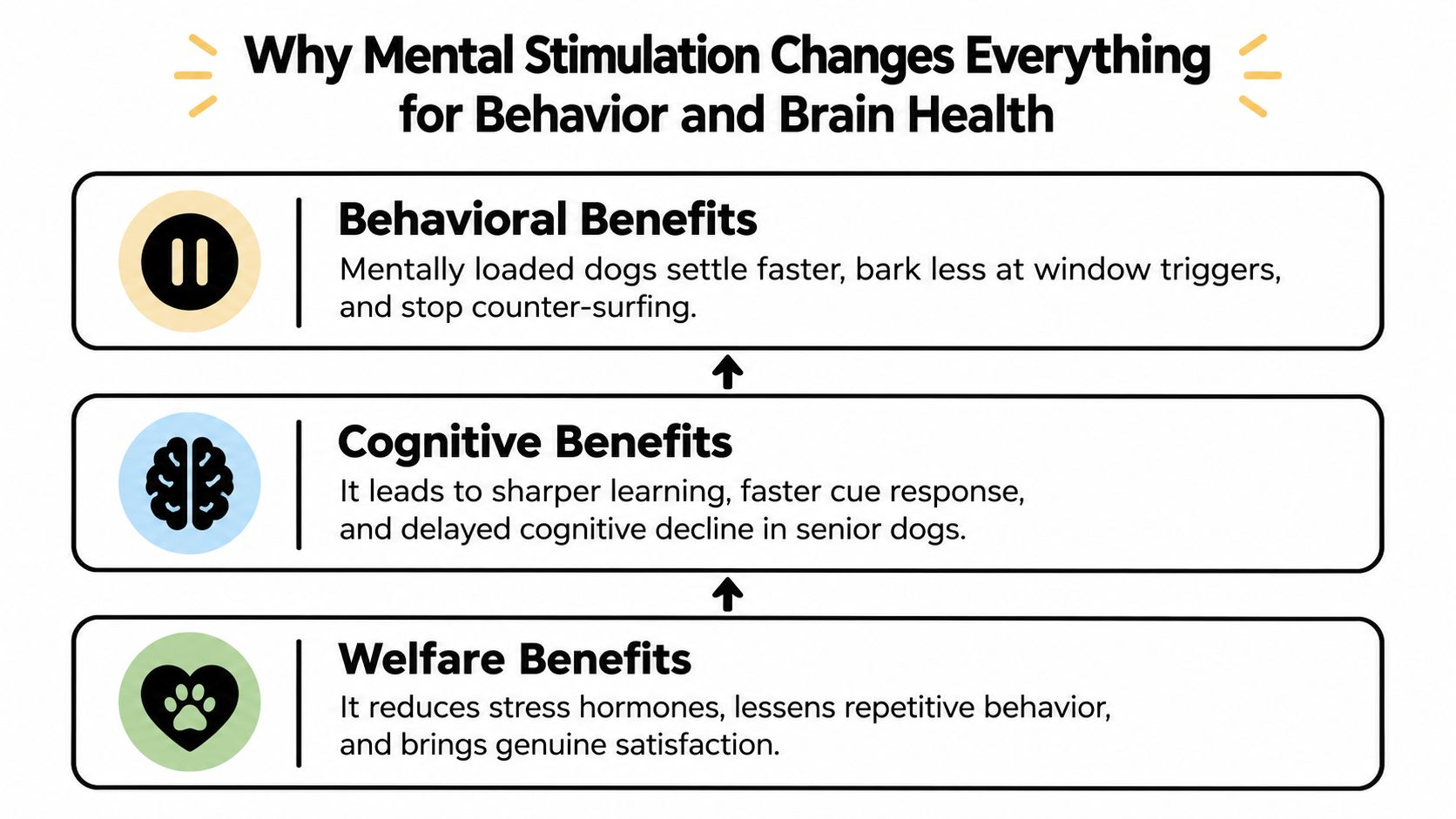
Why Mental Stimulation Changes Everything for Behavior and Brain Health
A mentally loaded dog usually looks different at home before anyone notices the training plan behind it. The dog settles faster, checks the windows less, and stops auditioning for every possible nuisance behavior. That shift happens because the brain has had productive work, not because the dog was worn out.
Behavior changes come first
The most obvious payoff is calmer behavior. Dogs that get real enrichment often have fewer demand behaviors, less barking at triggers, and less bouncing off the furniture by the end of the day. That's not magic, it's redirected effort.
The type of enrichment matters too. In dog enrichment studies, food-based and calming items often outperform generic toys for engagement and stress reduction. One study found dogs spent the most time with a long-lasting chew and showed the calmest emotional responses compared with a treat-dispensing toy or a smart treat-dispensing device, while another found calming enrichment reduced stress-related kennel behaviors and tactile items reduced vocalization the most dog enrichment study summary.
Brain health is part of the story
Enrichment also works on the cognitive side. Novelty, problem-solving, and repeated choice-making help keep a dog's learning systems active. In older dogs, that matters because cognitive decline can show up first as confusion, slower learning, or less confidence in familiar places.
A 2024 study found behavioral enrichment improved hippocampal volume but didn't prevent prefrontal cortex atrophy, which is a useful reminder that enrichment affects some regions more than others 2024 neuroscience study. That nuance matters. Mental stimulation isn't a cure-all, but it is more than entertainment.
Working definition: a tired body is not the same thing as a satisfied mind.
Welfare improves when dogs get choice
A dog that can sniff, decide, and recover from small mistakes is practicing more than obedience. It's also getting a sense of control, which is a major part of good welfare. That's why enrichment fits so well with modern welfare thinking, especially for dogs who spend long hours waiting for something interesting to happen.
The bottom line is simple. Physical exercise matters, but it can't fully replace cognitive load. The next step is matching the activity to the dog, because the menu changes with age, energy, and daily routine.
The Clear Signs Your Dog Needs More Mental Enrichment
A lot of owners miss boredom because the dog still looks active. The clues usually show up at the same time each day, often right when the house gets quiet or the owner gets busy. If your dog is acting out in predictable ways, the brain probably needs more work.
Behavior signs
Watch for the classic evening blow-up, the dog that gets the zoomies around 9 p.m., starts shadow-chasing, demands attention, or goes after pillows and baseboards. An apartment Lab shredding a baseboard while everyone is commuting to LoDo is a good example of a dog with too little to do.
The same goes for obsessive staring at reflections, window barking, and counter-surfing that seems to come out of nowhere. Those behaviors often flare when the dog hasn't had any meaningful problem-solving earlier in the day.
Energy and mood signs
Some dogs sleep all day and then explode the moment their people walk through the door. Others can't settle on the couch for more than a few minutes before nudging, pacing, or trying to restart the action. That pattern usually means the dog isn't tired, just under-engaged.
Mood changes matter too. A dog that seems flat, withdrawn, or uninterested in familiar hobbies may need more enrichment, not more yelling or more random play. Senior dogs can also seem confused in familiar rooms when they're missing the kind of structured cognitive work that helps them stay oriented.
Dogs that look “lazy” are often under-stimulated, not low-energy.
For a fast self-check, these signs of boredom in dogs line up closely with what owners see at home. The encouraging part is that these patterns are common and usually respond quickly to a better routine.
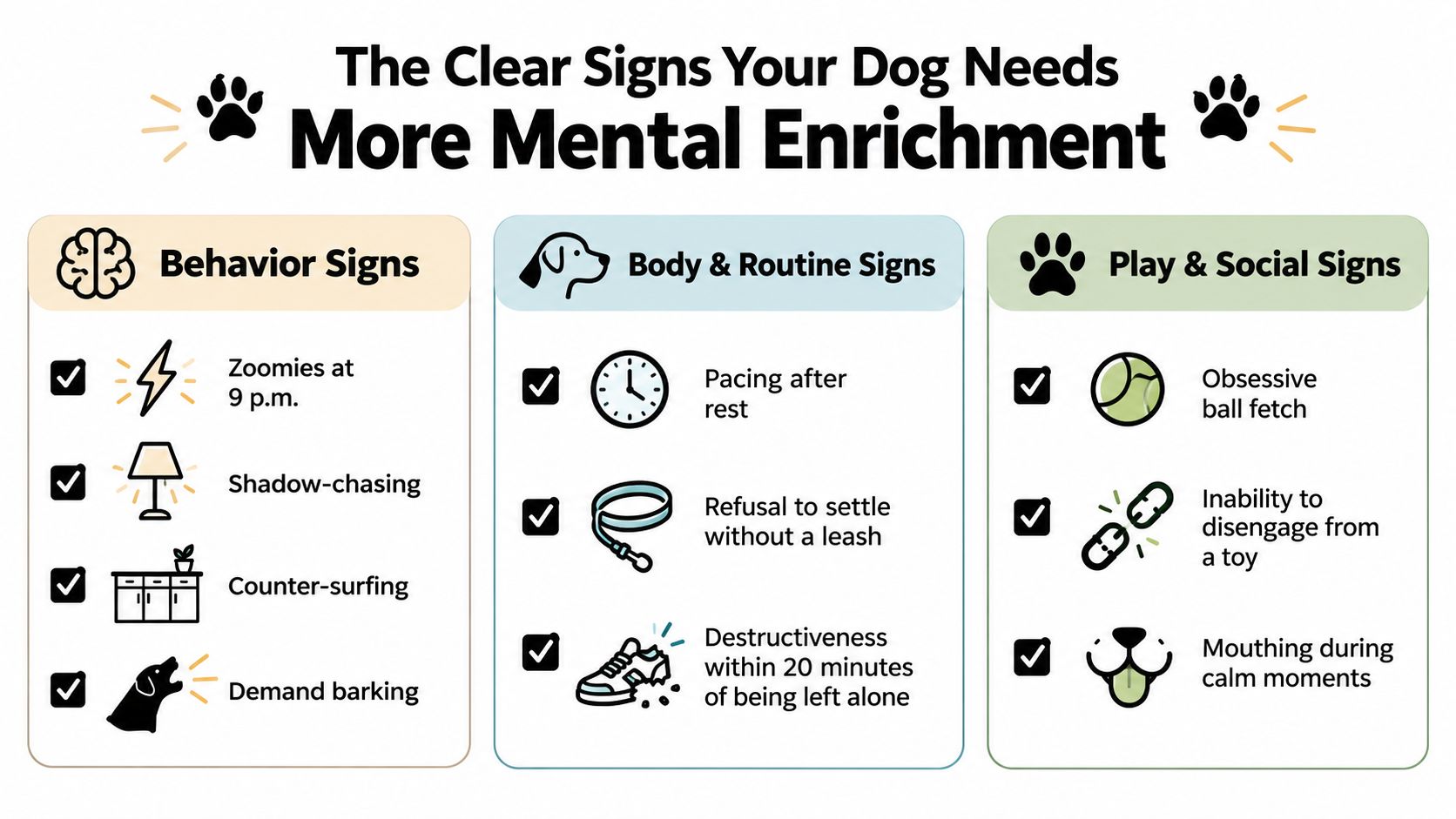
Here's a useful benchmark. If the same dog looks relaxed only after a long training session, a sniff-filled walk, or a puzzle meal, boredom was probably driving the earlier chaos.
How Dogs Learn and Which Activities Engage Their Brain
Dogs don't learn from one channel only. They learn through reward, association, and scent-driven investigation, and each channel lends itself to a different kind of enrichment. That's why the same toy every day gets stale fast.
Match the activity to the learning system
Operant conditioning is the “when I do this, something good happens” system. That's where clicker training shines, especially for impulse control, loose-leash skills, and quick cue work.
Classical conditioning is about association. A reward marker, a cue, or a routine can tell the dog what's coming next, which helps create predictability and confidence.
Scent-driven cognition is where dogs spend a huge amount of mental energy. Nose work and sniff trails fit here because the dog is gathering information, comparing odor sources, and deciding where to go next.
Why mixing formats works better
A puzzle feeder can challenge problem-solving, but it doesn't always recruit the same kind of attention as a scent trail. A training drill can sharpen cue response, but it won't always give the same deep foraging satisfaction as a long sniff session. Novel-environment exploration adds another layer, because the dog has to process new ground, new sounds, and new decision points at the same time.
That's why enrichment should look like a menu, not a single item. One day can be all about a frozen food toy, another can focus on recall games, and another can be a neighborhood sniff walk. The brain stays more engaged when the pattern changes.
Good enrichment rotates the challenge. The dog should have to think in different ways across the week.
The practical takeaway is easy. Use one activity for impulse control, another for problem-solving, and another for scent work. The dog gets more complete mental work, and you don't end up relying on the same puzzle toy until it stops being interesting.
How On-Leash Running and Hiking in Denver Provide Real Mental Work
A weekday outing near Sloan's Lake, Mount Falcon, or Bear Creek can leave a dog physically exercised and mentally occupied before dinner. On-leash movement gives the dog new scents, changing ground, and safe chances to make decisions beside a handler. Indoor puzzles and toys have value, while outdoor movement adds information-rich work they cannot fully reproduce.
Why the trail does more than the yard
A Denver trail works like a living scent library. Wildlife traces, other dogs' odors, shifting surfaces, and small environmental changes require the dog to gather information and update its choices as the route continues. That ongoing processing is cognitive enrichment, not background noise.
Uneven ground adds proprioceptive work. The dog makes constant adjustments in balance, stride, and foot placement while reading the environment. A familiar backyard loop offers fewer new decisions, so the brain receives a different level of input.
Why leash work adds cognitive load
A structured hike or run also teaches restraint during movement. Passing a squirrel, cyclist, or another dog while staying in position asks for impulse control, attention, and recovery. The dog is working through competing signals while its body keeps moving.
Denver Dog's weekday service area covers Denver Dog's weekday service area across the Denver metro, including Arvada, Denver, Englewood, Golden, Lakewood, Littleton, and Wheat Ridge. Sessions use route planning, pace matching, and enrichment cues, allowing a booked outing to combine exercise with outdoor cognition in one weekday slot.
For practical guidance on the physical and mental benefits, read this guide to running with your dog. A professional on-leash hike or run adds real-world sensory work that indoor toys rarely provide, and it pairs well with puzzle feeding at home.
Tailoring Mental Stimulation to Your Dog's Age and Energy
A puppy, a working-breed adolescent, and a senior dog all need mental stimulation, but they don't need the same kind. The right choice depends on joints, stamina, frustration tolerance, and how much novelty the dog can handle before tipping into chaos.
Puppies and young dogs
For puppies, short training bursts, gentle scent games, and food puzzles are a smart mix. The point is to build confidence and problem-solving habits without overwhelming developing joints or nervous systems.
A few minutes of enrichment can be enough if the activity is novel and clear. A five-minute food puzzle before a nap often does more for a young dog than a long, messy play session that leaves them overstimulated.
High-energy adults
Adolescent and athletic adults usually need the most layered work. They do well with problem-solving, leash manners, recall practice, and longer on-leash hikes that ask them to settle into a rhythm instead of exploding into motion.
A dog in this stage often needs both mental fatigue and body fatigue. If you skip the brain piece, the dog may come home physically tired and still go looking for trouble.
Senior or limited-mobility dogs
Senior dogs can still learn, and often benefit from it. Scent work, gentle sniff walks, and stationary puzzle feeders give them a job without stressing joints or stamina.
For older dogs, think slower pace, richer scent, easier footing .
A shorter neighborhood walk can work better than a hard hike, especially if the dog needs extra time to sniff and choose. The best plan is the one the dog can repeat without pain or frustration.
| Life Stage | Best Enrichment Types | Daily Time Budget | Suggested Denver Dog Service |
|---|---|---|---|
| Puppy | Food puzzles, short training, scent games | Short, frequent sessions | Neighborhood walk or light enrichment walk |
| High-energy adult | Recall work, on-leash hikes, sniff-heavy runs | One active session plus small home game | Denver Dog Joggers style run or longer hike |
| Senior or mobility-limited dog | Sniff walks, gentle puzzle feeders, hide-and-seek | Brief, low-impact sessions | Slower neighborhood walk with extra sniff time |
The best routine is the one that matches the dog's current body and brain, not the one that looks impressive on paper. That's especially true when weekday time is tight and consistency matters more than intensity.
Common Misconceptions About Keeping Dogs Mentally Engaged
The biggest mistake is assuming a long walk automatically solves boredom. Duration matters less than novelty, scent variety, and choice-making. A dog walking the same loop every day can treat it like a commute, not an experience.
The backyard myth
A fenced yard helps with movement, but it doesn't automatically create enrichment. If the dog is only pacing, patrolling, or staring through the fence, the brain is still underused. Same space, same smells, same story.
Fetch is not the same as enrichment
Fetch can be great exercise, but repetitive fetch is still repetitive. The dog is chasing, returning, and waiting for the next throw, which doesn't always ask for much thought. If you want mental work, add searching, cueing, or choice-making instead of endless repeats.
Puzzles are not just for certain breeds
Some owners assume food puzzles are too complicated for scent hounds or herding dogs, when the opposite is usually true. Those dogs often benefit a lot from problems that involve searching, sorting, and persistence. The activity just has to fit the dog's style.
Training and enrichment are related, but not identical
A dog can be well trained and still under-enriched. Obedience focuses on reliable behavior, while mental stimulation also asks the dog to investigate, choose, and recover from small mistakes. That freedom matters because it gives the brain somewhere to go besides compliance.
The cleanest way to think about it is this. Training tells the dog what to do. Enrichment gives the dog a chance to think.
A Simple Weekly Plan to Start Enriching Your Dog Today
A good week doesn't need fancy gear. It needs variety, repeatable habits, and at least one activity that makes the dog use the brain on purpose every day.
A seven-day starter routine
Monday, start with a five-minute snuffle mat breakfast, then keep the evening easy with a short sniff walk.
Tuesday, add a two-minute nose-work game in the living room, where you hide a few treats under cups or behind chair legs.
Wednesday, book a 45-minute on-leash hike on varied terrain, with enough scent density to keep the dog engaged without overdoing the pace.
Thursday, use a frozen Kong or lick mat while you work from home, so the dog gets calm, focused licking instead of restless pacing.
Friday, do a 30-minute faster-paced on-leash run through a neighborhood with new sights and smells, then follow it with quiet downtime.
Saturday, make the day lighter, but still include a regular walk with extra sniff time and a short loose-leash or recall micro-session.
Sunday, keep it calm and low-pressure, with a toy rotation or a puzzle feeder during a slower morning.
Simple rule: one brain job a day beats random bursts of activity.
How to adjust it
If the dog starts settling faster, barking less, and disengaging more easily, keep the routine but trim the intensity a little. If the dog still looks restless, add novelty before adding duration. A different route, a different food toy, or a different scent game usually does more than just making the session longer.
For a weekly outdoor anchor, Denver Dog can handle on-leash movement in the Denver metro with routes and pacing built around the dog in front of the handler. That gives you a reliable place to plug in the harder cognitive work while home enrichment fills the gaps.
If you want a weekday routine that gives your dog real mental work, Denver Dog can help with on-leash runs, walks, and hikes built around safe movement and outdoor enrichment. Visit Denver Dog to see how a structured schedule can fit your dog's energy, your calendar, and the kind of brain work that changes behavior.
The Run Down