Your dog slept through your workweek, then charged up a Saturday trail like he'd been training for months. By Sunday night he's stiff on the stairs, slow to rise, and uninterested in his usual walk. That's not stubbornness. It's a dog who got asked for a weekend effort his weekday body wasn't ready for. Dog conditioning exercises fix that gap by building readiness in measured steps, not by hoping enthusiasm carries him through.
Why Conditioning Is More Than a Longer Walk
A familiar pattern plays out every spring. A dog gets short neighborhood walks all winter. Then the weather breaks. His owner picks a bigger hike, adds distance, and assumes a willing dog is a ready dog.
He keeps up on the way out. He lags on the way back. At home he drinks hard, flops down, and moves carefully the next morning. The outing didn't prove fitness. It exposed the lack of it.
Enthusiasm Hides Poor Preparation
High energy and good conditioning aren't the same thing. A young, athletic dog will chase pace long after his muscles have tired. He'll pull toward another dog, scramble up a bank, and keep offering effort you didn't ask for.
That willingness makes him easy to overwork. You can't judge readiness by how excited he looks at the trailhead. You judge it by what he can repeat, recover from, and do again without a change in gait or behavior.
A dog who finishes one long outing hasn't shown he's conditioned. A dog who repeats similar work and recovers normally has.
What Conditioning Actually Means
Conditioning is a deliberate, progressive program with a starting point you can measure. You repeat a similar type and duration of work often enough that the body adapts. Then you raise the demand a little.
Research described in the Frontiers refinement of the Penn Vet Working Dog Center Sprint Test emphasized that muscular fitness matters for companion dogs, not only working and sporting dogs, and that standardized functional testing can help assess fitness and injury risk. Separate work described conditioning as performing a similar exercise type and duration daily for at least four weeks . One heroic Sunday doesn't meet that definition.
That distinction changes how you plan:
- Occasional activity: varied, unmeasured, often longer than the dog's normal week
- Conditioning: repeatable sessions, tracked recovery, one variable increased at a time
- Testing: a check on what the dog handles now, not a guess based on breed or energy
Start by measuring readiness, workload, fatigue, and recovery . If you can't describe those four things for your dog, you don't have a program yet. You have a walk that got longer.
Checking Your Dog's Readiness Before the First Session
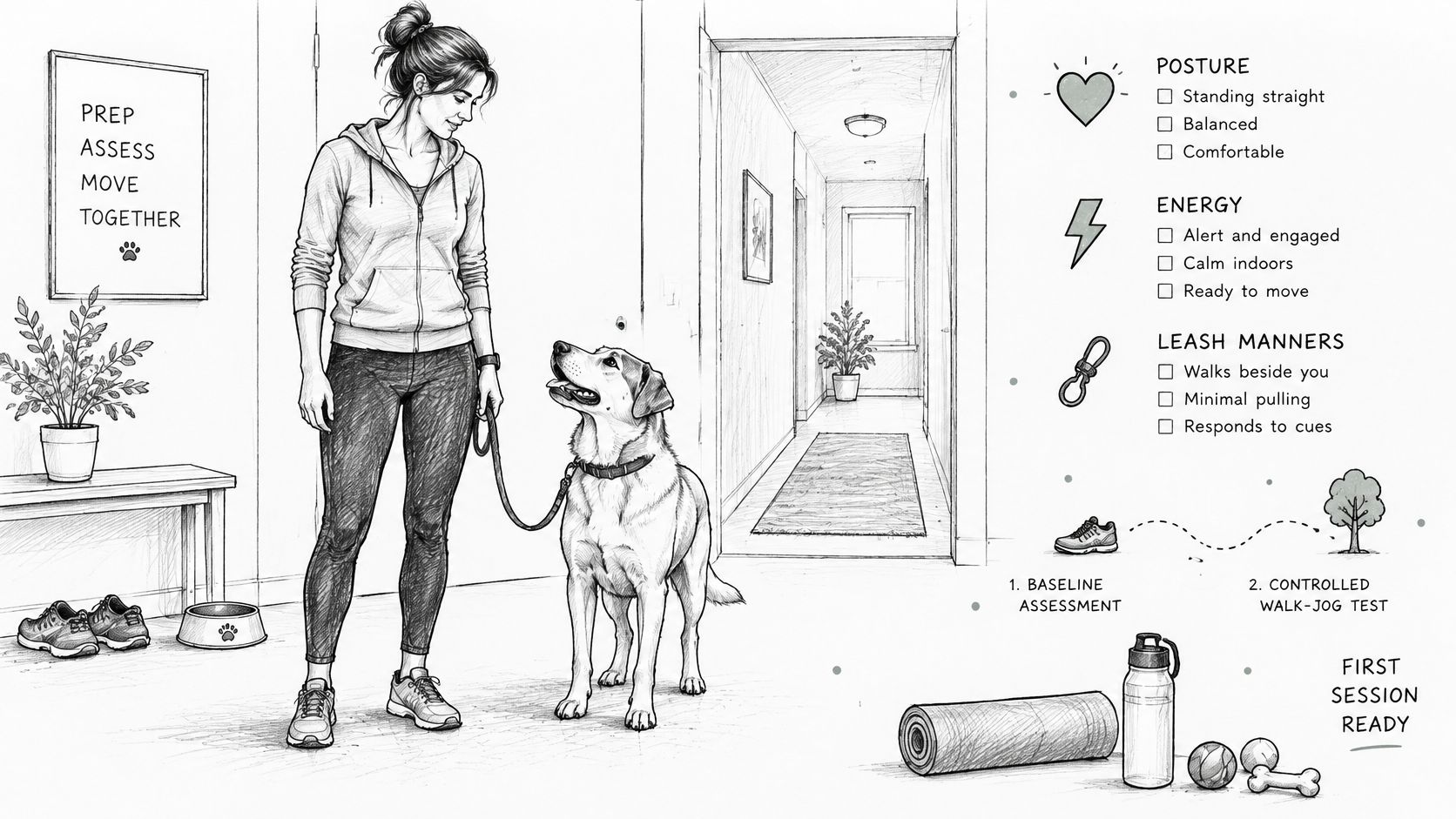
You don't need lab equipment to set a baseline. You need a flat, familiar route, a leash, and a notebook. Keep the first checks easy. You're gathering information, not chasing a workout.
Run Three Simple Home Checks
1. Controlled walk-jog intervals. Walk at your normal pace, then jog lightly for a short stretch if your dog moves comfortably. Return to walking before he falls behind or starts pulling erratically. Note how quickly his breathing settles once you slow down.
2. Next-day stiffness check. Watch him rise from rest the following morning. Note hesitation on stairs, shortened steps, or reluctance to jump into the car. Mild tiredness is one thing. A clear change in how he moves is a reason to hold the workload.
3. Paw and recovery check. Inspect pads after pavement, gravel, or trail surfaces. Look for redness, cracks, or tenderness when you handle each foot. Then watch whether he eats, drinks, and settles in his usual pattern that evening.
Record What You See
Write down surface, weather, pace, and how he moved the next day. Two or three sessions of notes beat your memory every time. Patterns show up fast.
A newly adopted dog, for example, may walk calmly but panic at bikes and spend the whole outing tense. His limit that week is mental, not muscular. A sedentary dog may look fine during the session and stiffen overnight. His limit shows up late.
Practical rule: If next-day movement isn't normal, the previous session was too much, whatever the distance said.
Know Where Home Checks Stop
Stop and call your veterinarian for pain, lameness, repeated lagging, or a suspected weight problem. Don't try to condition through those signs. A life-stage health screening guide for dogs helps you frame that conversation before you raise intensity.
Dogs who are overweight, senior, brachycephalic, or dealing with orthopedic issues need veterinary input first. Everyone else starts at the most gradual level their baseline supports. That's not being cautious for its own sake. It's how you avoid spending your first month managing soreness instead of building fitness.
Building Warm-Ups, Strength Work, and Cool-Downs
A good session has a beginning, a middle, and an end. Most owners skip straight to the middle. They clip the leash on, start at full pace, and stop abruptly at the front door. Structure costs you a few minutes and buys you a dog who warms into work and comes down from it calmly.
Warm Up Before You Ask for Pace
Start with easy walking and let your dog sniff. Sniffing pace isn't wasted time. It lets breathing rise gradually and gives you a first look at gait before you add speed.
Add gentle direction changes and short, relaxed mobility work through the hips and shoulders. Walk a loose figure eight on flat ground. Ask for a few calm turns each way. If he moves stiffly here, you've learned something cheaply, before work starts.
Build the Main Work Block
The middle of the session mixes sustained forward movement with resistance oriented work. On a run or hike, forward movement is the base. Strength work fills the gaps that steady trotting doesn't cover.
Useful options include:
- Controlled sit-to-stand repetitions: slow, square, and stopped before form gets sloppy
- Slow uphill walking: a gentle incline walked, not charged, so the hind end does deliberate work
- Balance work on safe surfaces: standing calmly on stable, non-slip ground while weight shifts naturally
Keep repetitions low and clean. A dog who starts flopping into a sit or scrambling for footing is telling you the set is over. End it there. Sloppy repetitions don't build strength. They rehearse compensation.
Cool Down on Purpose
Finish with a slow walk until breathing eases and your dog can move and sniff at a relaxed pace. Don't go from a hard effort straight to the car or the couch. The cool-down is also your inspection window. Check pads, watch stride at a walk, and offer water.
Scale every part to the dog in front of you:
- Tires quickly: shorten the work block, keep the warm-up and cool-down intact
- Loses focus mid-session: drop strength work and finish with easy walking
- Breathing stays hard after slowing: end the session and reassess before the next one
Ending early isn't a failed session. It's information you acted on in time. The dog who stops while he's still moving well comes back ready sooner than the dog you pushed to finish a planned route.
Progressing Workload Safely Over Several Weeks
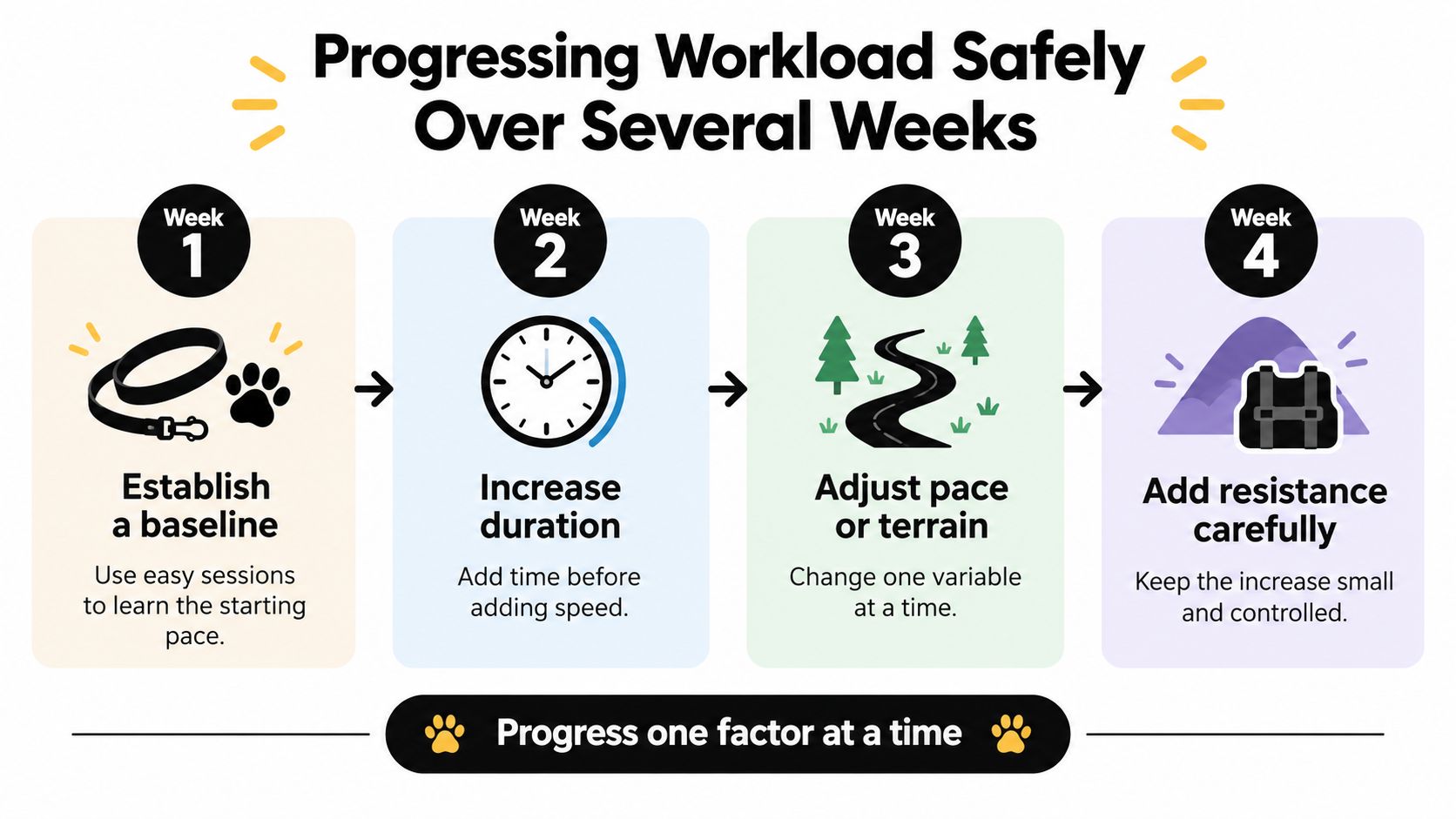
Progression is where plans fall apart. Owners add time, speed, and hills in the same week because the dog seemed fine. Then soreness shows up and nobody knows which change caused it. Change one variable at a time , duration, pace, terrain, or resistance, and you'll always know what your dog responded to.
What the Evidence Shows
A peer-reviewed eight-week study followed 21 healthy dogs exercising with their owners through jogging and strength exercises, with no calorie restriction. In the eight-week jogging and strength exercise study in healthy dogs, mean body-condition score fell from 5.1 ± 0.9 to 4.7 ± 0.6 , a significant change at P = 0.007 , while body weight stayed stable and thigh circumference increased.
The share of dogs at an ideal body condition, defined as BCS 4 to 5 , rose from 13 of 21 to 19 of 21 , roughly 62% to 90% . Read that carefully. Weight didn't drop. Shape changed. Muscle increased while condition improved.
That's the outcome a scale alone would miss. It also explains why a conditioned dog can look leaner and move stronger at the same weight. The study was small and short, so don't generalize it to every breed, age, or medical condition. It still makes a solid case that consistent, progressive work combining aerobic activity with resistance beats casual walking alone.
The Advance or Hold Decision
Use a simple rule before you add anything. Advance only when your dog recovers normally, behaves steadily, and moves comfortably the next day. Pair that check with the habits in a solid set of injury prevention strategies for active dogs and you'll catch problems while they're small.
- Advance: normal appetite, normal rising and stairs, eager for the next session
- Repeat the week: mild tiredness, slightly slow recovery, inconsistent focus
- Step back: stiffness, soreness, appetite change, or reluctance to start
Repeat a similar exercise type for several weeks before you layer in new demands. Boring consistency is the mechanism here. The body adapts to what it does repeatedly, not to what it survives occasionally.
Progress is earned the morning after a session, not during it.
If fatigue signs appear, pause the block. Hold or reduce the load until movement and appetite are normal again. You'll lose a few days. Pushing through costs more.
Adjusting Routines for Breed, Age, and Heat
There's no universal routine, and breed charts that promise one are selling you false precision. Two dogs of the same breed can sit at opposite ends of readiness. Age, build, coat, body condition, and weather rewrite the same plan in practice.
Match the Plan to the Dog
Athletic breeds often tolerate pace sooner, but they still need structured progression. Their risk is different, not smaller. They'll outrun their preparation and hide fatigue until they're well past a sensible stopping point.
Brachycephalic dogs need shorter, cooler sessions and a lower threshold for stopping. Breathing sets their limit, so watch it closely and don't schedule their hardest work in warm conditions. Senior and overweight dogs usually do better with low-impact options, gentler surfaces, and veterinary input before intensity rises.
Treat Temperature as a Hard Limit
Denver Dog's published operating guidance sets a running temperature range of 10°F to 89°F and caps running distances at 2.5 miles when temperatures rise above 80°F , as set out in the Denver Dog operating guidance and FAQs. That second number matters most. The run shortens well before the upper limit arrives.
Temperature alone still isn't the whole decision. Humidity, direct sun, hot pavement, coat type, body condition, and acclimatization all interact. Trail elevation does too. A moderate looking outing at altitude asks more of a dog who trained all week on flat neighborhood streets.
Cornell's guidance points the same direction. The Cornell Riney Canine Health Center summer heat safety guidance recommends exercising during cooler times, avoiding strenuous activity in heat and humidity, using shade, and carrying water, and notes dogs may be unacclimated early in the warm season.
A Conservative Decision Framework
- Full session: cool conditions, acclimated dog, normal recovery from the last outing
- Shortened session: warming temperatures, direct sun, or new terrain or elevation
- Low-impact enrichment instead: heat, humidity, hot surfaces, or any doubt about breathing
Build heat acclimation over weeks, not days, and schedule harder work early. For the warning signs that should end a session outright, work through this Denver guide to preventing heat stroke in dogs before summer arrives. When in doubt, choose the shorter option. A dog can't tell you he crossed his limit twenty minutes ago.
Sample Weekly Conditioning Programs to Copy
Sporting dog handlers figured this structure out long ago. In a 2022 survey, researchers analyzed 1,582 dogs from 1,615 questionnaire responses , and 1,119 dogs, or 71% , received additional physical conditioning exercise beyond sport practice, as reported in the 2022 survey of Swedish sporting and working dogs. Another 732 dogs, or 46% , specifically addressed musculoskeletal components through conditioning.
That sample covers sporting and working dogs, not ordinary pets, so don't copy their workload. Copy their logic. Conditioning there spans daily movement, sport-specific work, cardiorespiratory work, and musculoskeletal preparation. It isn't one undifferentiated walk.
Two Templates to Adapt
| Day | New Adopter Focus | Athletic Dog Focus | Intensity Guide |
|---|---|---|---|
| Monday | Easy walk with warm-up structure | Steady jog with strength finish | Moderate |
| Tuesday | Home mobility and sit-to-stands | Easy walk and balance work | Low |
| Wednesday | Rest or sniff walk | Hike on varied terrain | Low to high |
| Thursday | Easy walk, repeat Monday's level | Rest or easy walk | Low |
| Friday | Short walk-jog intervals | Steady jog, one variable raised | Moderate to high |
| Saturday | Gentle incline walk | Longer hike, early start | Moderate to high |
| Sunday | Full rest | Full rest or sniff walk | Rest |
How to Use the Table
Alternate harder and easier days. Never stack your two biggest efforts back to back. Put heavier work early in the day during warm weather, and protect at least one genuine rest day.
Swap formats without breaking the logic. A joggers style session covers your sustained pace day. A hiking style outing covers terrain and endurance. Home mobility covers the strength and balance work you'd otherwise skip.
- Dog recovers slowly: repeat the same week before adding anything
- Weather turns hot: move the hard day earlier or trade it for enrichment
- Schedule breaks down: drop a moderate day, keep the rest day
These are templates, not prescriptions. Your readiness notes decide whether next week looks the same or steps up. A busy owner who repeats a sensible week will condition a dog better than an ambitious owner who improvises a bigger one every Saturday.
Choosing Joggers or Hikers and Booking Your First Session
Professional help fits best where your schedule breaks down. Most owners can manage weekend work. Weekday consistency is what slips, and consistency is the whole program. Two formats cover that gap differently.
Compare the Two Formats
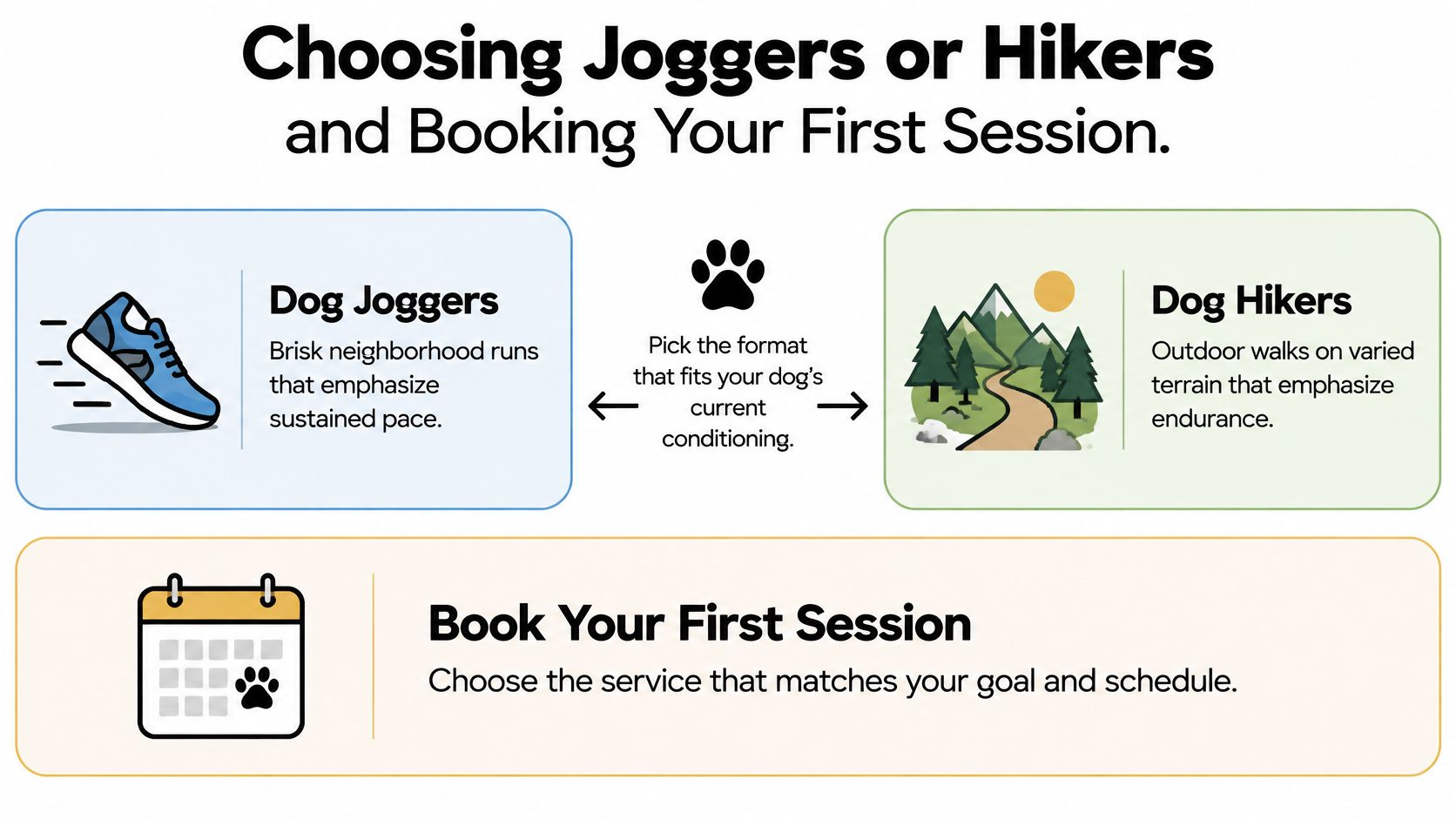
Denver Dog offers two formats, Dog Joggers for brisk neighborhood runs and Dog Hikers for guided trail outings, with mechanical demands that differ by session, as described in the Denver guide to hiring a dog walker. Jogging emphasizes sustained forward movement and pace on predictable surfaces. Hiking adds varied terrain, elevation, and longer periods of controlled exploration.
Pick based on your dog's current conditioning, not his enthusiasm. A new adopter or deconditioned dog starts with shorter, steadier efforts. Workload rises only when recovery and behavior stay normal. A dog already moving well can use trail work for the terrain variable while neighborhood runs hold his pace work.
See the Work Before You Book
The short video below shows what an on-leash session looks like in practice, which helps you judge pace and handling before you commit.
These on-leash runs and hikes slot straight into the weekly templates above as your moderate and terrain days. Coverage spans Arvada, Denver, Englewood, Golden, Lakewood, Littleton, and Wheat Ridge, and you can confirm your neighborhood on the Denver Dog service area page.
If you're on the business side of the trail world yourself, for example guiding clients rather than booking exercise for your own dog, Samba explains how operators can sell hiking trips from your website without building booking tools from scratch.
Bring your baseline notes to the first booking. Note current pace, next-day movement, and any veterinary concerns. Then request a first session at the intensity your baseline supports, not the intensity you're hoping for by summer. That's how a hired session becomes conditioning instead of another one-off adventure.
Denver Dog builds structured weekday running and on-leash hiking sessions around your dog's current readiness, with workload raised only when recovery stays normal. If your dog needs consistent conditioning you can't fit into a workweek, visit Denver Dog to choose a Joggers or Hikers session and book a first outing at the right intensity.
The Run Down