Shoppers often pick a dog walking waist belt like it's a convenience upgrade. That's the wrong frame. Once you clip a dog to your body, you're making a load-bearing decision that can help or hurt, depending on the dog, the route, and how steady you are when the line goes tight.
Hands-free gear is useful, but it's not automatically safer. A recent review found that the leash type involved in dog-walking injuries is generally not recorded, so there's no strong evidence that waist-attached systems are safer than handheld leashes. If your dog is predictable, your balance is solid, and you want your hands open for running, hiking, gates, water, or keys, a belt can be a smart tool. If your dog lunges, you're dealing with icy sidewalks, or you already worry about being pulled off line, skip the trend talk and judge the setup like safety equipment.
| Style | Best For | Key Strength | Watch Out For |
|---|---|---|---|
| Minimal running belt | Calm, trained dogs on short runs | Light, breathable, low bulk | Less padding, less forgiveness |
| Padded everyday belt | Regular neighborhood walking | Better pressure distribution | Can still rotate if fit is poor |
| Integrated retractable belt | Controlled open-space use | Convenience and reach | Slower correction, more control risk |
| Heavy-duty trail belt | Hiking, long outings, storage needs | Support, stability, carry space | Bulk and heat on warm days |
Practical rule: a centered load path only helps when the dog is predictable. If the dog isn't, the belt just moves the problem from your hand to your hips.
If you want a straight, city-side explanation of running with a dog before buying gear, Denver Dog has a useful guide on how to run with your dog on a leash safely. For Denver owners, that matters on crowded sidewalks as much as on park paths, because the issue isn't fashion, it's whether you can stay upright and in control.
Why a Dog Walking Waist Belt Is a Safety Decision, Not a Convenience
A hands-free belt can make a calm dog easier to manage, but it can also give a sudden lunge more force against your body. The pull moves from your hand and wrist to your pelvis, hips, and torso. That arrangement works only when your dog's behavior, your balance, and the route support it.
Choose a belt for running, hiking, or walking when your dog already follows leash manners and you need both hands for water, keys, waste bags, or a phone. Skip it for a reactive puller, anyone with balance concerns, or walks where a sideways tug could send you down. Denver's mix of crowded sidewalks, uneven trails, and icy corners makes that judgment practical rather than cosmetic.
Who should use one, and who shouldn't
Use a belt when your dog stays reliably beside you, the route is familiar, and you can absorb a brief surge without twisting or overcorrecting. Leave it at home when your dog chases movement, cuts sharply across your path, or throws its weight into the leash without warning. A centered connection cannot compensate for unpredictable behavior.
A belt also fails when you need immediate, one-handed steering at close range. Narrow sidewalks, icy corners, and busy trailheads leave little room for delayed correction. A handheld leash gives you a more direct connection and reduces the amount of body rotation during a fast change of direction.
Before buying, apply the same standard used for any load-bearing safety tool: identify the likely pull, the available stopping space, and your ability to stay upright. Denver Dog's running leash guide for 2026 offers a run-specific framework for deciding whether a leash setup supports movement or creates avoidable risk. That decision, rather than the athletic look of the gear, separates a sound purchase from a risky one.
How the Dog Walking Waist Belt Became Its Own Category
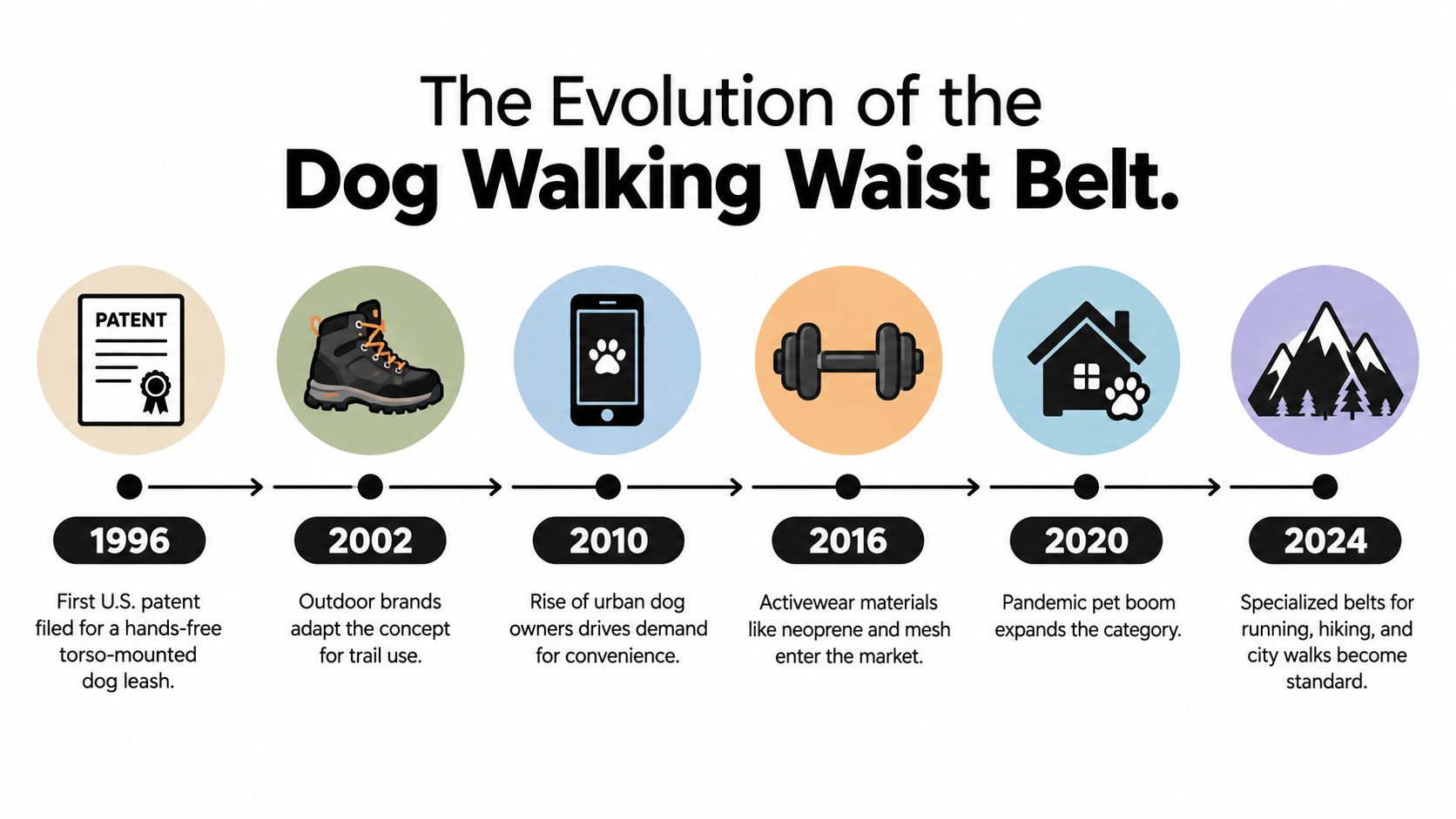
The waist belt didn't start as an influencer accessory. It started as a formal hands-free control idea in U.S. patent development. A U.S. patent application for a hands-free dog leash received priority on December 9, 1996, and the resulting patent, US5842444A , was granted on December 1, 1998, with a torso-worn belt and a sliding ring meant to keep the handler free while reducing jerking and neck strain. You can see the patent record in the historical filing itself, which shows that this category was already being engineered for load management by the late 1990s. US5842444A patent record
Why the feature list kept growing
By the time later designs appeared, the belt had already moved beyond a simple strap. A 2012 patent application described a waist belt with a retractable leash, attachment points for bags or water bottles, and front and rear lighting for visibility. That progression tells you what active walkers asked for: more control options, more carry options, and better visibility when the sun goes down.
That's why modern belts often add shock-absorbing bungees , padded lumbar sections, reflective trim, and quick-release hardware. Those aren't random add-ons. They're responses to the friction of jogging, trail walking, and city movement, where the handler needs to stay mobile without losing the ability to correct the dog fast.
The category split happened for a reason. A slim running belt, a padded walk belt, and a trail belt solve different problems. The mistake is treating them as interchangeable because they all clip around the waist.
The Four Main Dog Walking Waist Belt Styles Compared
A waist belt is load-bearing safety gear, not a comfort accessory. Choose it by the dog's movement and the route, because a belt that feels fine on a quiet Denver sidewalk can become a liability when a dog cuts across a bike lane or lunges on loose trail.
The belt amplifies good handling and amplifies bad handling equally. It never substitutes for a dog that holds its lane.
Choose by route and dog
| Choose this if | Avoid this if |
|---|---|
| You run with a light, trained dog that stays beside you | Your dog surges, crosses, or needs frequent correction |
| You walk daily with a medium-to-large dog and want pressure spread across your waist | You will leave the belt loose enough to twist or ride upward |
| You use open space with a controlled dog and can accept slower corrections | You walk mixed-traffic sidewalks or handle a reactive dog |
| You hike longer routes and need storage, stability, and a secure connection | You mainly take short neighborhood walks and dislike heat or bulk |
Minimalist running belts win on breathability and simplicity. They suit a dog that already moves beside you, especially during a steady jog. Their thin construction leaves little margin when the dog makes a sharp move, so I would not use one for a powerful puller or an unpredictable dog.
Padded everyday belts are the practical starting point for routine walking. They spread pressure more comfortably without bringing trail-pack bulk. For repeat neighborhood loops around Arvada, Denver, Englewood, Golden, Lakewood, Littleton, or Wheat Ridge, this style usually offers the best balance of comfort and usable control. Keep the fit firm. A padded belt can still twist if it sits loosely.
Integrated retractable systems are convenient, but the added reach changes the handling problem. More line means slower, less precise corrections, and the belt can encourage a dog to roam across your path. Reserve this style for open, controlled spaces. I would skip it on crowded sidewalks, near traffic, or with a reactive dog.
Heavy-duty trail belts earn their bulk on longer outings. They provide a steadier connection and room for water, bags, and other gear, which helps on uneven Front Range terrain. The trade-off is direct: more material and hardware create more heat, weight, and confidence than some handlers can manage safely. Use one when the route demands support, not because heavier automatically means better.
Fit, Materials, and Hardware That Actually Matter
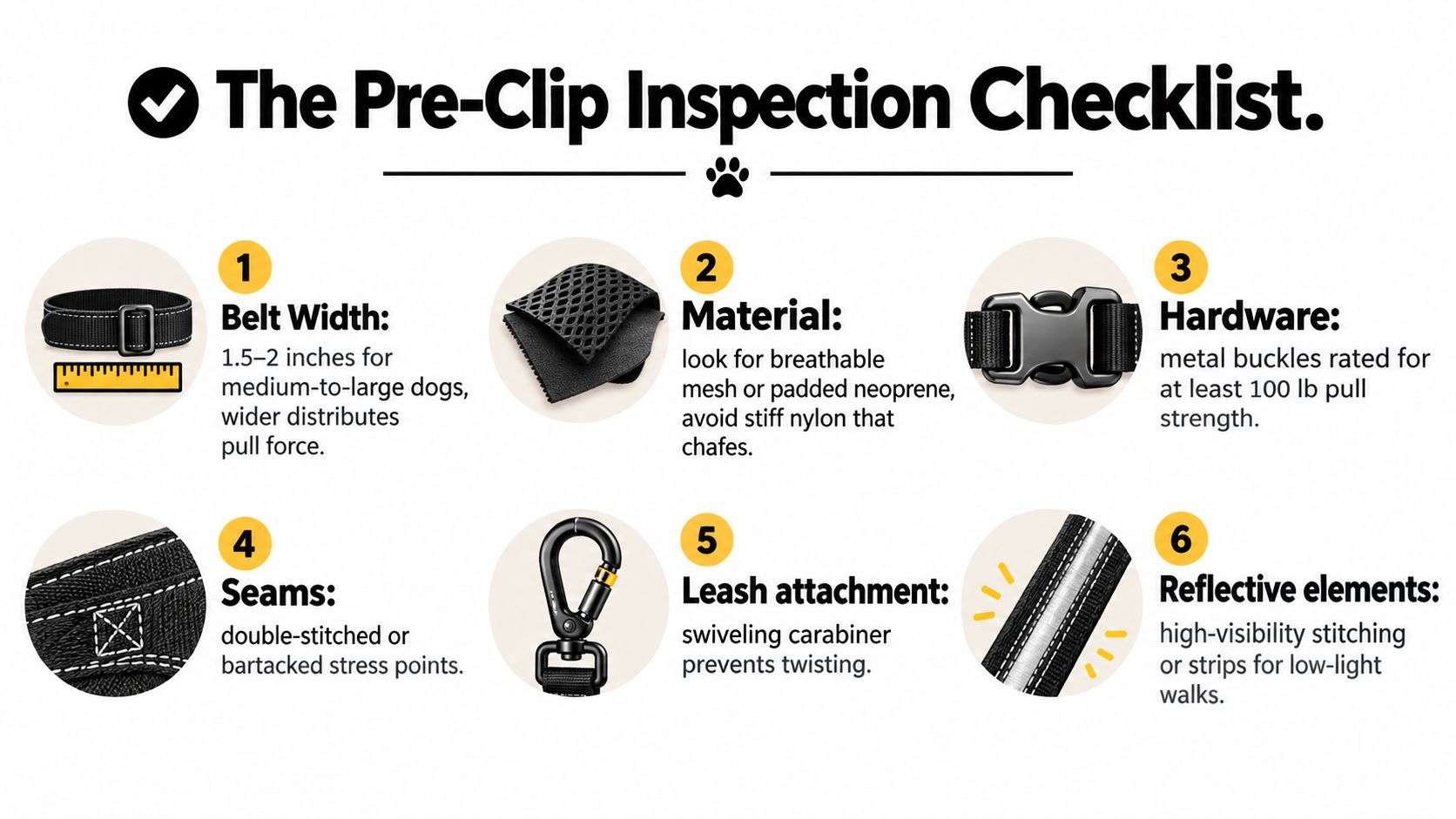
The right dog walking waist belt starts with fit, not branding. For medium-to-large dogs, product-selection benchmarks commonly favor a 1.5–2 inch belt , padded with foam or mesh to spread pressure, and metal-reinforced or auto-locking connectors instead of plastic dog-attachment clips. That benchmark matters because a belt that rides up, twists, or opens under load isn't doing its job.
What to inspect before the first clip
Check the belt flat against your body. If it rolls or migrates, the fit is wrong. The buckle should be protected against accidental opening, and the attachment point should be clearly load-rated, not just decorative.
Look at the webbing with the same suspicion you'd use for a climbing strap or towing line.
- Belt width: go wider for heavier, stronger dogs.
- Padding: choose foam or mesh when you expect repeated pressure.
- Hardware: favor metal or auto-locking parts over plastic clips.
- Seams: watch for loose stitching, fraying, or stress at the anchor points.
- Connector movement: a swiveling attachment helps reduce twisting.
- Visibility: reflective stitching helps in low light.
How to test the system
Start stationary. Click the buckle, check the attachment, and move the line side to side without walking. Then do short stops and turns in a controlled area. Only after that should you use a quiet route while watching for belt rotation, line crossings, and whether you can recover without fumbling.
Retire the setup after a fall, buckle opening, connector deformation, broken stitching, repeated rotation, pain or numbness, or a change in the dog's gait or comfort. That's not paranoia. That's basic gear discipline.
Shock Absorption Versus Control on the Run
Active dogs make the hands-free trade-off impossible to ignore. A bungee segment softens the peak of a sudden surge, reducing the sting through your hips and lower back. A fixed leash delivers immediate feedback, which matters when you need the dog close near traffic, cyclists, or a narrow trail section.
Recent university research found that half of participants experienced at least 28 pounds of leash force , a quarter experienced 45 pounds or more , and walking with a dog significantly increased stride-to-stride gait variability compared with walking alone. Those numbers should reset your assumptions. Leash force is strong enough to change how a person moves, even before a lunge turns ugly.
Where stretch helps, and where it hides trouble
Stretch earns its place when the dog is trained, the pace stays steady, and the pulls are small and predictable. It is a poor match for erratic movement. A sideways chase creates twisting force through the hips and can disrupt your balance faster than a straight pull.
A fixed line feels harsher, but it reports movement immediately. Choose it when you are improving leash communication or working a route where rapid control matters more than softened tension. Stretch helps with force, but it also dilutes control, so pick the trade-off deliberately.
Your own movement matters too. The SunnyBay pain relief blog offers a useful parallel on repeated load and running mechanics. The same principle applies to hands-free walking: poor positioning becomes more obvious as pace and force rise.
For most controlled outings, a 4 to 6 foot leash provides a workable balance. It keeps the dog close enough for quick handling while leaving room for a natural stride. Add a quick-release mechanism that opens in one motion, without requiring you to look away from the dog.
Denver Dog's running leash guide covers running-oriented leash setups in more detail. Use a bungee line for predictable forward motion, and choose a fixed line when immediate direction matters more. If your dog cuts sideways, chases distractions, or surges without warning, the belt may be the wrong tool entirely. Hand off the leash until training and route conditions support hands-free control.
Matching the Belt to Denver Walks, Runs, and Trails
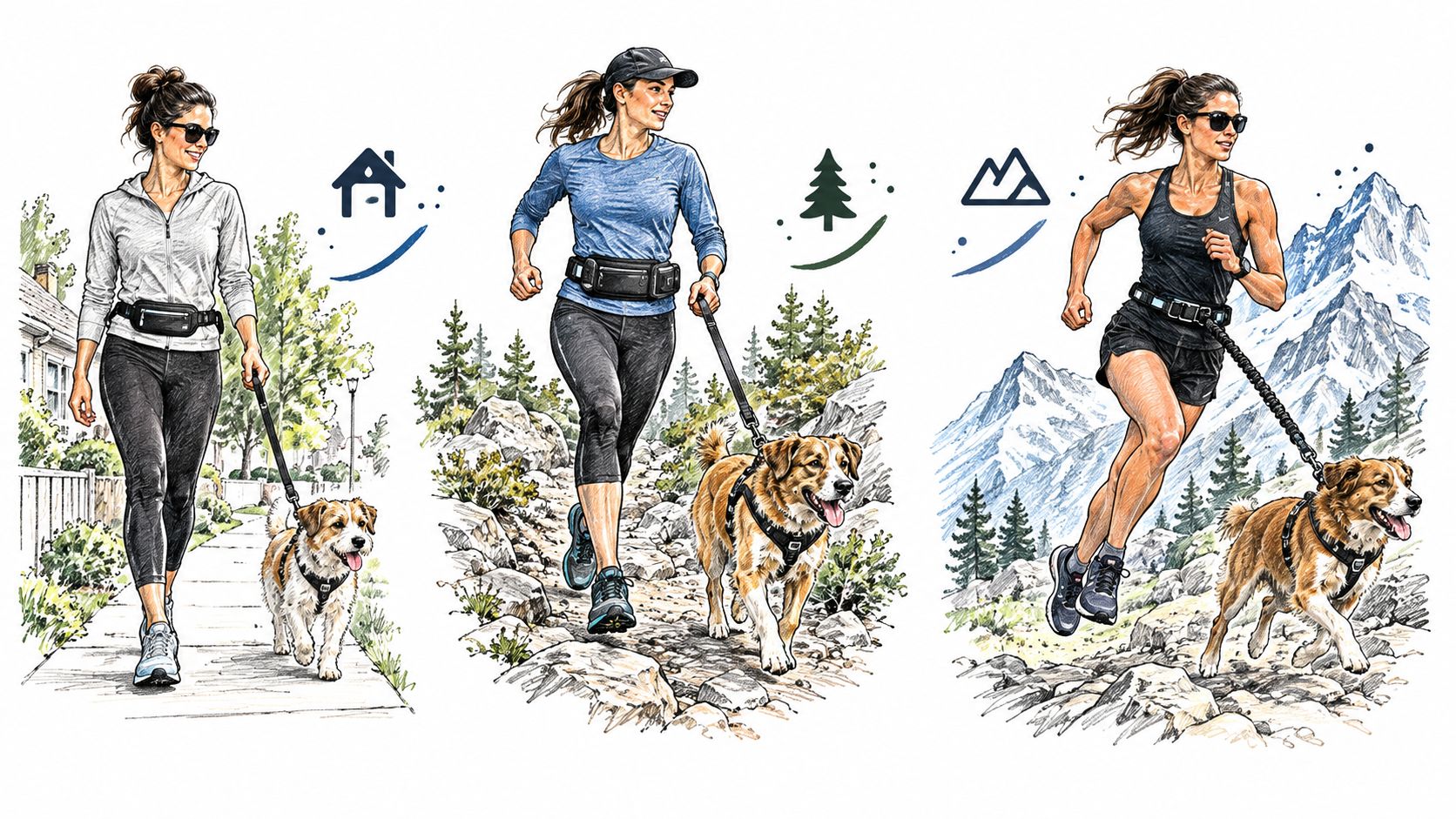
Denver routes expose weak gear quickly. Dry sidewalks, slushy curb cuts, loose gravel, steep trailheads, and sudden wildlife distractions each change how much control you need. A belt that feels comfortable on a quiet block can become unstable when the route turns slick, narrow, or crowded.
The right belt for the route
For short neighborhood walks on dry pavement, use a slim padded belt with a static leash. Keep the setup light and close to the body. A dog that already walks reliably does not need extra hardware or bulky storage for this kind of outing.
Brisk neighborhood jogs call for a centered attachment and a bungee line. The belt should remain stable at your hips while the dog travels in a predictable lane. That combination suits steady forward movement, but it gives you less immediate control when the dog cuts across your path.
Front Range trail hikes demand more support. Choose a wider belt with lumbar support, room for water, and a panic-release you can operate without fumbling. Extra equipment is normal on a trail, so the belt must carry essentials without shifting as the surface changes.
CDC walking data shows how frequently this equipment may be used. Among people who walked their dogs, 80.2% completed at least one walk lasting 10 minutes or more, while 58.9% completed two or more walks. That pattern makes comfort and durability recurring-use requirements. That's the reality of dog walking behavior is a poor fit for a hands-free setup that rubs, slips, or strains you after repeated outings.
When to leave the belt off
Use a handheld leash on icy surfaces, narrow trails, during reactive-dog encounters, or when fatigue has reduced your balance. In those conditions, a waist attachment can transfer a sudden pull directly through your center of gravity and slow your response.
Get Pet Vet's dog fitness advice from Get Pet Vet reinforces the practical point: exercise equipment must match the dog's body and energy level. Choose the setup that keeps movement controlled and comfortable.
Pick equipment for the dog in front of you, not the dog you wish you had.
Denver Dog's on-leash exercise programs follow the same principle. Their walking and hiking services give owners a practical alternative when the route, dog, or schedule makes a waist belt the wrong tool.
How to Choose the Right Belt and When to Hand the Leash Off
A waist belt earns its place through testing, not appearance. Start with the dog, then assess your stability and the route. Denver sidewalks, icy patches, crowded paths, and uneven trails each demand a different level of control. If any part of that combination feels wrong, use a handheld leash.
Test a new belt in a quiet area before taking it into traffic. Walk, stop, turn, and apply mild tension. Watch whether the belt stays centered, the hardware remains secure, and your dog can move without pulling you off line. A setup that fails this simple test will not improve in a crowded park or on a rough trail.
Apply the retirement checklist from the fit section above. If any item triggers, stop using the belt immediately. A hard snag or fall also ends the trial, even if the equipment looks intact.
Reconsider hands-free gear before shopping for a replacement. Some dogs need a structured on-leash session with a handler who can manage the line through sudden movement, distractions, and tight spaces. That choice often gives you better control than adding another attachment.
Your dog's comfort should guide the decision. Stiff movement, hard surges, or signs of discomfort call for a different setup. The MEDISTIK article on at-home arthritis care for dogs provides useful context for evaluating movement and comfort before using waist attachment.
For runners, pair the belt with a harness suited to the dog's movement and your pace. Denver Dog's running harness guide can help narrow that choice. Match the equipment to the dog, the weather, and the route.
Denver Dog also provides walking, running, and hiking services when a handheld leash or experienced handler makes more sense. Visit Denver Dog to compare options for your dog's pace, route, and schedule.
The Run Down