Approximately 76% of pedestrian fatalities occur in dark conditions , even though darkness represents a smaller share of daily travel and pedestrian activity, according to U.S. transportation-safety summaries. That figure concerns people, not dogs, but it changes how I assess dog walking around at night. After sunset, visibility, route choice, leash control, and the dog's behavior all matter more than just adding a reflective strip to a harness.
Denver adds another layer. A neighborhood sidewalk, an urban park, an unlighted dog park, and a mountain trail don't carry the same legal access, lighting, terrain, or emergency options. The safest outing is often a short, familiar loop that lets you see approaching vehicles and get home quickly, not the longest route your dog can physically complete.
Understanding the Real Risks of Nighttime Walks
Night walking creates a dangerous mismatch between what a handler can see and what a driver can detect. The same transportation-safety summary reports that nighttime pedestrian deaths increased 84% between 2010 and comparison years , compared with a 28% increase in daytime fatalities . Those figures describe pedestrians rather than dogs, so they shouldn't be treated as a direct measurement of canine risk. They do establish why darkness deserves a separate safety plan, not a casual extension of a daytime routine.
A person walking a dog also creates a more complicated roadside profile. The handler stands upright, while the dog is lower and often several feet away. A leash can extend toward the travel lane, and the pair may occupy different visual positions when crossing a driveway, passing a parked car, or stepping around an obstruction. A driver may notice the person while missing the dog, or see a light without understanding how far the leash reaches.
Where the risk concentrates
The most difficult locations are predictable:
- Streets without sidewalks: You have less separation from vehicles and fewer places to move aside.
- Blind driveways: A reversing vehicle may emerge with little warning.
- Intersections: Headlight glare, parked cars, and turning vehicles can hide a dog.
- Poorly illuminated residential roads: Drivers may not see dark clothing, dark fur, or a leash crossing their path.
Route decisions therefore matter as much as equipment. A reflective vest doesn't make an unlit trail suitable, and a bright collar doesn't compensate for walking an extendable leash beside moving traffic.
Practical rule: Treat every driver as unaware of you until the vehicle visibly slows or stops.
Professional handling after dark means reducing the number of decisions required in a crisis. Choose sidewalks and streetlights where possible, keep the dog close near roads, cross at visible intersections, and maintain enough attention to hear cyclists, cars, and animals. Darkness shortens the time available to correct a mistake, so the best route is the one that gives you visibility, control, and a straightforward way home.
Building a Layered Visibility Protocol
Most night-walk visibility failures come from relying on a single bright item and assuming it covers every angle. It doesn't. On Denver sidewalks, the problem is usually more specific: a driver catches your jacket in a headlight beam, but not the dog drifting half a step wider, or sees the dog's collar light without understanding where the leash runs.
That is why a night setup needs layers with different jobs. Active illumination lets you and the dog register before a car's headlights do the work. Passive reflectivity sharpens that outline once outside light hits it. Neither replaces the other, and neither fixes a route with poor sightlines.
I build the setup from the outside in.
First, match the gear to where you are walking. A lit neighborhood sidewalk calls for a different level of output than a dim block with patchy lighting, but in both cases the dog should carry its own light source. An LED collar, harness light, or illuminated leash works best when it stays visible through movement, turning, and changes in body position. If your dog has heavy fur or wears a winter coat, check whether the light disappears from the side.
Next, add reflective points to the harness, leash, and your own clothing. Reflection helps once headlights reach you, especially at crossings and driveways, but it has a delay built into it. That delay is the reason I do not treat reflective trim as the main layer.
Then light the handler. A flashlight or headlamp is not just for being seen. It lets you read broken pavement, ice, debris, curb edges, and anything the dog is about to investigate. Aim it at the ground ahead, not into traffic. For a practical explanation of beam patterns and output in motion, see this lumen guide for cyclists.
Leash length belongs in the visibility protocol too. A short fixed leash keeps the dog inside the visual picture a driver can understand. A retractable leash can send the dog well beyond that picture before you can reel it back, a risk covered in veterinary guidance on walking dogs safely at night.
Before leaving, step outside and look at the full setup from the front and from the side. If one layer disappears, fix it before you commit to the walk.
Choosing the Right Route After Dark
Denver's routes fall into three practical categories after sunset: neighborhood loops, urban parks, and mountain or open trails . They shouldn't be treated as interchangeable.
A familiar neighborhood loop is usually the strongest default. You know where driveways open, which sidewalks are uneven, where streetlights fail, and how quickly you can return home if the dog becomes unsettled. Its drawbacks are limited lighting on some residential streets and the possibility of traffic, cyclists, or loose dogs.
Urban parks can offer wider paths and more room from vehicles, but access depends on posted rules, lighting, and closing times. Denver's official rules generally open urban parks from 5:00 a.m. to 11:00 p.m. , while mountain parks are open only from one hour before sunrise to one hour after sunset . An unlighted dog park is specifically off-limits when it's dark, while a lighted dog park may remain open until 11:00 p.m. , subject to posted hours and applicable curfews, according to Denver's dog-park rules.
Make the decision route by route
| Route type | What works | What can go wrong |
|---|---|---|
| Neighborhood loop | Familiar sidewalks, quick return, nearby homes and roads | Dark gaps, driveways, traffic, uneven pavement |
| Urban park | More separation from vehicles and defined paths | Closing times, cyclists, poor lighting, wildlife |
| Mountain or open trail | Quiet surroundings and natural enrichment in daylight | No lighting, hidden terrain, limited emergency access, daylight-only rules |
Inspect unfamiliar routes in darkness before taking a dog there. Look for blind driveways, unlit crossings, glare from headlights, damaged pavement, cyclists, and places where you can't safely step aside. If an alternative exists, avoid roads without sidewalks or lighting.
A route can be legally accessible and still be a poor nighttime choice.
For most Denver pet parents, the decision is simple: use a predictable neighborhood loop for a late outing, choose a lighted urban facility only after checking its schedule, and reserve mountain trails for daylight. Distance is a weak measure of quality when darkness makes the environment hard to read.
Managing Canine Behavior and Sleep Cycles
Night walks often fail for behavioral reasons before they fail for route reasons. A dog can hear, scent, or spot movement before you do, then build arousal faster than you can read in poor light. What looks like extra energy may be uncertainty, frustration, or a dog trying to sort out a stimulus it cannot identify.
Research in Scientific Reports found that shelter dogs spent 45% of a 24-hour period asleep and 72% of the nighttime interval asleep, with that interval defined as 17:00 to 08:00. The same study reported fragmented nighttime sleep, with dogs sleeping for about 16 minutes and staying awake for roughly 5 minutes at a time. That does not set a fixed schedule for every pet dog, but it does explain why some dogs feel flat one minute and sharply alert the next after dark.
I treat late walks as a behavior check, not a mileage target.
Some dogs settle with a short, familiar toilet loop and go back to sleep easily. Others get more wound up once the neighborhood gets quiet, especially if they start keying in on rustling shrubs, people stepping out from between parked cars, or wildlife near greenbelts and alleys. In those cases, adding distance usually makes the walk worse, not better.
Watch the dog in sequence rather than hunting for one perfect signal. A brief pause and soft sniffing are usually fine. Freezing, hard staring, rigid posture, repeated pulling, sudden retreat, or a tucked outline mean the dog is no longer processing the outing well. If you need a refresher on posture, facial tension, and movement, this guide on reading dog body language for safer, happier walks is useful.
The practical trade-off is simple. Structured movement can take the edge off a high-energy dog, but darkness lowers the quality of information your dog gets from the environment. Once arousal rises, a longer walk stops being productive exercise and turns into rehearsed reactivity.
That is the point to shorten the outing and shift the remaining activity indoors. Food puzzles, scatter feeding, brief pattern games, or calm obedience reps in the hallway often leave a dog more settled than another fifteen minutes outside.
For households that also manage cameras or motion alerts at home, pet movement can create its own confusion. This guide to stopping false alarms with pets gives useful background. The standard for a good night walk is straightforward: the dog comes home able to recover, rest, and sleep.
Leash Control and Emergency Protocols
Denver's leash rules matter more at night because the margin for error gets smaller. In public spaces, dogs are expected to stay leashed and under control under the city's leash guidance and frequently asked questions. After dark, that is less about obedience in the abstract and more about preventing one bad second, a dart into traffic, a hard pull at a shadow, or a chase response before you can read what set it off.
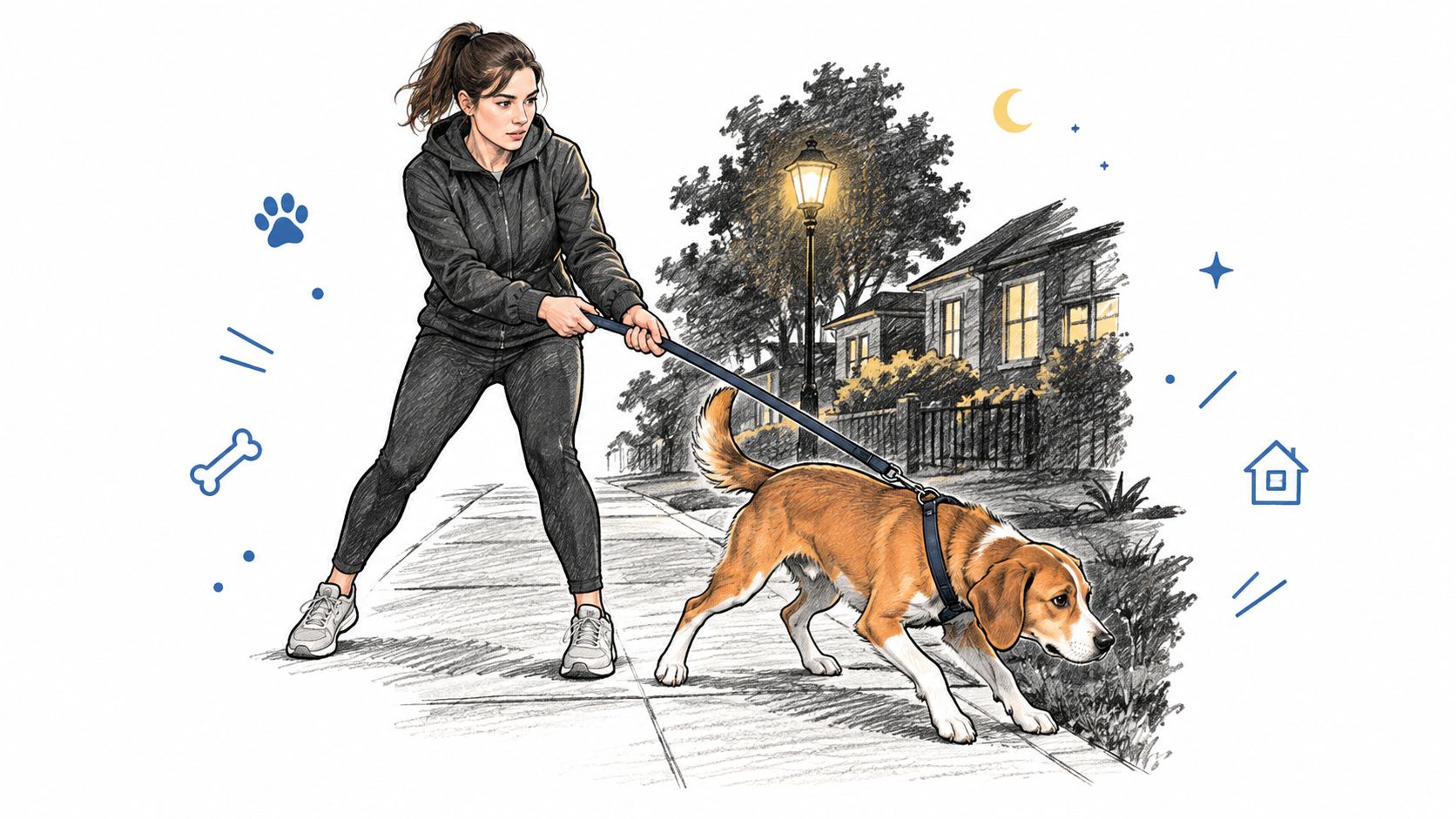
I handle night walks with one question in mind. If something appears from a parked car, side path, or alley right now, can I stop my dog within one stride?
That standard changes how you use the leash. On brighter residential blocks, a little extra slack may be fine. Near corners, trail access points, busier crossings, or stretches with weak lighting, shorten up before the trigger appears. Do not wait for the dog to load up and then try to recover control. The correction is earlier positioning, not stronger pulling.
A practical reset sequence works better than a generic “heel” cue once a dog is already keyed up. Stop your own feet first. Shorten the leash smoothly. Turn the dog's body with you and create space toward the safer side of the street, preferably the side with better lighting and fewer blind exits. If the dog can reorient and move with you, continue on the known route. If the dog stays fixed, scanning, or pulling hard, head home the familiar way and end it there.
Route choice matters here. A retractable leash can feel manageable on an empty sidewalk, but it creates too much uncertainty near roads, corners, and park edges after dark. Even with multi-use gear such as DigiDevice's 3in1 dog leash, the nighttime job stays the same. Keep the line short, readable, and easy to gather without fumbling.
On streets without a sidewalk, keep the dog on the side away from passing vehicles and face oncoming traffic so you can judge space early. At crossings, pause at the curb and wait for a clear, predictable gap. Reflective strips help only once headlights hit them.
If leash handling falls apart at night, practice the mechanics in daylight first. This guide to walking a dog on leash is a useful refresher.
Professional Alternatives for Busy Pet Parents
Sometimes the safest nighttime decision is not to make a long nighttime walk happen. If work ends late, the route is poorly lit, or the dog becomes reactive after sunset, a short controlled potty outing followed by indoor enrichment may be more responsible than forcing a demanding walk.
Use this quick check before leaving:
- Route: Is there a familiar sidewalk, usable lighting, and a quick way home?
- Equipment: Are both dog and handler visible, with a light source and reflective elements?
- Control: Can the dog walk on a short fixed leash and respond around ordinary distractions?
- Behavior: Is the dog calm enough to recover from a sound, shadow, cyclist, or animal?
- Access: Is the park or facility open, and does its lighting match the planned outing?
A professional walker can remove the pressure of fitting exercise into the darkest part of the day. Owners comparing providers should understand what professional dog walkers do and how to hire one, including how they handle routes, leash control, transport, and individual temperament.
Denver Dog drivers must maintain a seven-year clean driving record and are monitored with advanced in-vehicle camera technology that tracks speeding, following distance, distraction, and drowsiness, with real-time coaching to uphold high scores, according to Denver Dog. That kind of operational discipline matters when a handler is transporting dogs to structured walks, runs, or hikes rather than improvising a late outing on a dark route.
Denver Dog serves Arvada, Denver, Englewood, Golden, Lakewood, Littleton, and Wheat Ridge , giving busy pet parents a weekday alternative when daylight exercise is difficult to manage safely.
Denver Dog provides structured, on-leash walks, runs, and hikes for dogs whose owners can't reliably fit safe daytime exercise into the week. Visit Denver Dog to explore service options across the Denver area and choose a practical routine that keeps your dog active without making after-dark safety a daily gamble.
The Run Down