Active safety systems are vehicle technologies that prevent crashes or reduce their severity before impact. In real-world research, autonomous emergency braking reduces rear-end collisions by 38% , while U.S. estimates project that standard automatic emergency braking could save at least 360 lives and prevent more than 24,000 injuries each year .
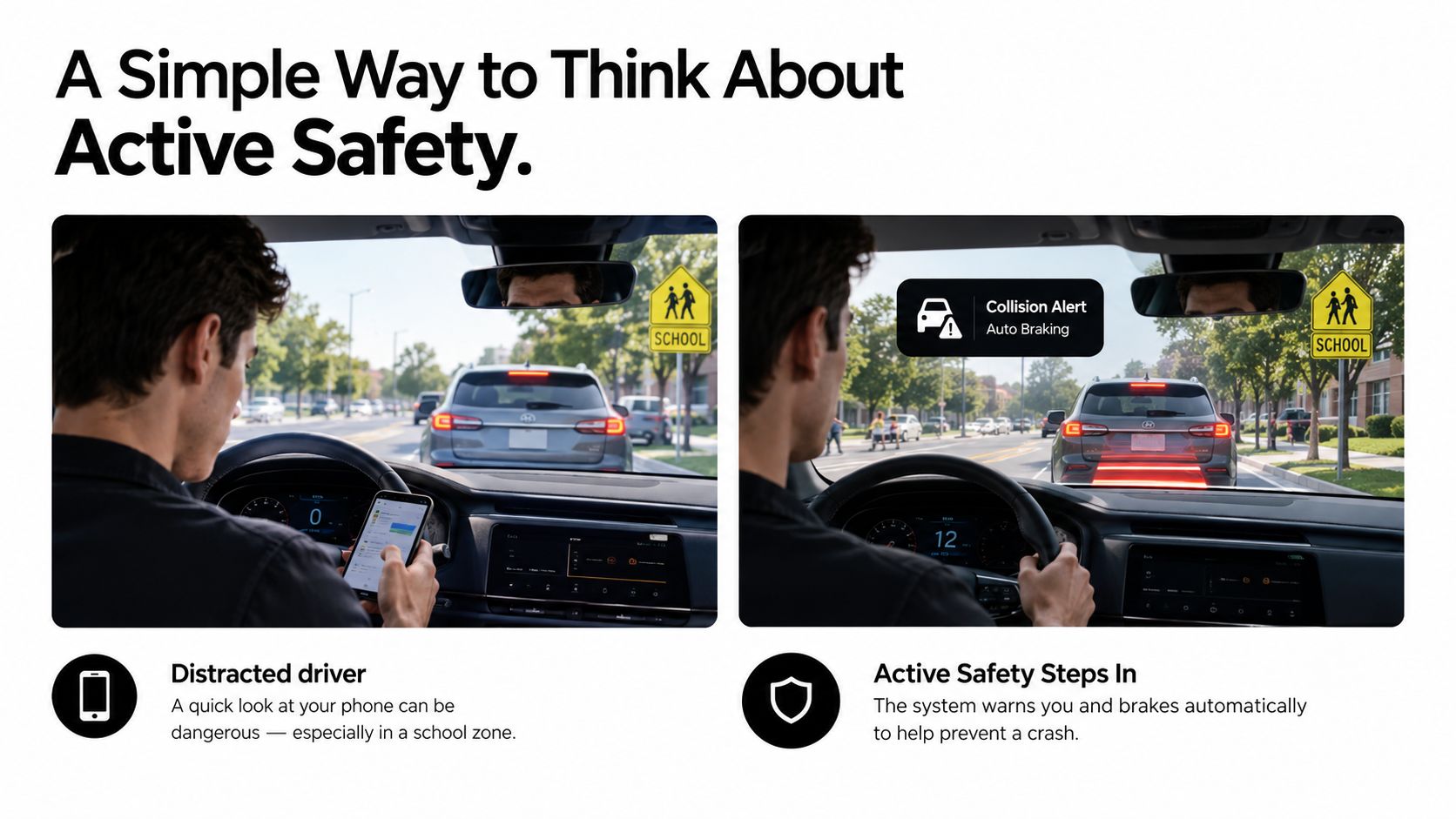
You're driving through a school zone when traffic stops suddenly. For a moment, your attention shifts, the gap closes, and your car detects that your response is too slow. It warns you, prepares the brakes, and may brake automatically. That intervention is active safety in action.
The important distinction is timing. Active safety works before a collision , while passive safety features such as airbags, seatbelts, and crumple zones mainly protect people after a crash begins. Active systems use sensors, cameras, radar, and software to understand what the vehicle is doing and what's around it, then provide a warning or take a limited control action.
A Simple Way to Think About Active Safety
A distracted parent glances at a phone while approaching a school-zone stop. The vehicle ahead has already stopped, but the following car continues forward. The driver looks up, hears a warning, and feels the car begin braking before the front bumper reaches the stopped vehicle.
That moment illustrates the basic purpose of active safety systems . They're designed to identify danger early enough to help prevent a crash or reduce the force of an impact. The system doesn't need to drive the entire car. It only needs to recognize that the closing gap, road position, or vehicle motion has become dangerous and assist sooner than the driver can react.
Active and passive safety do different jobs
Think of vehicle safety as two layers:
- Active safety: Watches for danger and helps avoid a collision through warnings, braking, steering, or stability control.
- Passive safety: Manages crash forces after impact through seatbelts, airbags, head restraints, and crumple zones.
A seatbelt can hold your body in the correct position during a crash, but it can't stop the vehicle from drifting into another lane. An airbag can cushion your head and chest, but it doesn't recognize a stopped car ahead. Active systems address the moments before impact, while passive equipment limits injury when avoidance fails.
How the vehicle decides to intervene
The vehicle continuously collects information from its surroundings and its own movement. A forward camera may identify lane markings or a vehicle, radar can estimate distance and closing speed, and wheel-speed or steering sensors can reveal whether the car is following the path the driver intended.
Software compares those inputs with programmed safety thresholds. If the car detects a likely collision, it might issue a visual or audible warning. If the driver doesn't respond, a system such as automatic emergency braking may apply the brakes. Other systems may add steering resistance, correct the vehicle's path, or selectively brake a wheel.
Practical rule: Treat active safety as a second set of eyes and hands, not as a replacement for the driver.
The technology has developed from foundational systems such as anti-lock braking. Toyota describes the broader adoption of ABS and four-wheel ABS as a turning point in active safety as vehicle electronics advanced, while Japan's development of driving-assist and automated-braking concepts accelerated from the 1990s. For readers who want a deeper technical overview, this guide to automotive sensor types shows how different sensors support vehicle decisions.
The Two Core Systems Every Modern Car Builds On
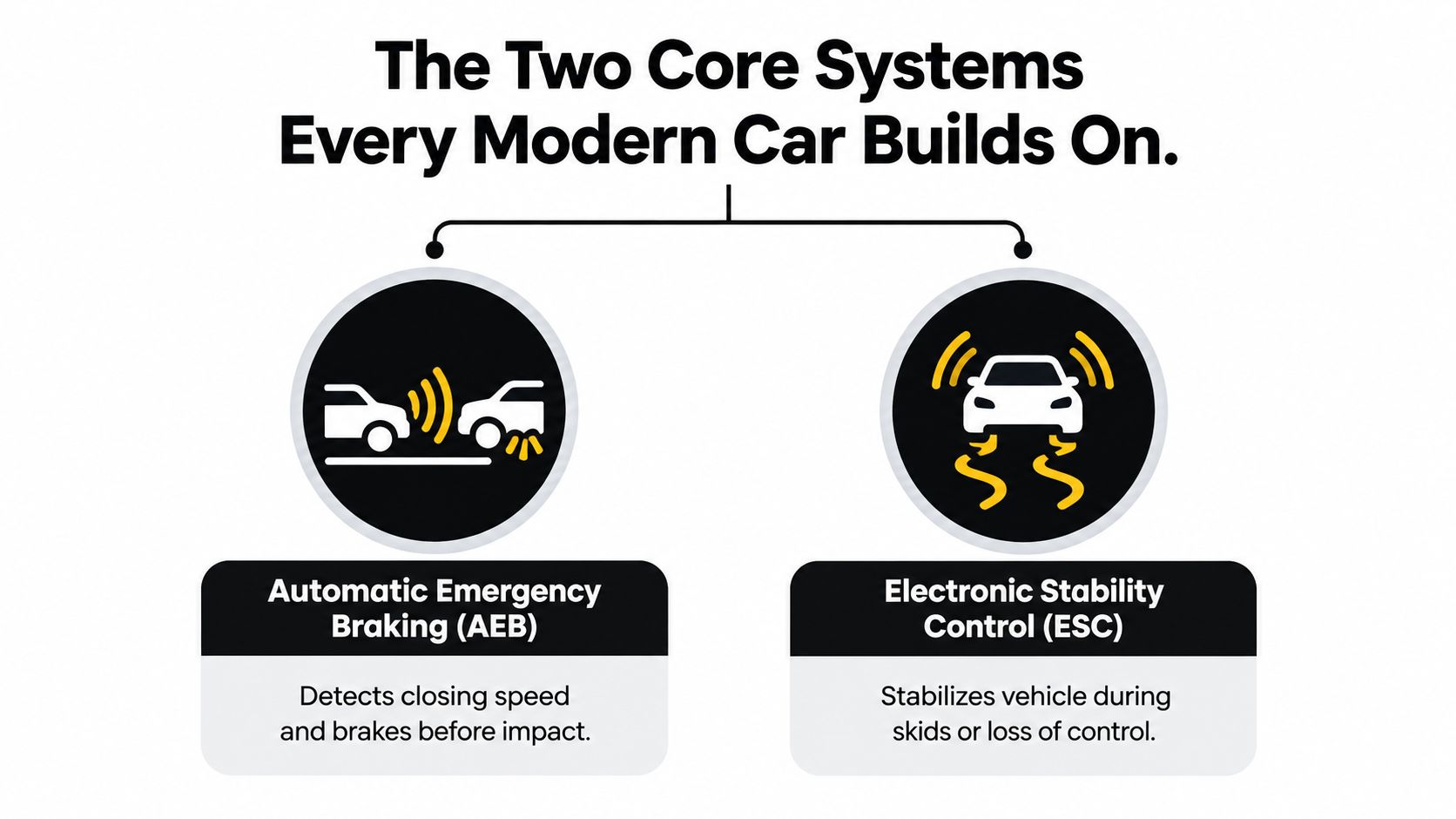
Two systems provide the foundation for much of today's crash-avoidance technology: automatic emergency braking , or AEB, and electronic stability control , or ESC. They solve different problems. AEB manages what happens in front of the vehicle, while ESC manages whether the vehicle is following the driver's intended path.
Automatic emergency braking manages closing distance
Suppose you're approaching a line of traffic. You're moving faster than the vehicle ahead, so the gap shrinks more quickly than normal. AEB uses forward-facing sensors, such as cameras or radar, to detect that closing speed.
The response usually develops in stages:
- Detection: The system identifies a vehicle or other recognized obstacle ahead.
- Warning: It alerts you through sound, dashboard graphics, or steering-wheel vibration.
- Brake preparation: The vehicle makes braking pressure available quickly.
- Automatic braking: If you don't respond, the system can apply the brakes to reduce speed or help avoid the collision.
The exact operating range varies by vehicle. NHTSA describes qualifying AEB functions as dynamic brake support and crash imminent braking , and its driver-assistance guidance explains that AEB can warn and brake when the driver doesn't react. AEB doesn't make a poor following distance safe, but reducing speed before impact can make the difference between a warning, a minor contact, and a serious crash.
Electronic stability control corrects a skid
ESC becomes most noticeable during a sudden maneuver. You swerve to avoid an obstacle on a wet road, and the vehicle begins rotating or sliding instead of following the steering wheel. ESC compares steering input with wheel speed and the vehicle's yaw, which is its rotation around a vertical axis.
If the car starts to understeer or oversteer, ESC can brake individual wheels to help restore the intended path. NHTSA describes the system as detecting loss of steering control and applying individual wheel brakes to help the vehicle travel where the driver is directing it.
ABS and ESC don't steer around an obstacle for you. They give the tires and vehicle control system a better chance to maintain traction during hard braking or abrupt direction changes. A technical explanation of active driver-assistance functions is also available in this in-vehicle camera monitoring system guide.
AEB and ESC are commonly treated as core active-safety baselines because they use closed-loop intervention. They don't merely tell you that something is wrong. AEB can change braking, and ESC can change braking at individual wheels. Newer systems build on this same pattern of sensing, deciding, and assisting.
Everyday Driver Assist Features Explained
Many active-safety features operate during ordinary driving rather than dramatic emergencies. Their value appears in small moments, such as a lane drift, a blind-spot check, or a sudden change in traffic speed.
Lane systems help with unintentional drift
You're on a highway and glance toward the navigation display. The car moves toward the lane line without a turn signal. Lane departure warning , or LDW, uses cameras to track the vehicle's position relative to lane markings and alerts you when it detects an unintended departure.
Lane departure prevention goes further. It can resist the drift or guide the vehicle back with light braking or small steering corrections. The assistance is usually subtle, so you may feel the wheel gently push against your input rather than experience a dramatic steering movement.
Adaptive cruise control manages the gap
Traditional cruise control holds a selected speed. Adaptive cruise control , or ACC, also monitors traffic ahead and adjusts speed to maintain a following distance. If vehicles slow, ACC can reduce your speed. When the lane clears, it can accelerate toward the selected setting.
You still need to watch the road. ACC doesn't understand every traffic pattern, and its behavior can vary around stopped vehicles, sharp curves, motorcycles, and construction zones.
Blind spots and reversing areas need extra awareness
A vehicle sits beside you in the shoulder-side mirror zone as you prepare to change lanes. Blind-spot monitoring can use radar or cameras to identify the nearby vehicle and illuminate a warning in the mirror. Some systems add an audible alert or steering resistance if you signal toward the occupied lane.
When backing out of a parking space, rear cross-traffic alert watches for approaching vehicles or pedestrians from the sides. It can warn you, but it doesn't replace checking mirrors, looking over your shoulder, and reversing slowly.
Other systems add information rather than direct control. Traffic sign recognition can read signs and display speed information, while driver drowsiness detection can monitor driving patterns and prompt a break when it detects possible fatigue.
| System | What It Monitors | How It Responds |
|---|---|---|
| Lane departure warning | Lane markings and vehicle position | Warns when the car drifts without a turn signal |
| Lane departure prevention | Lane position and steering path | Resists drift or guides the car back |
| Adaptive cruise control | Traffic speed and following distance | Slows or accelerates with traffic |
| Blind-spot monitoring | Vehicles beside or near the rear quarter | Shows a mirror warning and may add an alert |
| Traffic sign recognition | Road signs and displayed limits | Presents detected sign information |
| Rear cross-traffic alert | Traffic crossing behind the vehicle | Warns during reversing |
| Driver drowsiness detection | Steering and driving behavior patterns | Prompts the driver to pause or refocus |
Hill-start assistance is another useful example of a system that supports a specific driving moment. If you're learning how the feature differs from broader ADAS functions, AutoProv's buyer's guide to hill start assist provides practical context.
What the Crash Data Shows
A driver glances down, traffic slows, and the gap ahead closes faster than expected. Automatic emergency braking, or AEB, can warn and apply the brakes when the system detects an imminent forward collision. Real-world research links AEB with fewer crashes and injuries, although the strongest evidence concerns AEB rather than every active safety feature in every condition.
A European Transport Safety Council summary reports that AEB on current-model passenger cars reduces rear-end collisions by 38% . The result matches the system's purpose. A rear-end crash often develops as a closing gap, and AEB can respond while the driver is still recognizing the danger.
The U.S. Department of Transportation estimated that making automatic emergency braking standard by 2029 would save at least 360 lives per year and prevent more than 24,000 injuries , according to the European Transport Safety Council summary of AEB research. These figures describe the expected effect of widespread standardization. They do not promise the same result in every vehicle or driving situation.
Results vary by system and environment
A China study estimated that 100% market penetration of AEB could mean 13.2% fewer fatalities and 9.1% fewer injuries . It also projected AEB penetration of 34.0% in 2025 and 60.3% in 2030 . These modeled outcomes show how broader installation can increase population-level benefits, but they are not a prediction for one driver.
| Active Safety Feature | Primary Crash Type Targeted | Reported Reduction Range |
|---|---|---|
| Automatic emergency braking | Rear-end collisions | 38% reduction in current-model passenger-car research |
| Automatic emergency braking at full penetration | Fatalities and injuries across relevant crashes | 13.2% fewer fatalities and 9.1% fewer injuries in a China study estimate |
| Electronic stability control | Loss-of-control events | Qualitative evidence supports its role in reducing instability, but no verified percentage is provided here |
| Lane departure systems | Lane-drift and roadway-departure events | No verified percentage is provided here |
Availability is also changing through regulation and market adoption. A 2024 IIHS survey found AEB enabled on 93% of registered vehicles and lane-departure systems activated on 87% , according to IIHS survey data on advanced driver-assistance use. As these features become standard equipment across major markets, check your vehicle's manual rather than assuming two cars use identical settings or coverage.
Vehicle technology and driver history remain separate. Colorado drivers reviewing the human side of safe driving can use this guide on how to get a driving record in Colorado.
Where Active Safety Still Falls Short
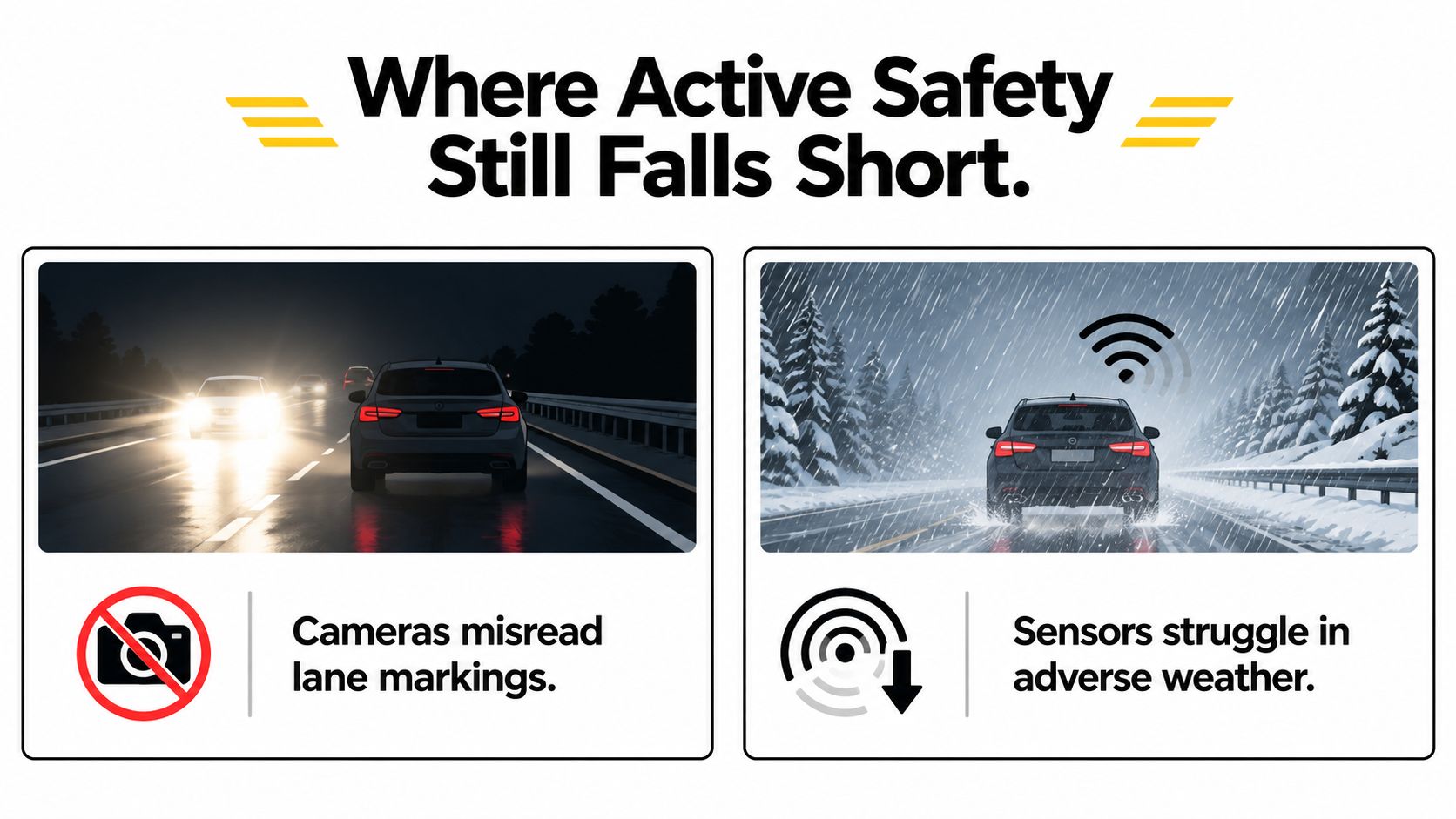
A car can have cameras, radar, and automatic braking yet still miss a hazard. The system's decision depends on what its sensors can see, how clearly they can interpret it, and whether the situation falls within the vehicle's operating design.
At night, glare from headlights or low contrast can make lane markings difficult for a camera to read. Heavy rain, snow, or road spray can obscure a camera or weaken the quality of sensor data. A lane-keeping system may then provide no assistance, issue a warning that seems late, or disengage with a dashboard message.
Edge cases can defeat good intentions
AEB is designed around detected objects and defined operating conditions. A stopped motorcycle, unusual road object, or partially obscured vehicle may not be recognized in time. Blind-spot monitoring also has a narrow job. It can warn about a vehicle in a monitored area, but it may not prevent a collision when a cyclist or passenger opens a door into an adjacent path.
Newer systems are expanding into situations such as exit warnings that can delay door opening and emergency steering that can help guide a vehicle around an obstacle. Those functions remain dependent on sensors, software, vehicle speed, and the specific model's design. A warning is not the same as physical protection.
Maintenance affects what the system can see
A windscreen replacement can change the camera's position enough to require calibration. Dirt, ice, snow, stickers, or accessories can block a sensor. Even a system that worked correctly yesterday may be limited today if its camera or radar area is covered.
Use the owner's manual to identify sensor locations and calibration requirements. If the vehicle displays a sensor-blockage or driver-assistance warning, reduce your reliance on the feature and arrange inspection when necessary.
Driver responsibility: If you can't clearly see the lane, the system may not be able to see it either.
The safest approach is to treat intervention as assistance, not permission to look away. Keep a proper following distance, scan mirrors, control speed for conditions, and stay ready to brake or steer yourself.
Why the Same Safety Logic Matters for Your Dog
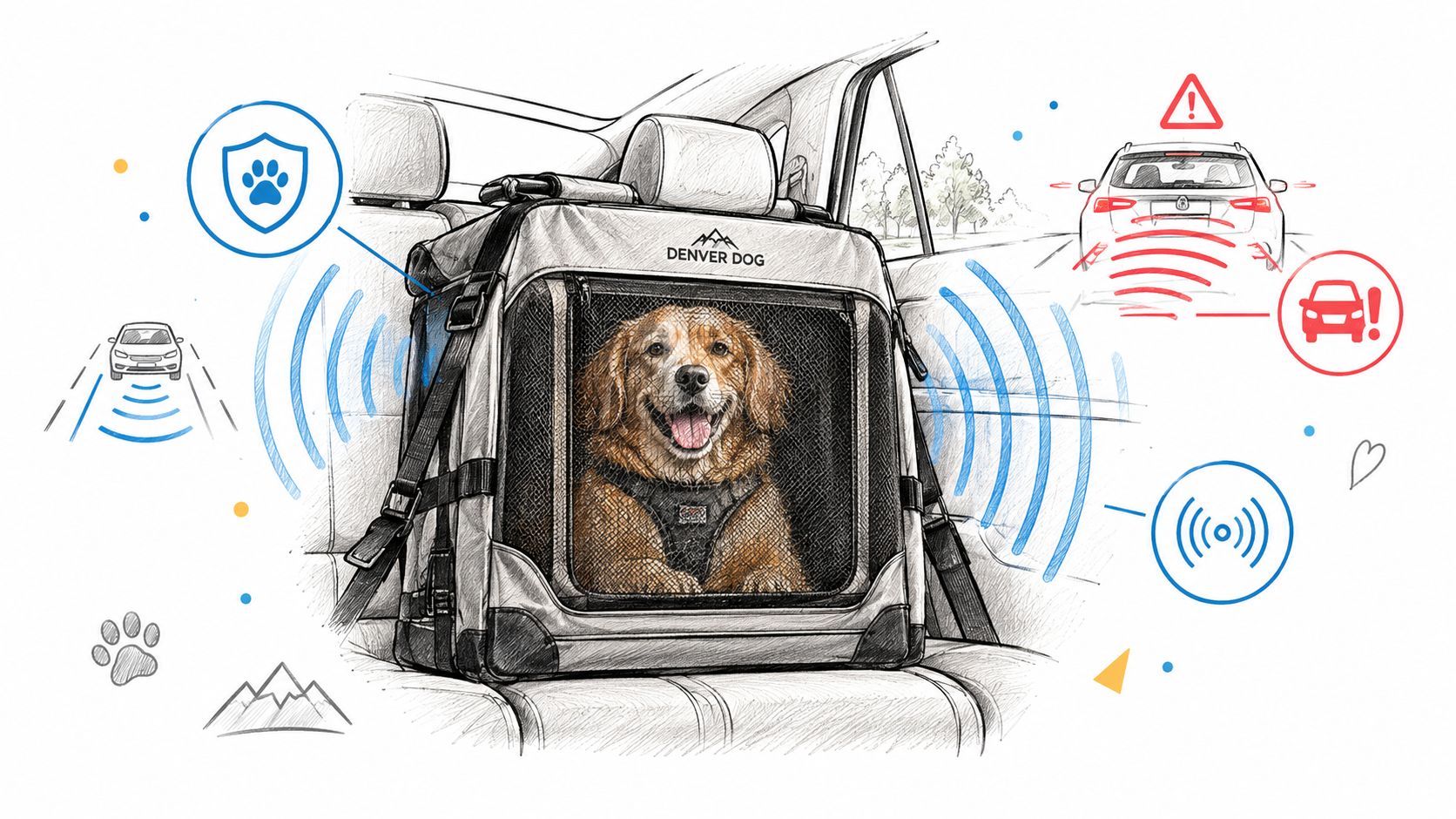
The active-safety principle applies to more than the person behind the wheel. A dog riding loose in a vehicle can move suddenly during hard braking or become a dangerous projectile in a crash. Vehicle technology may prevent the collision, but it doesn't automatically secure an unrestrained animal inside the cabin.
A safer transport setup uses the same broad logic: monitor the risk, restrain movement, and reduce consequences when something goes wrong . A crash-tested carrier or harness limits how far the dog can travel. A properly attached tether reduces forward movement during a sudden stop. Padded structures can help manage contact, while a stable barrier can keep the dog separated from the driver and front-seat controls.
Match the restraint to the travel arrangement
A carrier works as a contained travel space when it fits the dog and can be secured correctly inside the vehicle. A crash-tested harness uses a restraint connection to limit movement while allowing the dog to remain in a seating area. A crash-rated barrier separates the cargo area from the passenger compartment, which can help prevent the dog from reaching the driver.
The attachment point matters. A loose carrier, an unsuitable tether, or a harness connected in the wrong way can undermine the protection the product is meant to provide. Read the manufacturer's instructions and check that the restraint remains secure before each trip.
Safety continues after the car stops
Active safety doesn't end with collision avoidance. A dog can also face heat, escape, and handling risks during loading or unloading. Owners should plan the full journey, including secure doors, controlled exits, water, ventilation, and weather conditions. This Denver guide to dog heat-stroke prevention covers the environmental risks that vehicle restraints alone can't solve.
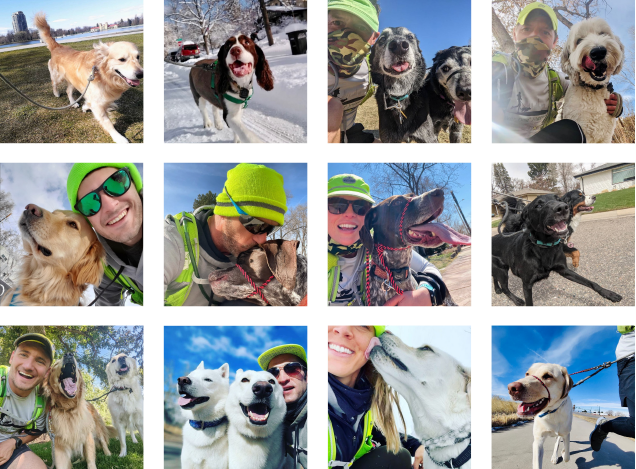
Denver Dog offers on-leash dog running, walking, and hiking services, and its specialized transport vehicles use in-vehicle camera technology that provides real-time coaching around driving behaviors such as speed, following distance, distraction, and drowsiness. The service area includes Arvada, Denver, Englewood, Golden, Lakewood, Littleton, and Wheat Ridge , so owners can consider both vehicle safety and supervised exercise when arranging weekday care.
What to Expect as Standard and Questions to Ask
Active safety is moving from an optional feature list toward baseline equipment, but the details depend on the market, vehicle class, model year, and regulation. In the United States, NHTSA finalized a rule in April 2024 requiring automatic emergency braking on new passenger cars and light trucks by September 2029 , as described in this overview of automotive active safety systems.
European and global frameworks are also raising expectations. Independent industry coverage describes Euro NCAP's 2026 protocols as requiring pedestrian AEB and driver monitoring across model classes, while UNECE WP.29 has approved a global framework for autonomous driving systems. These regulatory and testing developments don't mean every current vehicle includes every function, so buyers should check the exact specification.
Standard equipment and optional packages
In markets with newer requirements, buyers may increasingly find features such as AEB, lane-keeping assistance, attention assistance, and speed assistance included with new vehicles. Other functions are often bundled into trim packages or offered as options:
- Adaptive cruise control: Traffic-aware speed and following-distance support, sometimes with stop-and-go operation.
- Blind-spot monitoring: Mirror-zone warnings during lane changes.
- Surround-view cameras: A combined view that helps with parking and tight maneuvers.
- Emergency steering assistance: Support for avoiding a detected obstacle in qualifying conditions.
- Exit warning: Alerts about approaching road users before a door opens.
Before renting or buying, ask direct questions:
- Does AEB operate at highway speeds, and which objects can it recognize?
- Can lane-keeping assistance be adjusted for narrow rural roads?
- What happens when a trailer is attached?
- Which sensors are affected by rain, snow, ice, or glare?
- Does the owner's manual specify calibration after windscreen replacement?
- Will the feature remain active after a camera, bumper, or windscreen repair?
- Can the driver adjust warning distance, steering assistance, or intervention strength?
For a model-specific example, review the safety information available on VinCheck's Toyota RAV4 page, then confirm the equipment on the exact vehicle identification number and trim. A dealership or rental counter should be able to demonstrate the warnings and explain the limits instead of just naming the package.
The best purchase decision comes from matching features to your driving. AEB may matter most in dense traffic, ESC in sudden maneuvers, lane assistance on marked roads, and rear cross-traffic alert in busy parking areas. Read the owner's manual before relying on any system, keep sensors clear, and remember that your attention remains the vehicle's primary safety layer.
Denver Dog provides weekday on-leash runs, walks, and hikes for dogs, with service across Arvada, Denver, Englewood, Golden, Lakewood, Littleton, and Wheat Ridge. If your dog needs structured exercise with safety-conscious transport and handling, visit Denver Dog to learn about the available programs and arrange care.
The Run Down