45.5% of U.S. households owned a dog in 2024 , representing approximately 59.8 million households , according to the American Veterinary Medical Association's ownership figures. That makes fitting exercise into everyday life more than a niche concern. For busy owners, the challenge isn't just finding someone to tire the dog out. It's finding the right activity, at the right intensity, for the dog they have today.
Active dog services should start with readiness, not mileage. A young dog bouncing at the door, an overweight adult pulling toward the park, and a fit trail companion may all look enthusiastic. They don't necessarily need the same exercise.
Active Dog Services Compared at a Glance
| Service type | Pace and typical session | Best-fit dog | What it does not replace |
|---|---|---|---|
| On-leash jog or run | Controlled jogging or running, with duration matched to conditioning | Conditioned adults with sound joints and high energy | Age-appropriate alternatives for puppies and dogs with joint problems |
| Fast-paced walk | Brisk walk, 30-60 minutes as a comparison format, not a universal prescription | Adults building stamina, when conditions allow brisk activity | A full cardio workout for an athletic dog |
| Leisurely walk | Comfortable walking with sniffing pauses, adjusted to the dog | Seniors, reactive dogs and newly adopted dogs | A progressive physical-conditioning plan |
| Guided hike | Off-pavement trail, 1-3 hours as a comparison format, including pauses | Conditioned dogs responsive to their handler while leashed | Route checks, water and rest breaks |
| Daycare with exercise | Mixed play and rest, potentially a full day | Social dogs needing extended supervision | One-on-one attention |
| Structured play | Games and training blocks, 30-60 minutes as a comparison format | Under-stimulated dogs, or shy dogs comfortable with individual play | Distance-based fitness |
Active dog services are paid, planned exercise sessions delivered by a trained handler. That's different from open-ended yard time or an unplanned dog-park visit, where nobody may be controlling the pace, workload or recovery.
The table compares service formats, not guaranteed appointment lengths. Its timed examples aren't exercise targets or a statement of our booking options. Daycare and structured play are included to explain alternatives, not to imply that we offer them as standalone services.
Understand the difference between movement and workload
Think of a gym visit. A run can resemble interval training when movement alternates with walking breaks. A leisurely walk is closer to a warm-down, while a hike can become an endurance session because terrain and time both add work.
The analogy has limits. A steep walk can demand more effort than an easy jog, and a slow outing can still be mentally challenging for a worried dog. Service names don't tell you the whole exercise dose.
Denver Dog Joggers provides fast-paced, on-leash neighborhood runs. Denver Dog Hikers provides guided trail outings, and both programs draw on the same trained walker pool. Our listed services also include fast-paced walking, leisurely walking and overnight dog sitting, although overnight care isn't itself an exercise prescription.
Read the table from your dog's starting point
Start with age, current activity and comfort around the environment. Then consider energy level. An energetic but unconditioned adult may need brisk walks before running, while a newly adopted dog may benefit more from predictable, quiet outings.
Our guide to active dog daycare can help clarify the difference between extended group care and a focused exercise appointment.
Practical rule: Choose the service your dog can comfortably manage now, not the service you hope they'll eventually manage.
Why Dogs Benefit from Structured Activity
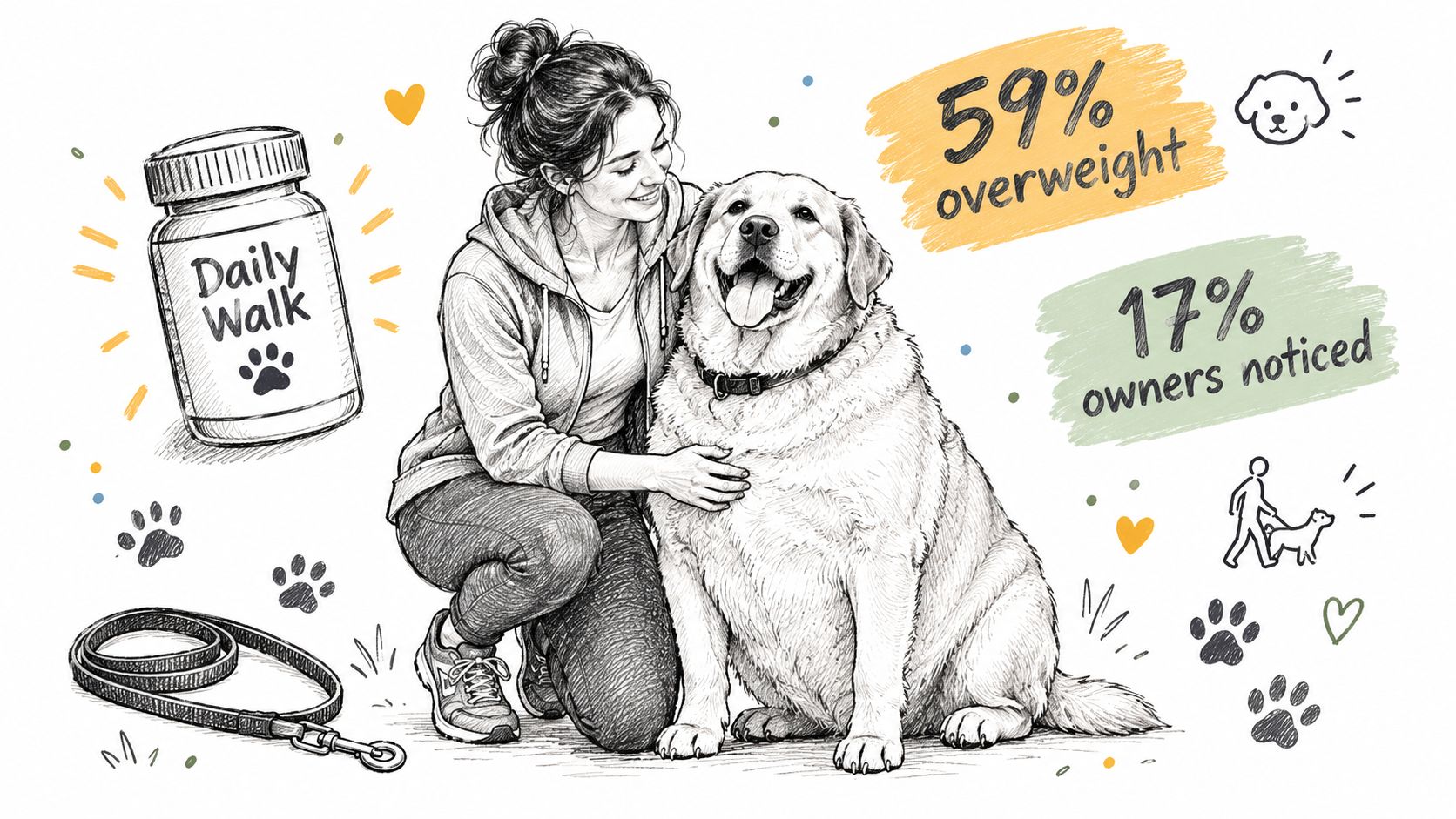
The health gap is substantial. The Association for Pet Obesity Prevention found that 59% of evaluated dogs were overweight or had obesity in 2022 , while its 2023 owner survey found only 17% of dog owners recognized their own dog as overweight . Those pet obesity findings highlight why appearance and enthusiasm alone aren't enough to judge exercise needs.
The visual below puts everyday movement in the broader context of pet health.
Movement supports a plan, not a shortcut
Regular activity can support a veterinarian's nutrition and weight-management plan. It doesn't cancel out unsuitable feeding, establish a diagnosis or make an overweight dog ready for demanding exercise.
A useful comparison is taking medication on schedule rather than trying to make up for missed doses all at once. Exercise isn't medication, but the scheduling lesson applies: a predictable routine is a better starting point than occasional, exhausting outings.
For an owner working away from home, a recurring weekday appointment creates a practical commitment. The handler can follow an agreed plan instead of deciding each day how much activity seems convenient.
Different dogs need different benefits
Consider these as planning examples, not breed-based prescriptions:
- A conditioned young adult may need purposeful movement that offers more physical work than a relaxed stroll.
- A senior dog may need comfortable, sustained movement with room to pause, rather than a faster pace.
- A new adoptee may need a familiar route and predictable handling before more adventurous outings feel manageable.
High-energy breeds don't automatically belong in the hardest session. Their behavior may tell you they want an outlet, but their health and conditioning determine which outlet is appropriate.
Mental engagement matters too. An outing can give a dog something to investigate and a handler opportunities to reward calm responses. That's a different goal from returning a physically tired dog.
Activity is a routine, not a rescue.
Exercise shouldn't become the default answer to barking, chewing or pacing without considering why the behavior is happening. Those behaviors may call for changes to the environment, training support or veterinary assessment rather than a longer run.
The limit is clear: structured activity supports care, but it can't diagnose or treat a medical problem. If a dog's movement, stamina or behavior changes unexpectedly, the next step may be an examination rather than a tougher workout.
How to Tell If Your Dog Is Ready
| Dog profile | Routine running guidance | First step |
|---|---|---|
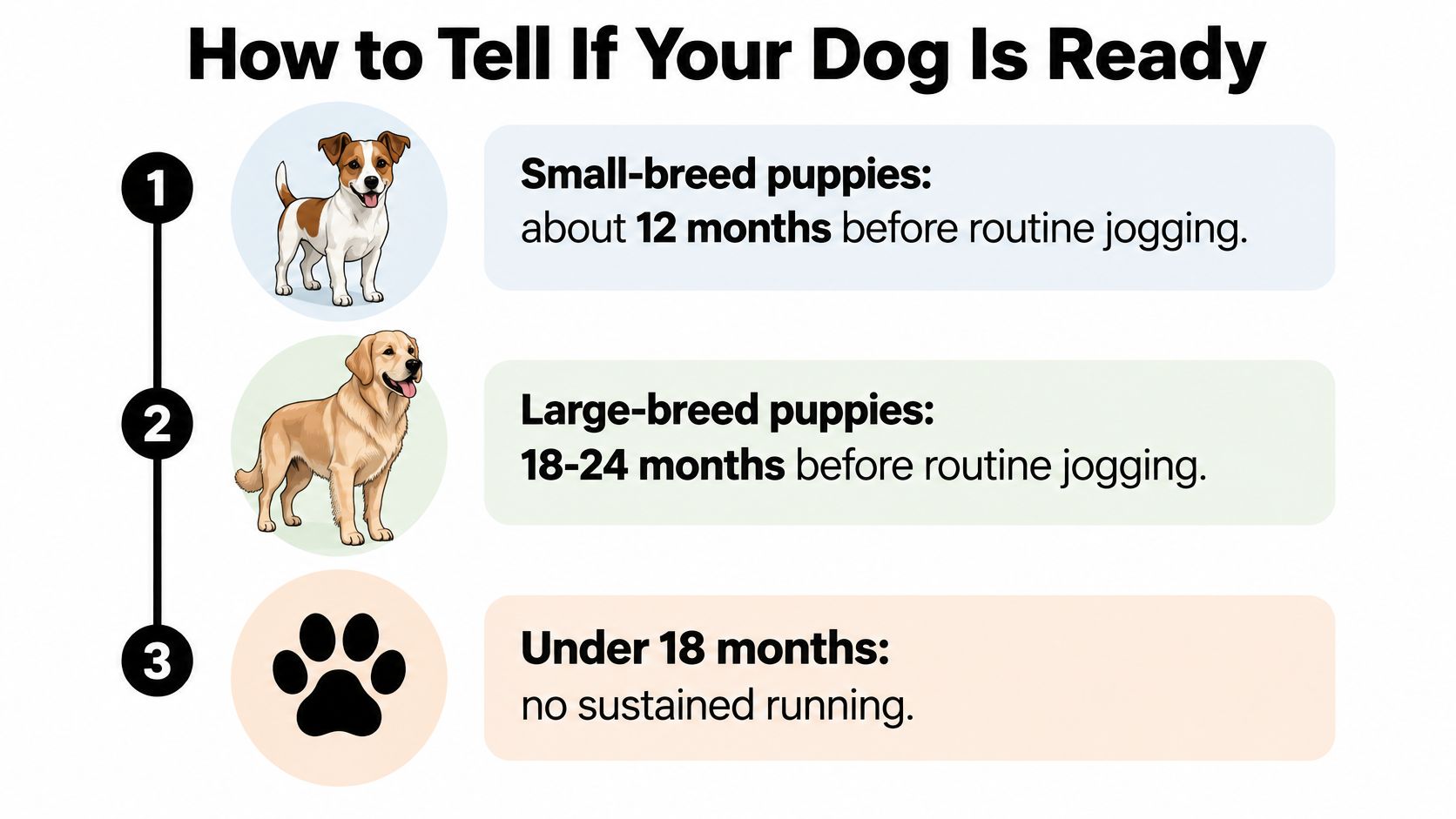
| Small-breed puppy | Routine jogging waits until about 12 months, subject to growth and veterinary advice | Walks, play and short sniffing outings |
| Large-breed puppy | Routine jogging waits until 18-24 months, subject to growth and veterinary advice | Walks, with a vet check on growth before demanding hikes |
| Any dog under 18 months | Sustained running may be inappropriate | Keep outings short and ask the vet |
| Adult with arthritis or hip dysplasia | Sustained running may be inappropriate | Veterinary clearance before any running |
| Adult, sedentary or overweight | Start with a walking-led progression | Build gradually over several weeks and track recovery |
| Senior dog | Intensity should be set by a veterinary exam | Vet evaluation before raising intensity |
The developmental age ranges above come from VCA's guidance on play and exercise. They aren't automatic clearance dates. The more cautious sustained-running guidance is a reminder that reaching an age threshold doesn't establish readiness for prolonged exertion.
This visual summarizes the puppy milestones.
Establish a baseline without testing the dog's limits
Conditioning means the capacity to handle a particular workload and recover from it. It isn't the same as excitement, willingness to chase or pulling hard on the leash.
The Penn Vet Working Dog Center Sprint Test research examines a 25-meter maximal-effort sprint from a down position as a field measure of muscular fitness. Owners don't need to reproduce a maximal sprint test. The useful lesson is to observe repeatable signs of function rather than label a dog as energetic or tired.
For an ordinary outing, note stride quality, how the dog recovers after a pause and whether they remain willing to move. Compare those observations with the dog's own usual pattern, not another dog's performance.
Our sessions are customized to age, breed and preference. Tell us about previous activity, medical restrictions and how your dog behaves after exercise so those details can inform the first outing.
Build from walking rather than jumping to distance
Use this sequence as a discussion framework with your veterinarian and handler, not a fixed timetable:
- Begin with comfortable walks. Establish a duration the dog already tolerates well.
- Introduce brisk sections. Keep easier walking available between more purposeful movement.
- Add walk-to-jog intervals if appropriate. Jogging should follow readiness, not replace the walking foundation.
- Explore hikes with rest opportunities. Treat uneven ground and climbing as added workload.
Change duration or terrain difficulty , rather than increasing everything together. A dog that handles longer flat walks hasn't necessarily developed the same comfort on steep or uneven trails.
Progress also isn't mandatory. A comfortable walking plan may remain the right choice, especially when a veterinarian identifies limits. Success means a sustainable activity routine, not graduating every dog to running.
Heat, Health and Stop Rules for Every Outing
The AVMA's warm-weather safety guidance advises exercising during cooler hours, avoiding hot pavement, providing water and shade, and taking frequent breaks. It also recommends shorter or less intense activity for overweight and short-nosed dogs. Treat exercise as a dose matched to the dog's age, body condition and conditioning. Check whether the dog is ready before deciding on a route or activity.
A dog may want to keep going even as heat or exertion becomes unsafe. Enthusiasm isn't protection against heat illness. Watch breathing, footing and coordination rather than using excitement or a willingness to pull forward as a sign to continue.
Check conditions before leaving
- Review the dog's risk factors. Consider age, body condition, short-nosed anatomy, health history and how familiar the dog is with the weather.
- Check the air and route surface. A shaded route and an exposed paved route place different demands on a dog.
- Carry water and a bowl. Plan where the dog can drink instead of relying on water being available along the way.
- Identify rest locations. Choose places where the handler can pause with the dog out of direct sun.
- Agree on when to escalate. The handler should know when to stop, contact you and seek veterinary help.
The plan should allow the outing to be shortened or abandoned as conditions change. Completing a route matters less than responding to the dog in front of you.
Use observable stop rules
| Warning sign | What it may indicate | Immediate action | Call a vet when |
|---|---|---|---|
| Excessive panting | Heat buildup or overexertion | Stop, move to shade and offer water | Panting doesn't settle promptly, or heat illness is suspected |
| Drooling | Possible heat stress | Stop activity and begin cooling | Drooling persists or accompanies other concerning signs |
| Restlessness or repeated lying down | Fatigue, discomfort or overheating | End exercise and assess safe transport | The dog won't stand or walk normally |
| Unsteadiness or stumbling | Heat illness or another urgent problem | Stop immediately and begin cooling | Any loss of coordination occurs |
| Abnormal gum or tongue color | Possible circulation problems or heat stroke | Seek emergency veterinary care | Always, without delay |
These signs help a handler decide when to stop, not diagnose the cause. There is no need to identify exactly what is wrong before ending the activity. Suspected heat illness calls for veterinary attention, not a wait-and-see return to exercise.
Safety boundary: An unfinished outing is preferable to asking a struggling dog to complete the route.
Cooling preparation isn't a substitute for emergency care
For suspected heat illness, stop exertion, move the dog out of the heat, begin safe cooling and arrange immediate veterinary care. Cooling steps are preparation, not a reason to delay help. Don't force a distressed dog into water or wait for every warning sign to appear before contacting a veterinarian.
Choosing Routes and Outings by Dog Type
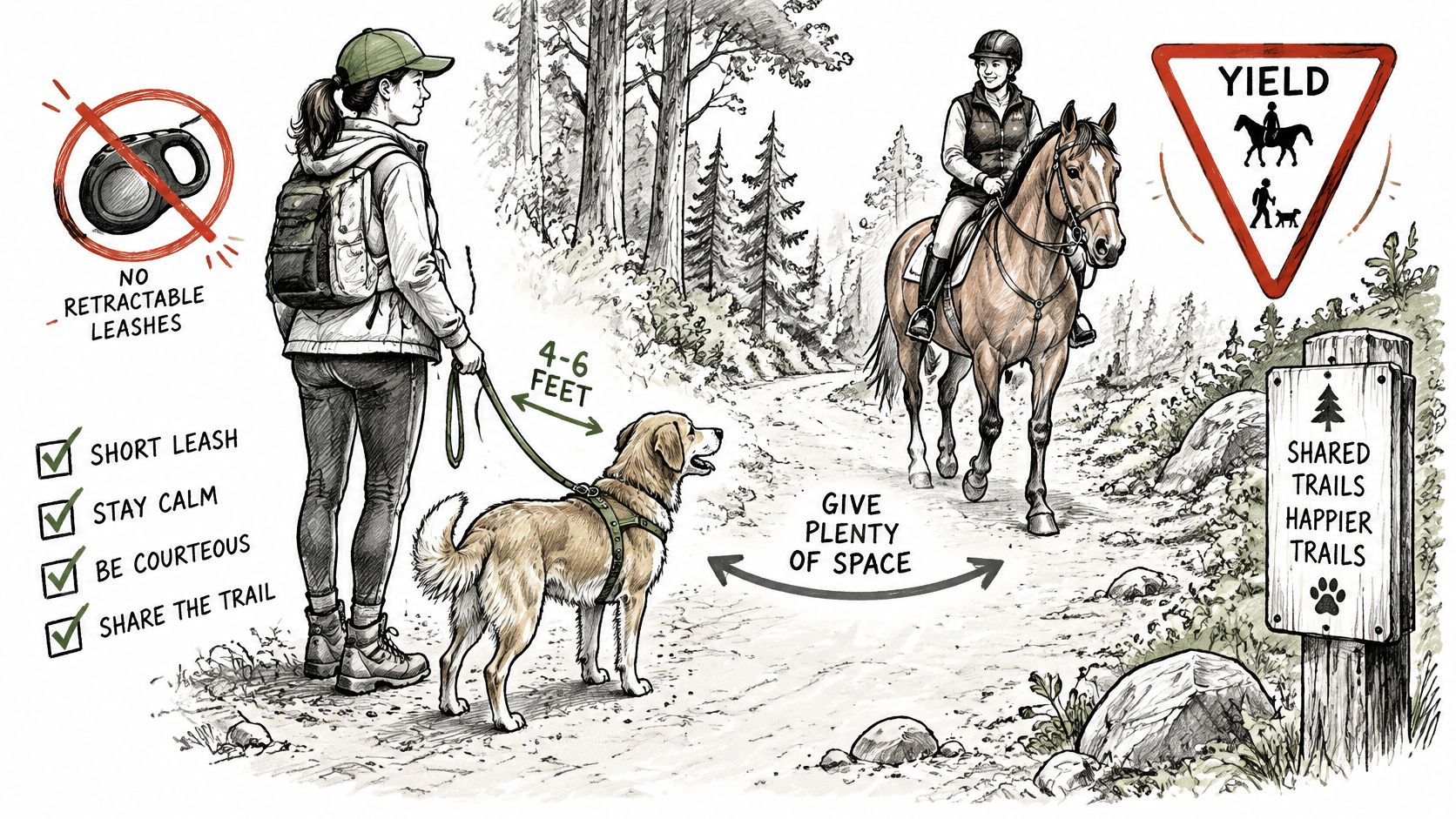
Use a standard leash rather than a retractable line in wooded areas, where a line can tangle in brush. The ASPCA's outdoor safety guidance also recommends yielding to horseback riders and cyclists. A 4-6-foot standard leash is a useful route-planning choice when it allows close control without interfering with comfortable movement.
Trail etiquette starts with giving other users room.
Before a Front Range outing, confirm whether dogs are permitted and what leash rules apply. Check parking, access, footing after recent weather and likely crowding. A destination can be dog-friendly while still being a poor fit for a particular dog that day.
Match the surroundings to behavior
A quiet neighborhood route may suit a newly adopted, reactive or easily overstimulated dog better than a popular trailhead. Reactive means the dog responds strongly to something, such as another dog, a cyclist or a passing vehicle. It doesn't tell you how physically fit the dog is.
For these dogs, useful route features include space to move aside, predictable surfaces and options to turn away from approaching traffic. A crowded path can make a short outing harder than a longer walk in a calm setting.
Our neighborhood running program is designed for high-energy dogs, including suitable vizslas, huskies and border collies. Our fast-paced walks offer brisk movement without the impact of a full run.
For trails, prioritize conditioning and responsiveness to the handler. Our hiking program is on-leash . Reliable responses to a cue to return or move closer help with handling, but they don't replace the leash or local trail rules.
The video below offers another opportunity to consider how a dog outing fits into outdoor surroundings.
Count investigation as part of the outing
Sniffing, pauses and route variety belong in an exercise plan. They give the dog opportunities to explore rather than spend the entire appointment moving at a human-selected pace.
Consider the difference between a dog hurried past every scent and a dog allowed controlled pauses before moving on. The second outing may cover less ground while providing a better balance of movement and engagement.
- For a worried dog , choose familiar surroundings and room to avoid triggers.
- For a trail-ready dog , add terrain only when handling and conditioning support it.
- For an easily excited dog , include quiet pauses rather than making every moment faster.
Judge the outcome by comfort and recovery, not distance alone. A shorter, calmer outing that leaves a dog settled may be the better choice for welfare than a longer run that leaves them overwhelmed.
What to Check Before You Hire a Provider
A provider's answers should show how they match activity to the individual dog. Age, body condition and current conditioning help determine whether a walk, run or hike is an appropriate dose of exercise. Make readiness the first decision, before choosing a route or service. Then check how handlers prepare, communicate and respond when plans change.
| Criterion | Strong answer | Weak answer |
|---|---|---|
| Handler vetting | Background checks and recurring training in handling, fitness and welfare | Staff are friendly and experienced |
| Insurance and bonding | Bonded and insured, with coverage details available for review | Insurance is mentioned but not described |
| Dog-specific plan | Session tailored to age, breed, conditioning and preference | Same route and pace for every dog |
| Transport safety | Dogs secured during transport | General reassurance about careful driving |
| Communication | GPS-tracked check-ins, photo updates and useful observations | Updates only when requested |
| Emergency plan | Clear steps for veterinary contact and an outing that cannot continue | General reassurance that someone will handle it |
Treat the checklist as a way to ask about actual practices, not just reassuring language.
Verify the people and the plan
Handler vetting: Denver Dog staff are background-checked and receive recurring training in canine handling, fitness and welfare. A friendly manner helps, but handlers also need preparation to manage a dog that becomes frightened, tired or hard to guide. Use this guide to dog-handler qualifications to understand what to verify.
Insurance and bonding: Denver Dog is bonded and insured and specializes in canine fitness. Ask to review coverage details, and consider them separately from staff preparation. Insurance does not show how a handler will adjust an outing to a particular dog.
Individual planning: Share known medical restrictions, your dog's current activity level and situations that cause difficulty. Then ask how those details would change the session. A useful answer explains the adjustment, rather than merely describing the dog as friendly.
Look beyond the exercise itself
Transport: Denver Dog secures every dog during transport. During outings, GPS-tracked check-ins and photo updates help you follow along. These updates provide useful information, though a location record or photo alone cannot show how comfortably your dog managed the workload.
Emergency preparation: Ask who will be contacted if your dog is injured or an outing cannot continue, and how veterinary authorization is handled. Training, insurance and tracking do not answer those practical questions on their own.
Denver Dog offers a free meet-and-greet at your home . Use the conversation to explain your dog's handling needs and clarify arrangements for changing weather, a dog refusing an activity or a session that does not go as planned.
Look for consistency across the answers: prepared handlers, individual planning, secure transport, useful communication and a clear way to escalate concerns. A polished conversation matters less than practices that protect your dog throughout the outing.
Book a Trial Session Before Committing
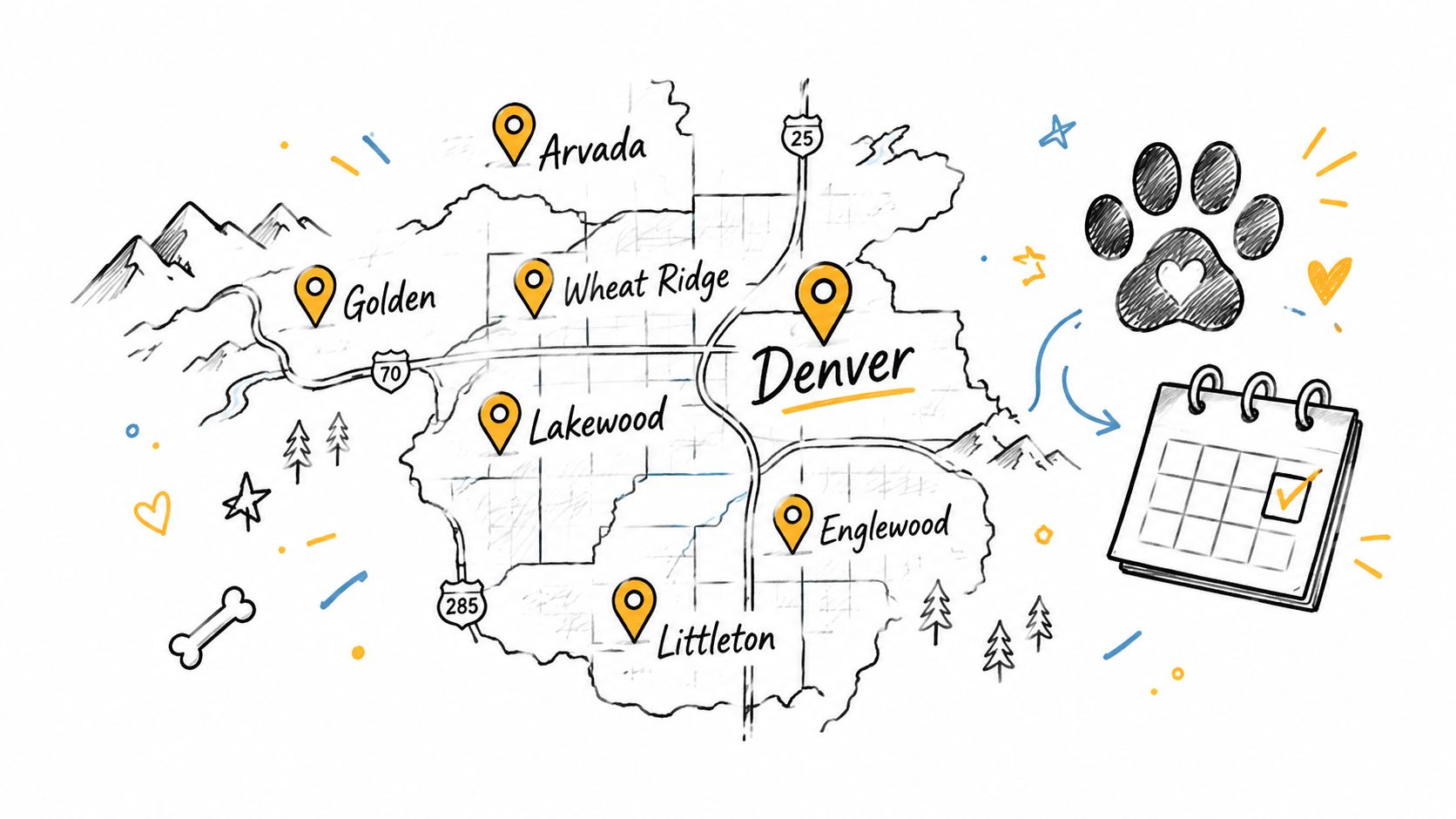
A trial is a readiness check, not a test of endurance. Before choosing a route or recurring service, match the exercise dose to your dog's age, body condition, and current conditioning. Denver Dog works with pet parents across the Denver metro. Its listed service area covers that region. Dog walking and running are listed Monday to Sunday, 8 am to 2 pm; hiking is listed Monday to Friday, 6 am to 2 pm. Check published service hours and confirm availability for the specific program before planning appointments.
This map offers a visual introduction to the metro area.
Use the trial to learn, not to prove endurance
Your dog does not need to cover a set distance or keep pace with another dog. The first appointment should show whether the activity suits your dog's present fitness and handling needs.
- Schedule a trial. Start with Denver Dog's pre-screening and trial-hike process and discuss which activity fits your dog.
- Check recovery at home. Notice comfortable movement and whether your dog returns to their usual behavior that evening.
- Review the handler's updates. Compare notes and photos with what you see after the outing.
- Repeat before increasing. If recovery seems normal and you have no concerns, consider repeating the same level of activity.
- Raise the workload gradually. Comfortable repeat outings can guide the next step, but one good session does not show readiness for a major increase.
Pause the progression if something seems wrong and discuss your concern. An unusually quiet evening alone does not prove the workout was suitable.
Confirm the practical commitment
Denver Dog Joggers session prices range from $46 to $91 . Confirm the session option and price before booking, since activities may use different formats.
After joining the system, clients schedule walks, runs, and hikes through the online platform. Start with a trial, then use your dog's response to decide whether the activity is a comfortable, repeatable fit. Choose exercise your dog can handle and enjoy, rather than the hardest available option.
Denver Dog offers structured, on-leash walking, running, and guided hiking for different activity needs. Visit Denver Dog to arrange a meet-and-greet and discuss a trial that suits your dog's readiness and schedule.
The Run Down