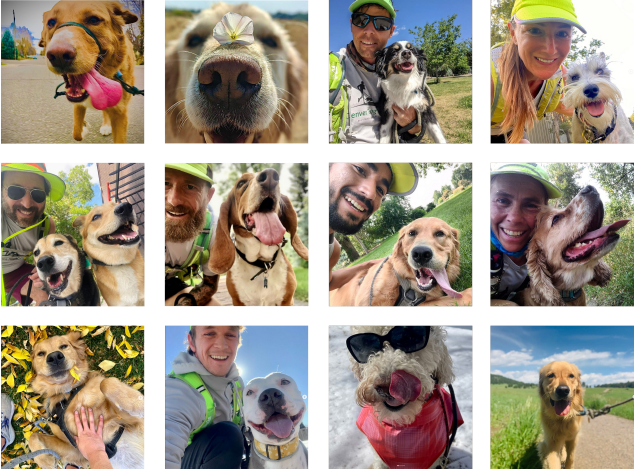
Your calendar is full, your dog is waiting by the door, and the afternoon walk is already competing with another meeting. You're comparing friendly profiles, trail photos, and promises of a tired, happy dog, but none tells you what happens if your dog starts limping or the pavement gets too hot.
Choosing professional pet services means choosing someone to make those decisions when you can't be there. The useful question isn't just who can take your dog out. It's who can match the activity to your dog, recognize when plans should change, and explain what happened afterward.
Choosing Care Your Dog Can Trust
Consider a Denver owner comparing a neighborhood walk with a longer trail outing. The hike looks more exciting, while the walk fits neatly between meetings. Neither is automatically the better choice. For a newly adopted dog whose reactions are still unfamiliar, a predictable neighborhood route may be the more sensible starting point.
A responsible provider should ask about that dog before recommending an appointment. Recent activity, medical restrictions, reactions to other dogs, and comfort with transportation all belong in the conversation. A profile photo can show warmth, but it can't show how someone makes a difficult handling decision.
Think of a capable provider as a coach, scheduling partner, and safety monitor , not a driver who delivers pets to activities. The service should combine competent handling, welfare knowledge, dependable execution, transportation planning where relevant, and accountable communication.
Different services solve different problems
Walking provides an opportunity for movement, toileting, sniffing, and ordinary environmental engagement. Running adds sustained physical effort for dogs whose condition supports it. Hiking introduces route-specific demands, including surfaces, exposure, and travel logistics.
Boarding answers a different question: who will provide care while the household is away? Training focuses on teaching skills and changing behavior through a planned learning process. These services can complement one another, but an exercise appointment doesn't become training because the handler asks for a sit.
For example, a dog may need a midday walk while the owner works and separate support for fear around unfamiliar dogs. Booking a more strenuous outing doesn't resolve that behavioral goal. Likewise, a walk during a trip doesn't replace the supervision and routine an overnight care arrangement must address.
The following summary highlights the difference between an appealing profile and an informed care decision.
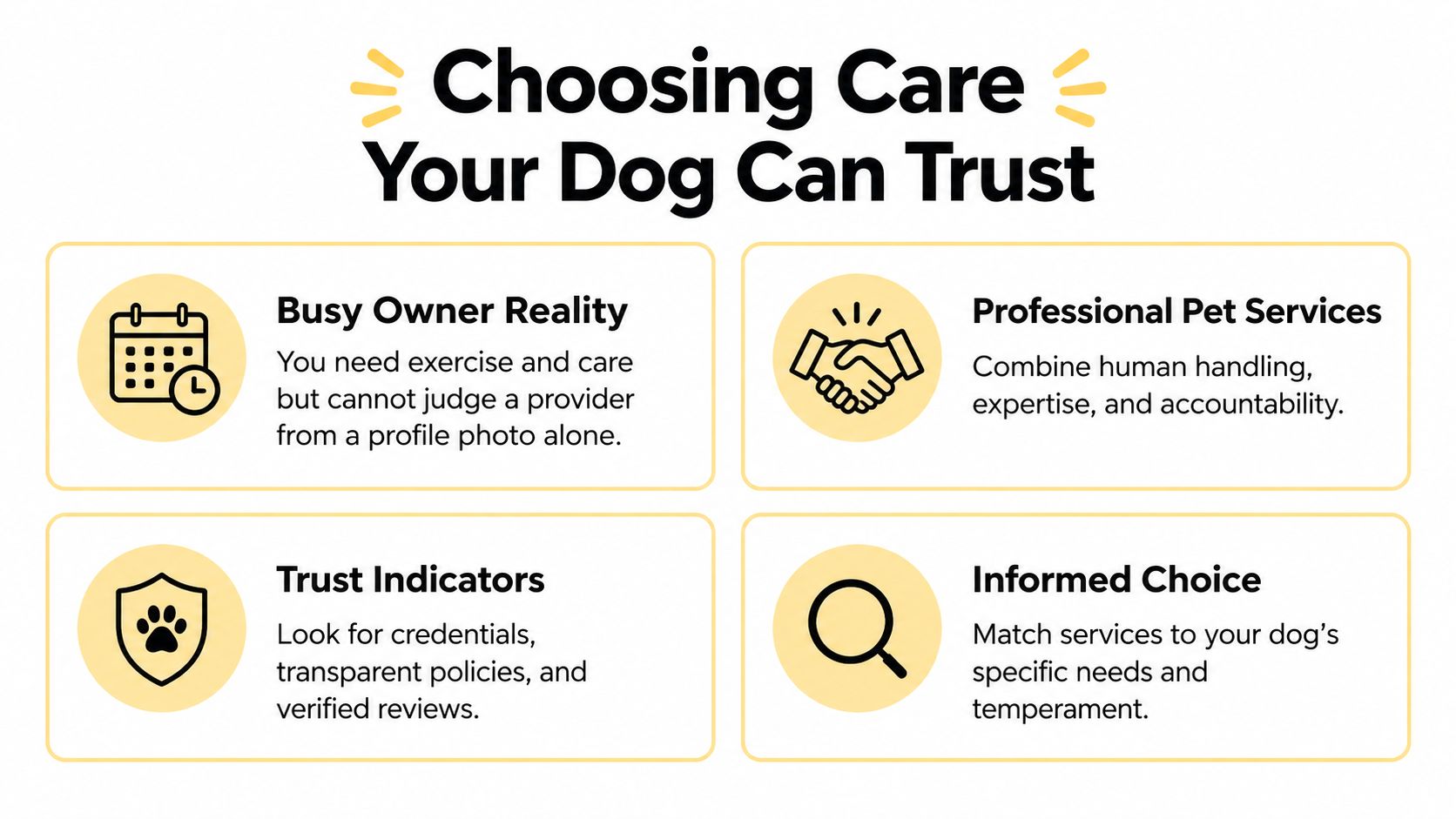
Look beyond the advertised activity
Signals of a Professional Pet Service
| Surface-Level Signal | Meaningful Professional Signal |
|---|---|
| Friendly photographs | Clear explanations of handling experience and assessment |
| A long route | A workload selected for the individual dog |
| A low advertised rate | A written description of what the appointment includes |
| Enthusiastic reviews | Specific feedback considered alongside policies and records |
| A promise of a tired dog | Attention to comfortable movement and recovery |
| An attractive booking page | Reliable scheduling and a documented backup process |
The commercial context helps explain why owners face so many choices. Americans spent $158 billion on pets in 2024 , including $14.3 billion on other services , according to the American Pet Products Association's industry figures. That category includes boarding, grooming, insurance, training, sitting, walking, and other nonveterinary services, so it mustn't be presented as the size of the dog-walking market alone.
Professional care has also become a substantial service industry. A Bureau of Labor Statistics analysis of pet-care productivity found that real output increased 144.6% from 2004 to 2021 . Industry growth, however, doesn't establish the quality of an individual provider.
Practical rule: Choose the person who can explain why an activity fits your dog, not just describe how enjoyable the outing looks.
Dependable care connects assessment, a suitable activity, observation during the appointment, and a useful follow-up. Ask a provider to describe that sequence using your dog as the example. A clear answer should help you understand both what they intend to do and what would make them change course.
Build Exercise Around the Individual Dog
A sedentary senior and an athletic young dog shouldn't receive the same exercise prescription because they're similar in size. A newly adopted dog may have an uncertain activity history. An overweight or short-nosed dog calls for particular caution around exertion and heat.
The American Veterinary Medical Association recommends short, frequent walks, rest periods, and gradual progression toward one or more 15-minute periods of brisk walking followed by recovery , rather than beginning with sustained exertion ( AVMA walking guidance). For a professional handler, that means establishing a baseline before increasing difficulty.
Gradual progression should look like an observable process, not a promise to add distance at every appointment.
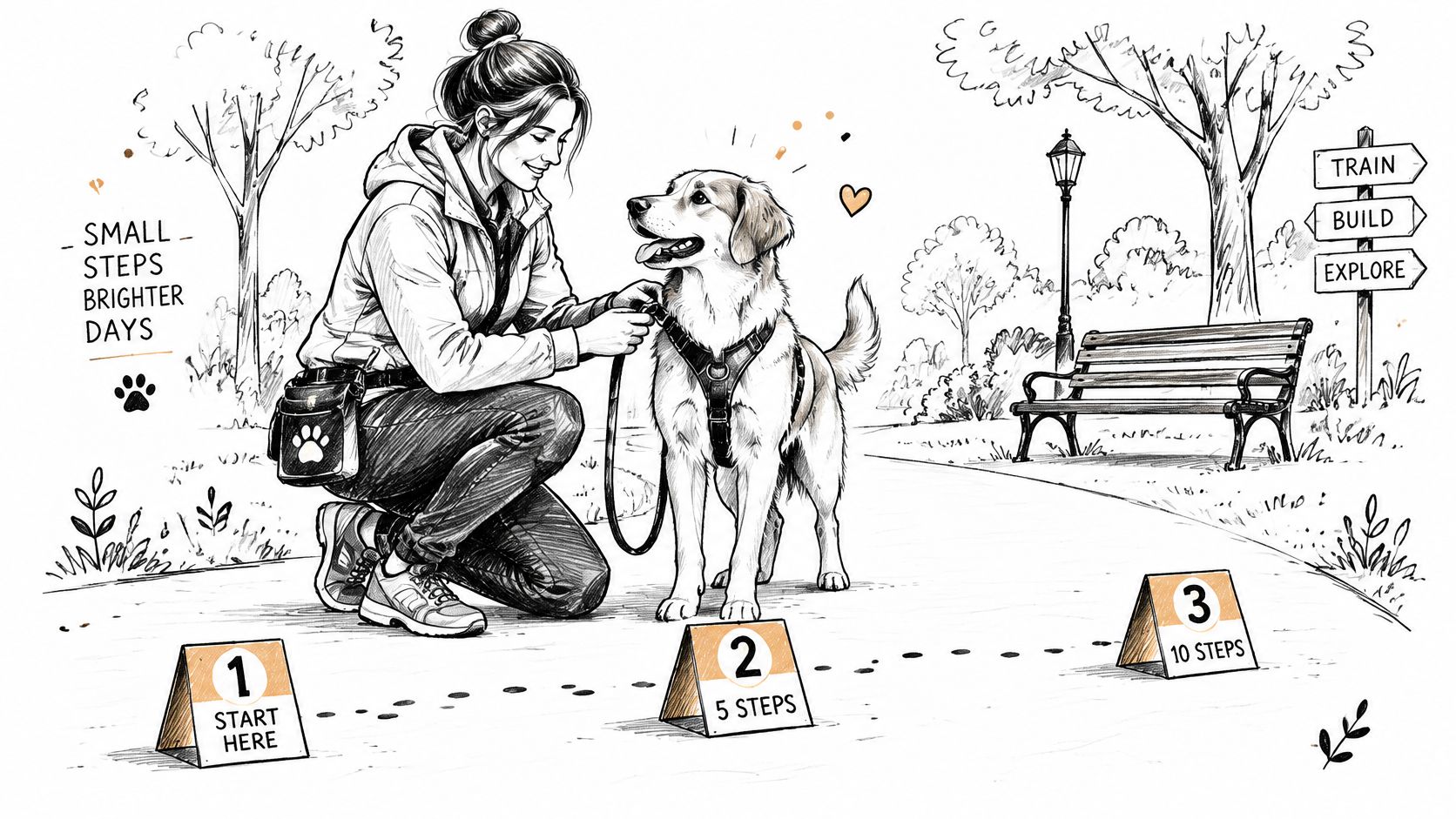
Establish a baseline before adding effort
Ask the handler to record the starting duration, pace, gait, breathing, and recovery behavior. Include opportunities to sniff and engage with the environment. A session isn't automatically inadequate because the dog spent part of it exploring rather than moving briskly.
The owner's observations afterward matter too. Was getting up comfortable that evening? Did the dog appear unusually reluctant to move the next morning? Those details should influence the next appointment rather than disappear into a generic completion message.
If stiffness or difficulty rising is already a concern, The Companion Project's resource on causes of dog mobility decline offers context for questions to bring to a veterinarian. A handler should document changes, not diagnose their cause.
Workload Signals and Responses
| Observed Signal | Likely Interpretation | Handler Response |
|---|---|---|
| Comfortable movement and normal recovery | Current workload may be appropriate | Maintain it, then consider gradual progression |
| Repeated sitting, lying down, or unusual slowing | Possible fatigue, discomfort, or environmental stress | Pause and reassess rather than coax onward |
| Lameness, weakness, or breathing difficulty | A potentially significant health concern | Stop activity and seek veterinary assessment |
| Difficulty rising after the outing | The workload or an underlying problem needs review | Record the change and discuss veterinary guidance |
Don't confuse exhaustion with success
VCA's guidance on play and exercise identifies unusual breathlessness, repeated stopping, irritability, and difficulty rising afterward as reasons to reconsider activity. A dog who finishes depleted hasn't necessarily received better care than one who returns comfortably engaged.
Veterinary weight-management guidance also cautions that the optimal exercise level for preventing or managing canine obesity hasn't been established ( AVMA journal review of weight management). Individual response matters more than a universal mileage target. Progress should follow evidence of comfortable recovery, not an assumption that every appointment must be harder.
Make Safety Decisions Before and During Sessions
A suitable plan can become unsuitable before the handler reaches the trailhead. The surface may be hotter than expected, shade may be unavailable, or the dog may arrive moving differently from normal. Professional safety requires permission to change the appointment, not pressure to complete the advertised route.
The AVMA's warm-weather safety guidance recommends cooler exercise hours, avoiding hot pavement, carrying water, taking breaks, and consulting a veterinarian before beginning an exercise program. It also identifies overweight and short-nosed dogs as particularly vulnerable.
A useful departure check connects those precautions to the actual outing.
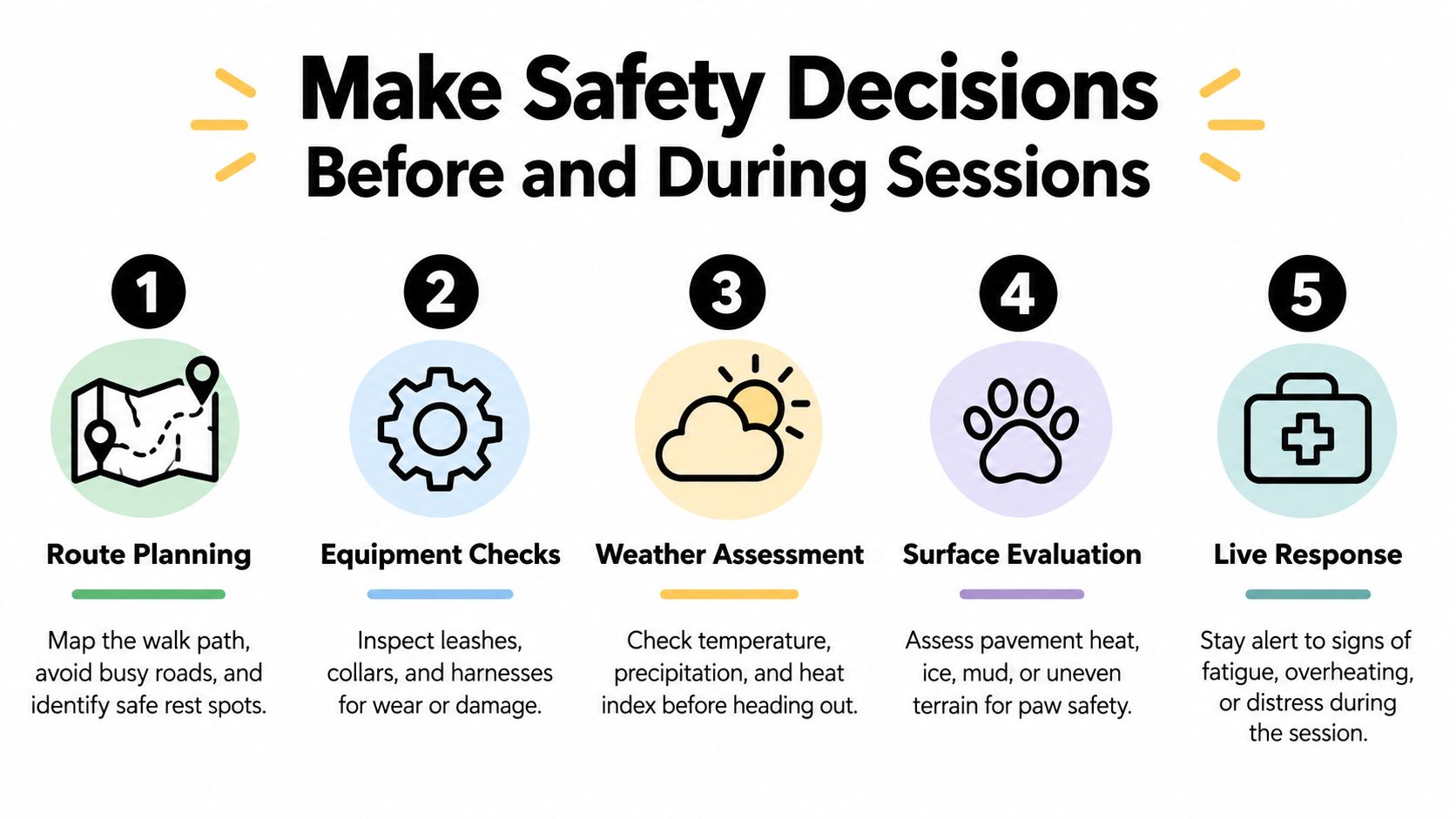
Decide what would change the plan
Before collecting the dog, the handler should review restrictions, inspect equipment, and identify a route with appropriate footing, rest opportunities, and an exit option. If transportation is involved, ask about secure loading, ventilation, parking, and access to emergency transport.
Water planning should account for the dog and the route rather than rely on finding a working fountain. For trail outings, ask how the provider evaluates elevation, exposed terrain, and the return journey. Poor air conditions should also prompt a deliberate decision, particularly when the dog has a relevant veterinary restriction.
Go, Modify, or Cancel the Session
| Condition | Decision Signal | Planned Adjustment |
|---|---|---|
| Heat or hot surfaces | The planned route lacks comfortable footing or cooling opportunities | Move to a cooler setting, substitute suitable activity, or cancel |
| Poor air conditions | Conditions conflict with the dog's health needs or the provider's safety policy | Reduce exposure or defer outdoor exertion |
| Difficult terrain | Footing exceeds the dog's demonstrated ability | Select an easier route |
| Unexpected fatigue | Movement or responsiveness changes from baseline | Stop exertion and assess recovery |
| Equipment damage | Secure control can't be maintained | Replace equipment before proceeding |
The video below provides an additional viewing resource alongside the practical checks.
Report the decision, not just the destination
A leash provides control, but it doesn't prevent overheating, dehydration, or paw injury. The handler must keep observing the dog after departure and be willing to shorten or abandon the outing.
A safe return matters more than completing the planned route.
Afterward, the owner should receive a concise account of energy, gait, drinking, paw condition, and recovery, with any changes clearly flagged. If the handler substituted a shaded walk for an exposed run, the update should explain why. That information gives the next handler a better starting point and lets the owner watch for changes at home.
Apply Denver Rules to Every Route
A provider's route plan should identify the land manager and the rules for the actual location. A neighborhood park, a designated dog enclosure, and a trail outside Denver aren't interchangeable operating environments. Ask who checks restrictions before an outing and how closures or changes are communicated.
Under Denver Parks and Recreation's park-use rules, dogs in public park spaces must remain leashed and under physical control; leashes on trails and park roads may not exceed six feet . The same regulations prohibit operating or riding human-powered devices while walking a leashed dog, except for qualifying mobility devices.
Separate trail procedures from dog-park procedures
Denver's designated dog-park requirements specify that unlighted parks generally operate from sunrise to sundown , while lighted parks operate from 5 a.m. to 11 p.m. They also require current rabies vaccination and a Denver dog license, with Denver residents required to have dogs spayed or neutered or hold a current intact permit.
Those rules also require dogs to remain leashed until inside the enclosure and to be leashed before leaving. The responsible person must maintain control and keep the dog in view. An off-leash designation doesn't remove the need for active supervision.
Route-Specific Operating Checks
| Setting | Professional Procedure | Reason It Matters |
|---|---|---|
| Public park trail | Use a compliant leash and maintain physical control | Meets the applicable park requirements |
| Dog-park entrance | Manage the leash transition at the enclosure | Avoids treating access paths as off-leash space |
| Designated enclosure | Check eligibility, hours, and visibility | Entry doesn't remove supervision duties |
| Trailhead or parking area | Plan loading and unloading away from moving vehicles | Controls the transition between transport and exercise |
Include the journey in the assessment
Where vehicle cameras are used, ask whether someone reviews speeding, following distance, distraction, and drowsiness alerts and provides timely coaching. Monitoring should support a qualified driver , not replace screening, sound judgment, or careful loading practices.
For a local starting point, consult this guide to Colorado leash law for Denver pet owners. Then confirm the requirements of the specific destination. A general guide is useful preparation, but the provider still needs route-specific procedures for the appointment being delivered.
Match the Service to Your Dog and Schedule
A household with a high-energy dog and an overloaded work calendar may need recurring exercise. A household leaving town needs continuity of care. Both may search for professional pet services, but they're solving different problems.
Start with the gap you need filled. Is your dog missing a daytime outing, struggling with a particular behavior, or needing care while you're away? Then consider which setting and level of activity your dog can comfortably manage.
Compare purpose before format
Choose the Service That Fits
| Service | Best-Fit Scenario | Primary Question to Ask | Watch For |
|---|---|---|---|
| Walking | A weekday dog needs a predictable outing | How do you balance movement, toileting, and exploration? | An inflexible pace or unsuitable group |
| Running | A conditioned dog needs structured aerobic activity | How do you establish readiness and manage effort? | Intensity selected from breed labels alone |
| Hiking | A trail-suitable dog enjoys environmental variety | How do you assess terrain, transport, and compatibility? | Scenic destinations without a clear operating plan |
| Boarding | The household needs care while away | Who supervises, and how are routines maintained? | Unclear responsibility outside activity periods |
| Training | The household has a specific learning or behavior goal | What methods and owner practice does the plan involve? | Guaranteed outcomes without assessment |
A reactive dog, for example, may benefit more from a quiet, controlled outing than from a busy group hike. The relevant question isn't whether hiking is enriching in general. It's whether that environment suits this dog today.
An athletic owner may want guided trail time for a dog already comfortable outdoors. A puppy learning household routines may need training alongside age-appropriate care. Neither household should be steered toward a more demanding service because it sounds more substantial.
Make the routine realistic
Research described in a study of dog-walking behavior and owner relationships connects walking patterns with household circumstances, dog characteristics, and the human–dog relationship. That supports a practical approach: remove scheduling friction without ignoring the dog's preferences and capacity.
Use these matching questions before booking:
- Owner goal: What responsibility must the appointment reliably cover?
- Dog fit: Which settings, companions, and activities are comfortable?
- Health context: Are there restrictions the provider needs to follow?
- Schedule fit: Can the household sustain the arrangement consistently?
- Service boundary: What care or training will still be needed separately?
There isn't a universal winner among walking, running, hiking, boarding, and training. The useful choice is the one that addresses the actual need without creating an unsuitable demand on the dog or leaving an important responsibility uncovered.
Vet Providers Before Booking
Ask who will handle your dog, not just who answers the inquiry. If the regular handler is absent, you should know how a replacement receives your dog's information and whether you'll be notified. Familiar branding doesn't answer those operational questions.
Then ask how handlers learn canine handling, fitness observation, and welfare practices, and how the company checks their work. For a more focused interview, use this guide to dog-handler qualifications owners should verify. Request concrete examples rather than accepting a broad claim of experience.
Use the same questions with every provider
Provider Vetting Checklist
| Vetting Area | Question to Ask | Evidence to Seek |
|---|---|---|
| Handler identity | Who is assigned, and who provides backup? | A clear staffing and notification process |
| Intake | How do you assess health, behavior, and suitability? | An intake form and assessment discussion |
| Training | How are handling skills taught and reviewed? | Relevant training records and refresh practices |
| Transportation | How are drivers screened and dogs transported? | Written vehicle and loading procedures |
| Insurance | What activities does the policy cover? | Current documentation and an explanation of scope |
| Emergencies | Who authorizes care and arranges transport? | A documented escalation plan |
| Communication | What will I receive after appointments? | A sample session update |
A claim such as fully insured should start a conversation, not end it. Ask about the services covered, who performs them, and how an incident would be handled. Similarly, safe and loved are welcome intentions, but you need to hear what staff do when a dog refuses to move or an owner can't be reached.
Emergency planning also requires a veterinary contact you trust. The Vet Price Comparison Site's guide to comparing local vet practices is a useful companion resource when reviewing your household's veterinary arrangements. Give the care provider clear contact details and authorization preferences.
Notice evasions as well as answers
- No intake: Booking proceeds without discussing health, temperament, or restrictions.
- No contingency: The provider can't explain an unsafe-weather or emergency response.
- Guaranteed results: Every dog is promised the same physical or behavioral outcome.
- Commitment pressure: You're pushed to purchase before suitability is discussed.
Interview test: Ask for a recent type of decision the team has had to make, without requesting another client's private details.
Finally, request a sample of attendance tracking and session notes. You're looking for a repeatable way to preserve relevant information, review concerns, and communicate changes, rather than relying on whichever staff member happens to remember the previous outing.
Compare Pricing Without Choosing by Price Alone
An inexpensive walk and a transported trail outing aren't comparable until you know what each quote includes. Appointment duration may mean time at your home, time outdoors, or a broader collection-and-return window. Ask the provider to define it.
Instead of asking only for a rate, describe the same dog, schedule, service, and supervision needs to each business. Request a written breakdown of the base appointment and anything that can change the total. That makes differences visible without assuming that either the cheapest or most expensive option is better.
Normalize the quote
Pricing Questions to Normalize Quotes
| Pricing Variable | Question to Ask | Why It Affects Comparison |
|---|---|---|
| Service and duration | What happens during the booked period? | Similar labels may describe different appointments |
| Individual or group care | Will my dog share the handler's attention? | Supervision arrangements may differ |
| Transportation | Are collection, travel, and return included? | A listed activity price may exclude logistics |
| Route complexity | Does the destination affect the quote? | Trail outings may involve different planning |
| Dog-specific needs | Are equipment or handling requirements additional? | Individual accommodations can change scope |
| Recurring schedule | What commitment does this rate require? | Flexibility and booking terms may differ |
| Changes and cancellations | What happens if either party changes plans? | The final cost depends on the policy |
Dog size, starting location, equipment, staffing, and the nature of the activity are all reasonable subjects to clarify. Don't assume any particular factor creates a surcharge. Ask the provider to identify its own pricing rules.
This Denver dog-walking pricing guide can help frame local questions, but your written quote should describe your actual arrangement. Avoid comparing an introductory offer with an ongoing service unless the later terms are clear.
Pay for defined work
A higher price isn't proof of stronger care. Ask what staffing consistency, planning, documentation, and individualized attention the fee includes, then compare that answer with the provider's evidence.
Choose the arrangement you can sustain and understand. A transparent cancellation policy and a clear description of changed-session charges are more useful for budgeting than an attractive headline rate with unresolved conditions.
How Denver Dog Applies Professional Standards
Denver Dog is one option for owners seeking weekday, on-leash walking, running, and hiking rather than boarding or a stand-alone behavior-training program. Its Denver Dog Joggers and Denver Dog Hikers programs offer different activity formats, with sessions designed for energy level and temperament. Owners should still discuss which format fits their individual dog before booking.
The operating model includes driver screening for a clean driving record, in-vehicle monitoring of speeding, following distance, distraction, and drowsiness, and real-time coaching. Staff receive recurring training in canine handling, fitness, and welfare. Those practices address meaningful parts of professional delivery, although owners should ask how they apply to the person and vehicle assigned to their dog.
Separate experience from proof of fit
Evaluating Denver Dog Against Core Standards
| Standard | Denver Dog Evidence | What Owners Can Verify |
|---|---|---|
| Appropriate activity options | On-leash walking, running, and hiking programs | Which option suits the dog's starting condition |
| Individual consideration | Sessions tailored to energy and temperament | How intake information changes the proposed outing |
| Transport oversight | Driver screening, camera monitoring, and coaching | Current screening and alert-review procedures |
| Handler development | Recurring handling, fitness, and welfare training | Training relevant to the assigned handler |
| Scheduling fit | Weekday service availability | Collection arrangements and recurring availability |
| Accountability | An established service history | Reporting, escalation, and review practices |
The company has delivered more than 135,000 sessions since 2010 and serves Arvada, Denver, Englewood, Golden, Lakewood, Littleton, and Wheat Ridge , as detailed on its service-area page. That history provides context for evaluating experience; it doesn't guarantee a particular outcome for an individual dog.
The company also reports top ratings on Google and other platforms. Treat reviews as an additional perspective, not independent proof of every operating practice. Read for specific descriptions of communication and care, then confirm current policies directly.
Make the final decision about your dog
Before committing, ask for a proposed starting activity, the conditions that would change it, and an example of the update you'll receive. Confirm what happens if the dog isn't comfortable with the original format. A provider's willingness to recommend a less demanding option can be more informative than an enthusiastic sales pitch.
Your final decision should rest on fit, oversight, and accountability . The activity needs to suit your dog, the handler needs authority to make safe adjustments, and you need enough information afterward to participate in the care. That's a stronger foundation than mileage, branding, or visible fatigue alone.
Denver Dog offers weekday on-leash walks, runs, and hikes for owners who need structured exercise and dependable care for their dogs. Visit Denver Dog to discuss your dog's health, temperament, current routine, and the activity format that may fit before booking.
The Run Down