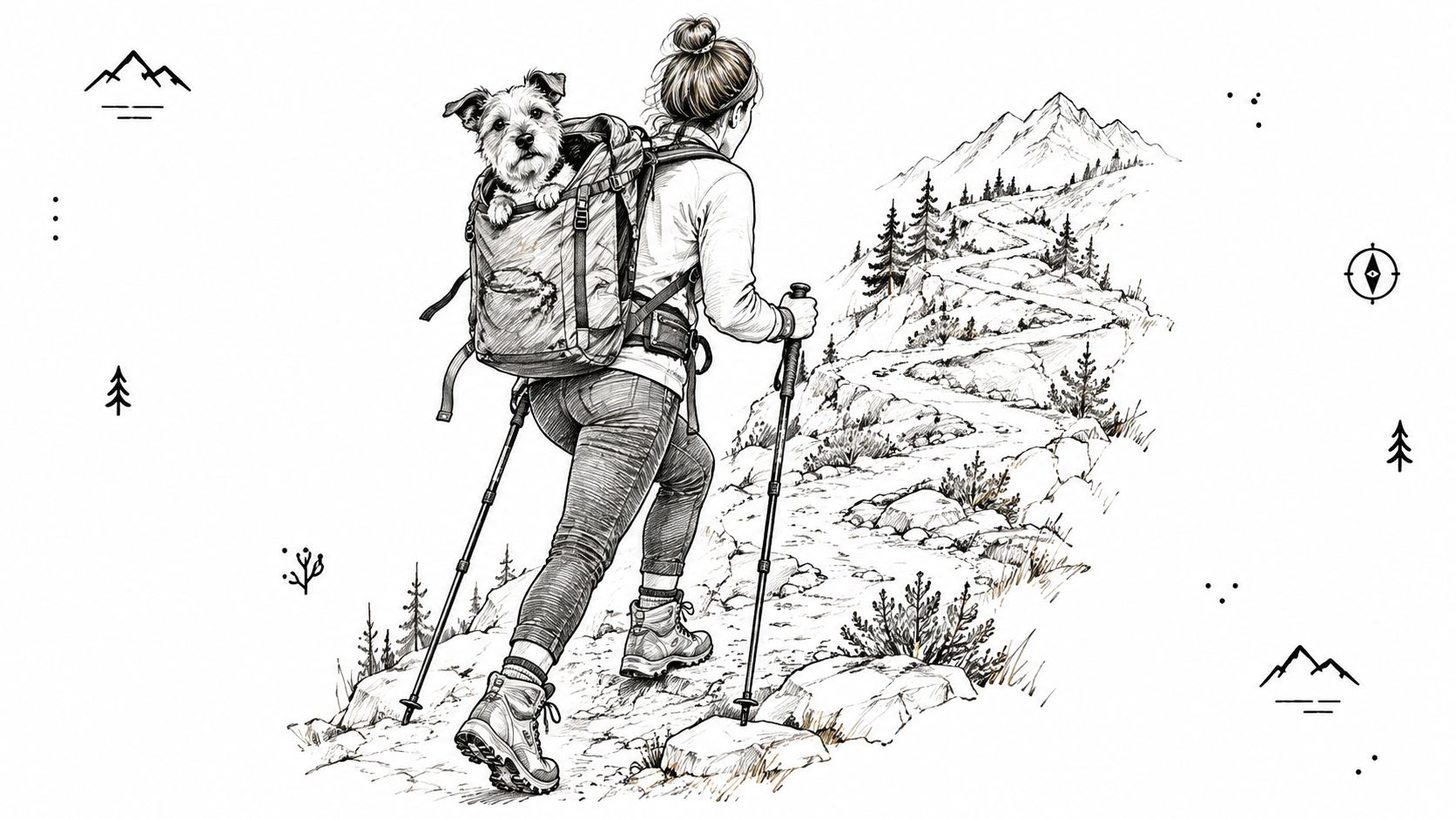
You're halfway up a Front Range trail when your small dog starts lagging. You lift the dog into the carrier, expecting the break to save the outing, but the pack sags, the tether twists, and the mesh sits against the dog's face. Instead of resting, the dog pants, braces against the sides, and tries to escape. The carrier didn't solve the problem. It added a new one.
A dog hiking backpack carrier should be treated as safety equipment, not a soft bag with shoulder straps. The right choice has to keep the dog stable while you move, manage heat in changing conditions, prevent escape, and distribute weight without creating harmful pressure. Manufacturer capacity is only one part of that decision, and it's often the least useful one.
This guide gives Denver-area dog owners a practical way to judge a carrier before the trailhead. You'll learn how to measure your dog, compare construction, calculate a conservative load, recognize heat danger, and decide when carrying your dog is safer than asking the dog to carry anything.
Why the Right Carrier Changes the Hike
A steep section can expose a weak carrier quickly. A dog that seemed comfortable at home may slide sideways on an incline, lose visibility when the pack shifts, or panic when the carrier's opening presses against the head. The handler then has to stop, readjust straps, calm the dog, and decide whether continuing is sensible.
That disruption matters because trail conditions change constantly. Uneven ground increases movement inside the pack, direct sun alters the carrier's microclimate, and fatigue changes how well a dog can brace or settle. A carrier that feels acceptable on a flat sidewalk may be unsuitable on a rocky climb.
The real buying criteria
Start with four questions:
- Does the dog fit by measurement? Weight alone can't tell you whether the dog can sit, turn, or lie down.
- Can the carrier control movement? A locking tether and stable base matter when the handler changes direction or footing.
- Can air move through the enclosure? Mesh panels help, but their appearance doesn't prove that the dog will stay cool.
- Can the handler manage the combined load? A structurally strong pack can still be too heavy for the dog or the person carrying it.
The category is substantial rather than a novelty accessory. Market research reported that carrier-style backpacks represented about 23.5% of the dog-backpack product-type market in 2025 ( DataIntelo's dog backpack market report). That popularity makes careful selection more important, not less, because many products serve travel or casual use rather than uneven, exposed trails.
Trail rule: A carrier earns its place when it protects the dog's posture, breathing, and security under movement. Storage pockets and attractive fabric come after those basics.
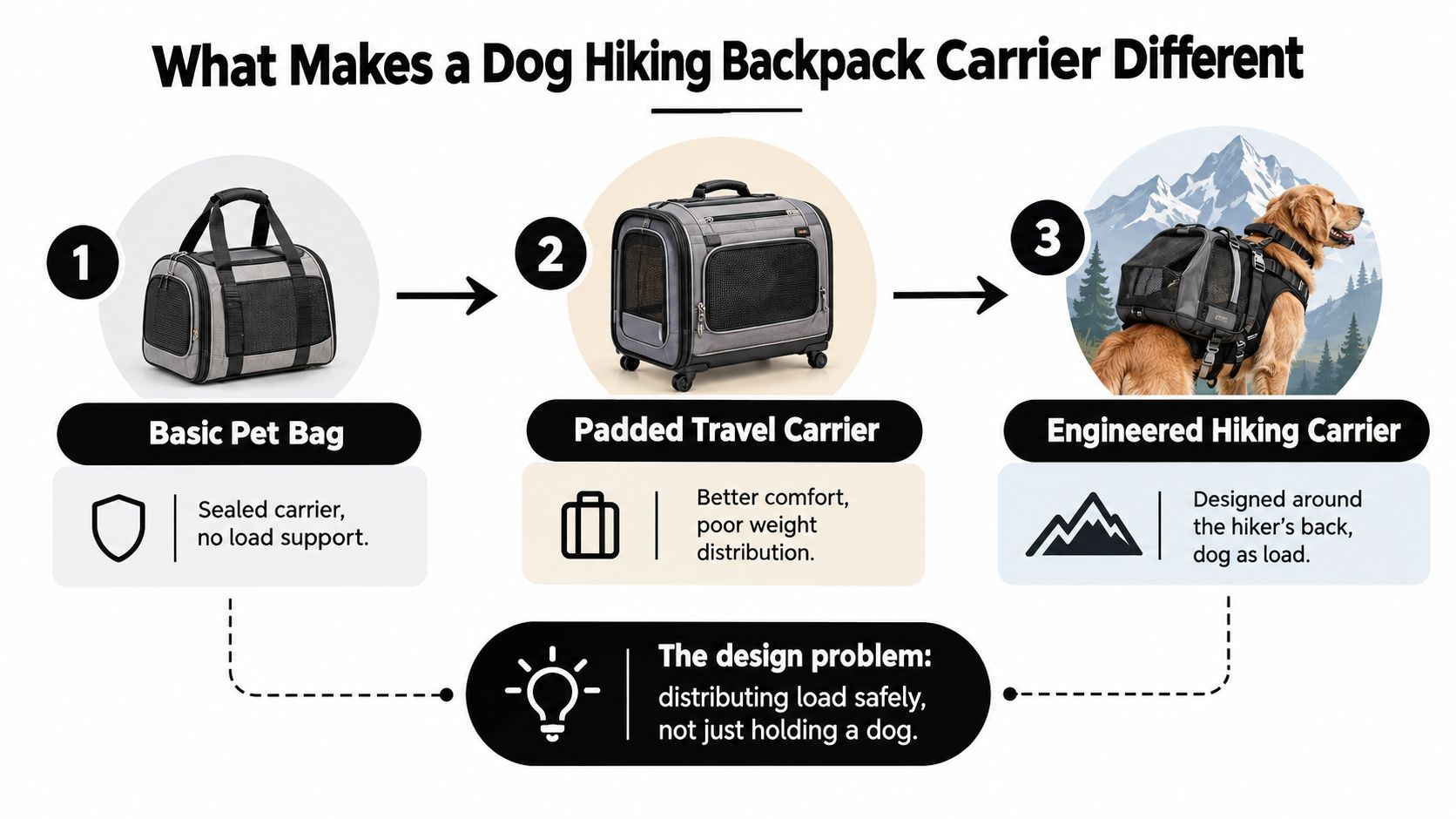
What Makes a Dog Hiking Backpack Carrier Different
The dog hiking backpack carrier category didn't appear fully formed. Patent records document a U.S. dog backpack design with a priority date of August 28, 1998 , and the same record points to a canine backpack listing from the prior year ( U.S. patent record). Later designs continued refining fit, restraint, ventilation, and access.
That progression matters because the engineering problem is more demanding than just enclosing a dog. The carrier must hold a moving animal in a stable position while the human body bends, climbs, descends, and reacts to loose rock. A dog that shifts dangerously can change the handler's balance, while a handler who compensates suddenly can make the dog move even more.
Modern patent concepts include stabilizing upper-body support, including a safety-belt-like restraint intended to allow limited comfortable movement while preventing unsafe shifting. Other designs use bottom-entry loading, allowing the lower section to separate for easier loading. These developments point to the same buyer lesson: containment, access, ventilation, and posture are connected design problems .
Why human comfort isn't enough
A padded shoulder harness may feel excellent while the dog hangs in an unstable compartment. Conversely, a dog may have a supportive interior while the handler struggles with a pack that pulls backward or shifts from side to side. Both halves of the system have to work together.
For hiking, prioritize a firm or semi-rigid base, adjustable torso fit, padded contact areas, ventilation that remains functional under load, and an escape-prevention tether that locks securely. These features don't guarantee a safe outing, but their absence creates predictable failure points.
Treat the carrier like a piece of trail equipment. The relevant question isn't whether it looks like a backpack. It's whether it keeps the dog contained, level, breathable, and observable while the handler moves through terrain.
Comparing Dog Backpack Carriers by Trail Readiness
Two carriers can look similar on a retailer page and behave very differently once the trail slopes upward. Compare the structure that supports the dog, not just the material listed in the product description.
A rigid or semi-rigid base helps prevent sagging and supports a level hip position. A hammock-like bottom can allow the dog's body to fold or slide, creating an unstable posture and concentrated loading through the spine. A secure tether should prevent escape without forcing the dog's neck or chest into an awkward position.
| Criterion | What to look for | Trail risk if weak |
|---|---|---|
| Base rigidity | Firm or semi-rigid floor that stays level under the dog | Sagging, sliding, and unstable posture |
| Restraint design | Locking tether attached to a suitable harness or secure point | Escape attempts, twisting, or unsafe shifting |
| Ventilation strategy | Multiple unobstructed airflow areas, with openings that remain clear when worn | Heat buildup and poor air exchange |
| Fit adjustability | Adjustable torso straps and an interior sized to the dog's measured body | Pack movement, rubbing, and poor load distribution |
| Escape prevention | Secure closures, reliable zippers, and an opening the dog can't push through | Sudden exit near vehicles, cliffs, or other trail users |
| Load distribution | Pack sits close to the handler without pulling sharply backward | Handler fatigue, balance changes, and rougher movement |
Match the design to the outing
For a short, smooth path, a compact carrier may be adequate if the dog fits correctly and the handler can monitor breathing and posture. A rugged, uneven trail demands more from the base, tether, and harness adjustment because every step creates movement inside the enclosure.
A carrier with attractive mesh may still perform poorly in direct sun or humidity if the panels are blocked by the dog's body or the handler's back. Ventilation is a system property, not a visual feature. Openings must remain usable after the dog is loaded and the straps are tightened.
The wider pet-transport category includes alternatives for different mobility needs. If a dog can walk but needs rolling support on flatter surfaces, owners may also compare equipment such as beach-ready dog cart wagons. That isn't a substitute for a trail carrier, but it reinforces the central point: choose the transport method for the surface, the dog's condition, and the handler's control.
A higher advertised capacity doesn't compensate for a weak base, poor fit, or carrier that traps heat.
How to Measure and Fit a Dog Backpack Carrier
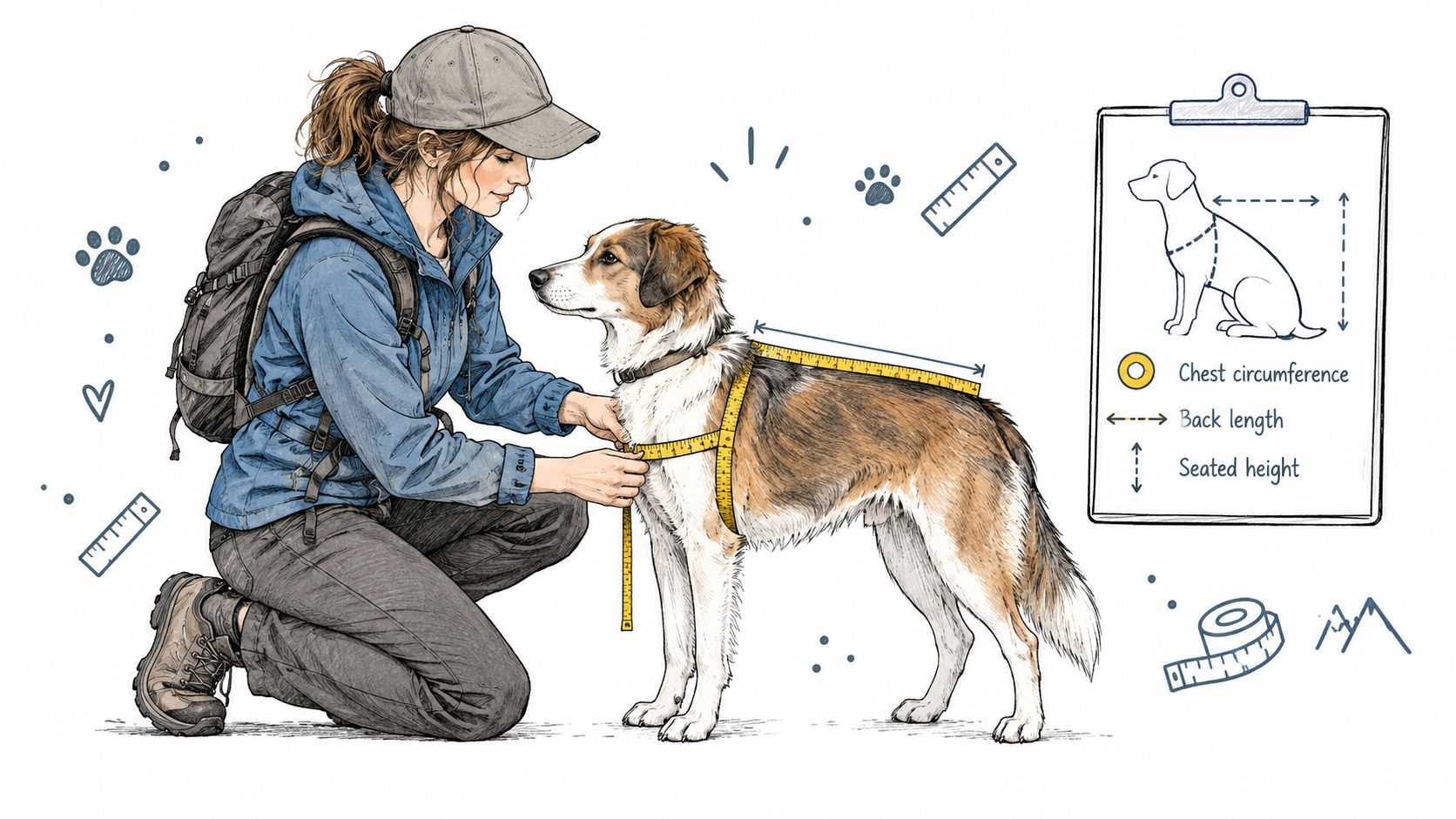
A carrier should be selected from the dog's measurements, not from a weight label alone. Measure back length from the base of the neck to the base of the tail , chest girth around the widest part of the rib cage, and seated height. Then compare those measurements with the carrier's internal size chart, as recommended in this dog backpack fitting guide.
Run the usable-space test
A usable carrier should let the dog sit, stand, turn around, and lie down without the head being forced against the top mesh. The body shouldn't slide laterally, and the dog shouldn't have to brace continuously to remain upright.
Check the base before checking the padding. A firm or semi-rigid floor is preferable because it limits sagging and supports a more level hip position. Soft, hammock-like construction may feel comfortable in your hand but can create instability once the dog's full weight rests inside.
Fit the torso straps so the carrier stays close to your back without compressing the dog or restricting breathing. The restraint should attach securely and allow limited movement without giving the dog enough slack to climb out. Test every closure while the dog is calm, then repeat the test after the dog shifts position.
Test in stages
Begin indoors. Let the dog enter voluntarily, keep the carrier empty of extra supplies, and watch whether the dog settles. Move to short walks before attempting a longer outing.
Stop immediately if you see:
- Rubbing: Repeated contact at the chest, legs, neck, or abdomen.
- Panting: Breathing that appears excessive for the effort or environment.
- Stumbling or short-striding: A sign that the dog or handler is moving poorly.
- Leaning: Persistent lateral shifting that suggests inadequate support.
- Reluctance to enter: A possible sign that the carrier feels threatening or uncomfortable.
These aren't harmless adjustment quirks. They indicate poor fit, excessive movement, stress, or unacceptable load distribution.
Use this short demonstration as a visual reference while checking dimensions and positioning:
Load Limits and Conditioning Realities
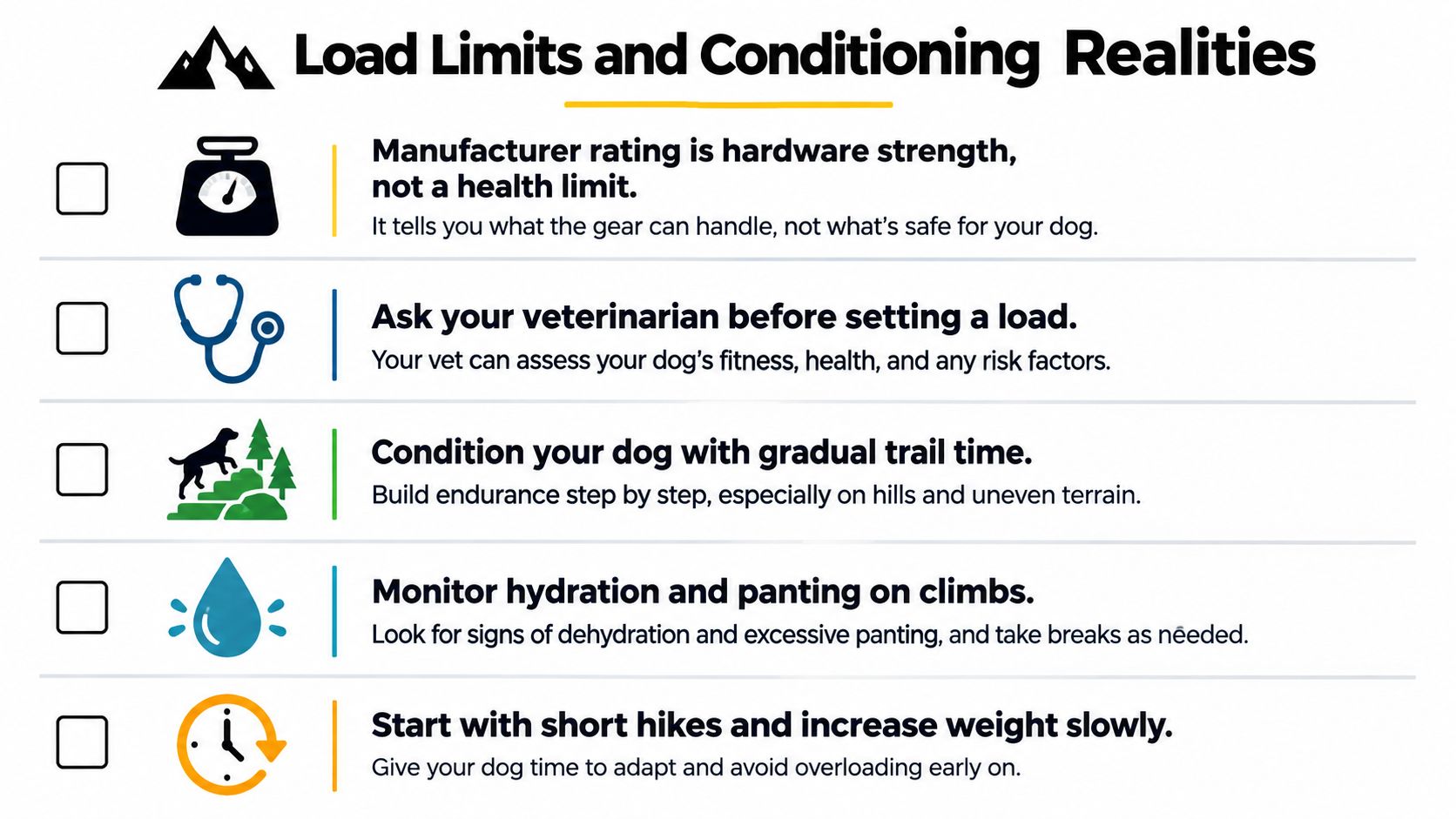
The most common carrier mistake is confusing hardware capacity with canine tolerance . A manufacturer's rating describes what the seams, straps, base, and closures are designed to support. It doesn't confirm that a particular dog can safely tolerate the load, remain cool, or recover well after the hike.
A conservative benchmark is to keep the dog's carried cargo, including the carrier and supplies, at or below approximately 10% of the dog's body weight unless a veterinarian approves otherwise ( American Kennel Club guidance). For a 50-pound dog, that means roughly 5 pounds total. For a 20-pound dog, it means roughly 2 pounds or less. The carrier itself uses part of that allowance.
Why the benchmark can be too high
A puppy, senior dog, overweight dog, or dog with orthopedic or respiratory disease may need a lower limit or no carried load at all. The same applies to a dog that hasn't been conditioned to wear equipment or one facing a long, steep, hot route.
Age, body structure, fitness, heat tolerance, and trip duration all change the decision. A strong-looking pack doesn't make an unconditioned dog ready for it.
Condition the dog, not the product
Start with the carrier empty. Add small amounts of weight only after the dog walks normally and settles without stress, then extend the duration gradually. The Denver Dog trail and fitness conditioning guide is a useful reference for building that routine without treating one successful walk as proof of readiness.
Keep a simple record before each outing:
- Dog weight: Use the current body weight, not an old estimate.
- Carrier weight: Include the empty pack.
- Cargo: Count water, food, clothing, and accessories.
- Duration: Record the planned time and actual time.
- Conditions: Note temperature, sun exposure, and terrain.
- Response: Watch gait, balance, panting, fatigue, and recovery.
Suspend use if the dog shows abnormal fatigue, heat stress, movement impairment, or breathing changes. A veterinarian should clear dogs before conditioning for extended terrain, especially when health history or body condition creates uncertainty.
Remember: Stronger straps mean stronger straps. They don't mean a safer load for the dog.
Heat, Microclimate, and When to Abandon the Carrier
A breathable-looking carrier can still become unsafe. Enclosed packs may trap heat, and internal temperatures can exceed ambient conditions, especially when direct sun, humidity, limited airflow, and the handler's body heat combine ( MedVet's hiking safety guidance).
Small dogs, flat-faced breeds, seniors, overweight dogs, and medically vulnerable dogs deserve the most conservative approach. A moderate-feeling morning can become a poor environment once the carrier is against the handler's back and the dog has limited ability to move away from warmth.
Use a decision matrix, not a single cutoff
Assess four factors together:
- Weather: Heat and humidity increase the burden on an enclosed carrier.
- Exposure: Direct sun can raise the carrier's internal heat load.
- Terrain: Steep climbs and slow, strenuous movement increase exertion.
- Dog risk: Age, body condition, breed structure, health, and conditioning change tolerance.
If two or more factors look unfavorable, skip the carrier or choose a cooler, easier outing. There isn't a universal temperature number that makes every dog safe. Shade, water, frequent breaks, and cooler activity periods reduce risk, but they don't eliminate it.
Monitor the dog continuously. Panting that settles during a shaded break may reflect exertion, while escalating panting, weakness, confusion, reluctance to move, or abnormal breathing requires immediate action. Move out of direct sun, cool the dog appropriately, and abandon the hike when the dog isn't recovering.
A practical guide to keeping dogs cool in summer can help owners prepare for warm-weather outings, but carrier users need an extra layer of caution. The dog may remain inside during a brief stop only if airflow, posture, and breathing are clearly normal. Otherwise, unload the dog into a safe, shaded area where it can stand and regulate position.
For local heat-risk planning, keep this Denver dog heat-stroke prevention guide available before choosing a route.
When to Carry Your Dog and When to Skip the Carrier
Conditioning matters more than gear. A premium carrier can't turn a novice dog into a trail-ready passenger, and it can't make a senior, overweight, brachycephalic, orthopedic, or respiratory-compromised dog suitable for carrying its own load.
For these dogs, consider a human-carried option, a shorter walk without a carrier, or no hike at all. A human-carried carrier removes the dog's carried cargo, but it still creates a combined load for the handler and can expose the dog to heat and confinement. It isn't an automatic solution.
Make the decision before the climb
Choose a dog-carried pack only when the dog has been measured, fitted, conditioned, and observed under comparable conditions. Choose human carry when the dog needs help but cannot safely bear additional equipment or when the terrain exceeds the dog's reliable walking ability.
Skip the carrier when the dog is already showing fatigue, has an unresolved health concern, or can't settle inside the pack. Steep terrain, a long duration, hot exposure, or slow recovery should move the decision toward a shorter route or an early exit.
Plan the exit before leaving the trailhead. Carry water, know where you can turn around, and decide which signs end the outing. A practical backpacking guide is useful for thinking through route logistics, but dog-specific decisions still depend on the individual animal.
Owners in Arvada, Denver, Englewood, Golden, Lakewood, Littleton, and Wheat Ridge can also arrange structured on-leash exercise through Denver Dog's local service area when a difficult trail isn't the right fit for the dog that day. For small-dog planning, this guide to hiking with a small dog offers another practical perspective.
The best decision may be leaving the carrier at home. A dog that walks comfortably, recovers normally, and enjoys the route is having a better outing than a dog being pushed past its capacity inside expensive equipment.
Final Checklist Before You Hit the Trail
At the trailhead, don't improvise. Run the same check every time:
- Fit: Confirm back length, chest girth, seated height, and free movement.
- Base: Press the floor and make sure it stays supportive rather than sagging.
- Restraint: Lock the tether and verify that the dog can't climb or twist out.
- Ventilation: Inspect every opening after the dog is loaded and the pack is worn.
- Load: Count the carrier and every supply within the dog's conservative allowance.
- Weather: Consider sun, humidity, terrain difficulty, and the dog's risk factors together.
- Stop criteria: Turn around for heat stress, abnormal panting, altered gait, stumbling, weakness, or refusal to move.
A successful indoor test doesn't clear the carrier for every trail. Recheck the dog during the outing, especially after climbs, exposed sections, and changes in weather. Conditioning, observation, and judgment matter more than upgrading to a stronger-looking pack.
The carrier is a tool. It isn't a substitute for fitness, gradual training, good trail choices, or a realistic plan for getting home.
Denver Dog offers structured, on-leash walking, running, and hiking support for busy pet parents who need safe weekday exercise without forcing an unprepared dog into a carrier. Visit Denver Dog to explore local services for your dog's energy level, temperament, and trail needs.
The Run Down