You're halfway up a Front Range climb on a warm Colorado afternoon. Your dog, who pulled eagerly from the trailhead, has slowed to a reluctant walk. The water bottle is nearly empty, the rocks are sharper than they looked from the parking lot, and a storm is building beyond the ridge.
That situation is preventable. Front Range hikes combine high altitude, fast weather changes, steep or rocky terrain, intense sun, wildlife, and busy multi-use trails . A dog that handles a neighborhood walk well may still need a different plan for Golden foothills, Denver trails, or higher routes near Lakewood and Littleton.
These dog hiking tips focus on decisions you can make before leaving the trailhead and adjustments you can make during the outing. You'll learn how to match a route to your dog's fitness, manage water and paws, use reliable control equipment, respond to heat and weather, pack for minor emergencies, recognize fatigue, and build endurance without overloading your dog. The same approach works whether you hike alone or book guided weekday outings with Denver Dog across Arvada, Denver, Englewood, Golden, Lakewood, Littleton, and Wheat Ridge. For another broad introduction, see this hiking with dogs guide.
1. Choose Appropriate Trails Based on Your Dog's Fitness Level
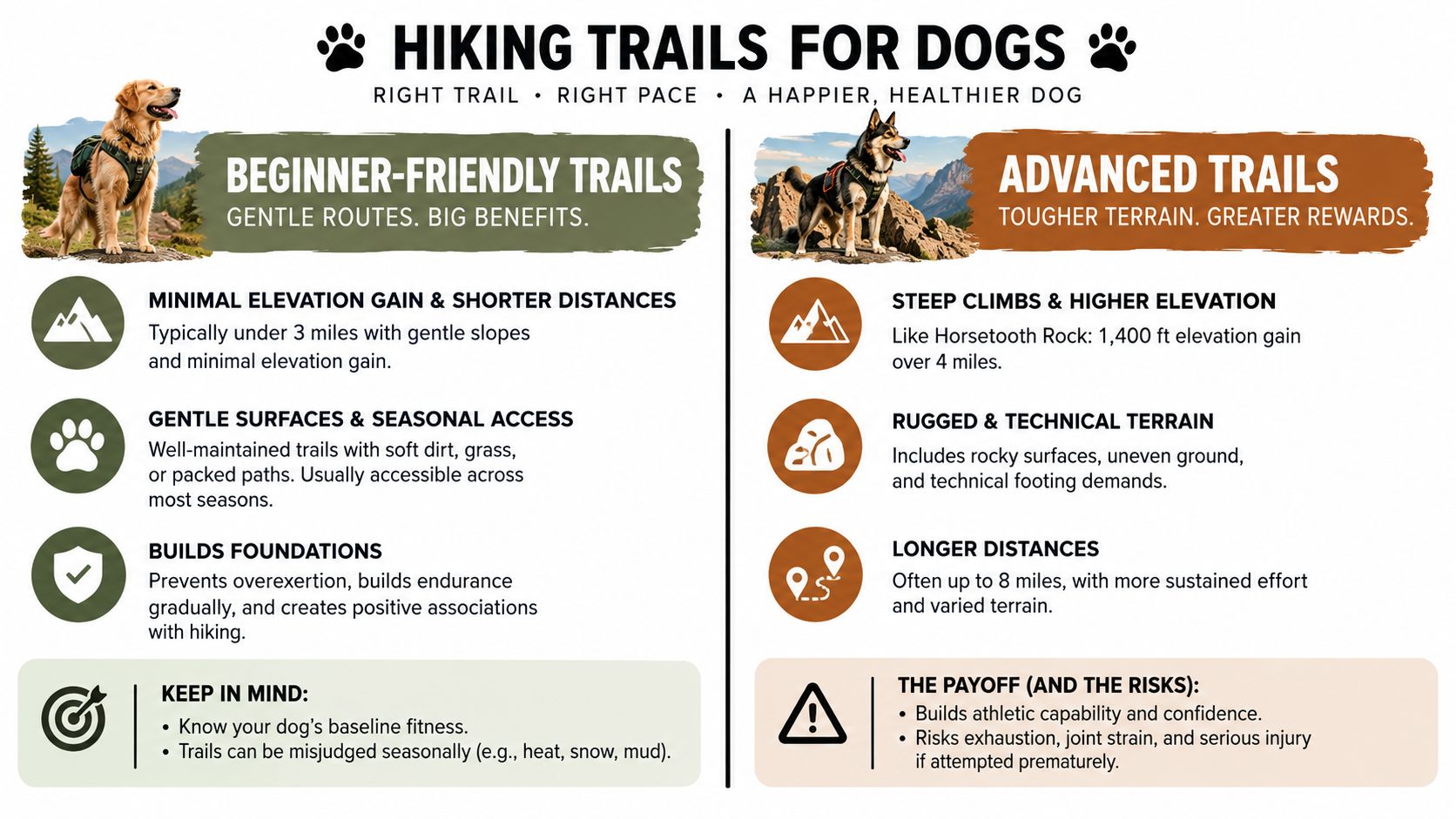
The right trail is the one your dog can finish comfortably, not the one that looks most impressive on a map. At the trailhead, assess distance, elevation, footing, weather, and turnaround options together. A flat route in Denver may suit a senior dog, while a young athletic Golden Retriever may be ready for a steeper foothills outing near Golden after proper conditioning.
Start with shorter, flatter trails when your dog is new to hiking. Watch breathing, pace, gait, and enthusiasm rather than relying only on breed expectations. A dog's age, body condition, medical history, temperament, and previous exercise routine matter more than a label such as “active breed.”
Match the route to the dog in front of you
A mixed-energy group in Lakewood or Littleton often does best on a short out-and-back route. The handler can turn around when the slower dog reaches its limit instead of forcing the entire group to complete a loop. A senior dog or a brachycephalic breed may be more comfortable on a gentle, relatively flat urban trail than on exposed rocky terrain.
A 2024 pilot study used a practical baseline of at least 2 kilometers twice per week , or approximately 4 kilometers of shared activity weekly , and reported improvements in owners' activity, sedentary time, dog body condition among slightly overweight dogs, and owner quality of life ( Scientific Reports). That finding supports consistency, not a universal distance prescription.
Trailhead decision: If your dog hasn't recently handled the planned distance, elevation, and surface, choose the easier route today and build from there.
Population activity data also show why one daily target cannot fit every dog. A 2025 study analyzed 8,726,606 days of activity records from 28,562 dogs . Average activity was about 51 active minutes per day , but individual dogs ranged from fewer than 10 minutes to more than 600 minutes ( Frontiers in Veterinary Science). Use your dog's normal activity as a starting point, then monitor recovery after each outing.
2. Maintain Proper Hydration and Bring Adequate Water
At a Front Range trailhead, water is a load-bearing decision. Don't assume a creek near Golden will solve the problem. Natural water can carry parasites or other contaminants, and a dog that drinks eagerly from a stream may still be taking in unsafe water. Bring treated water for both of you and offer it before your dog becomes desperate.
Colorado's elevation, dry air, sun exposure, and climbing can make a familiar walk feel harder. Panting increases fluid loss, and dogs can't cool themselves as efficiently as people. Start early when possible, especially for exposed trails near Denver, Golden, or Wheat Ridge, and plan shade and rest before the hottest part of the day.
Build a water plan around the route
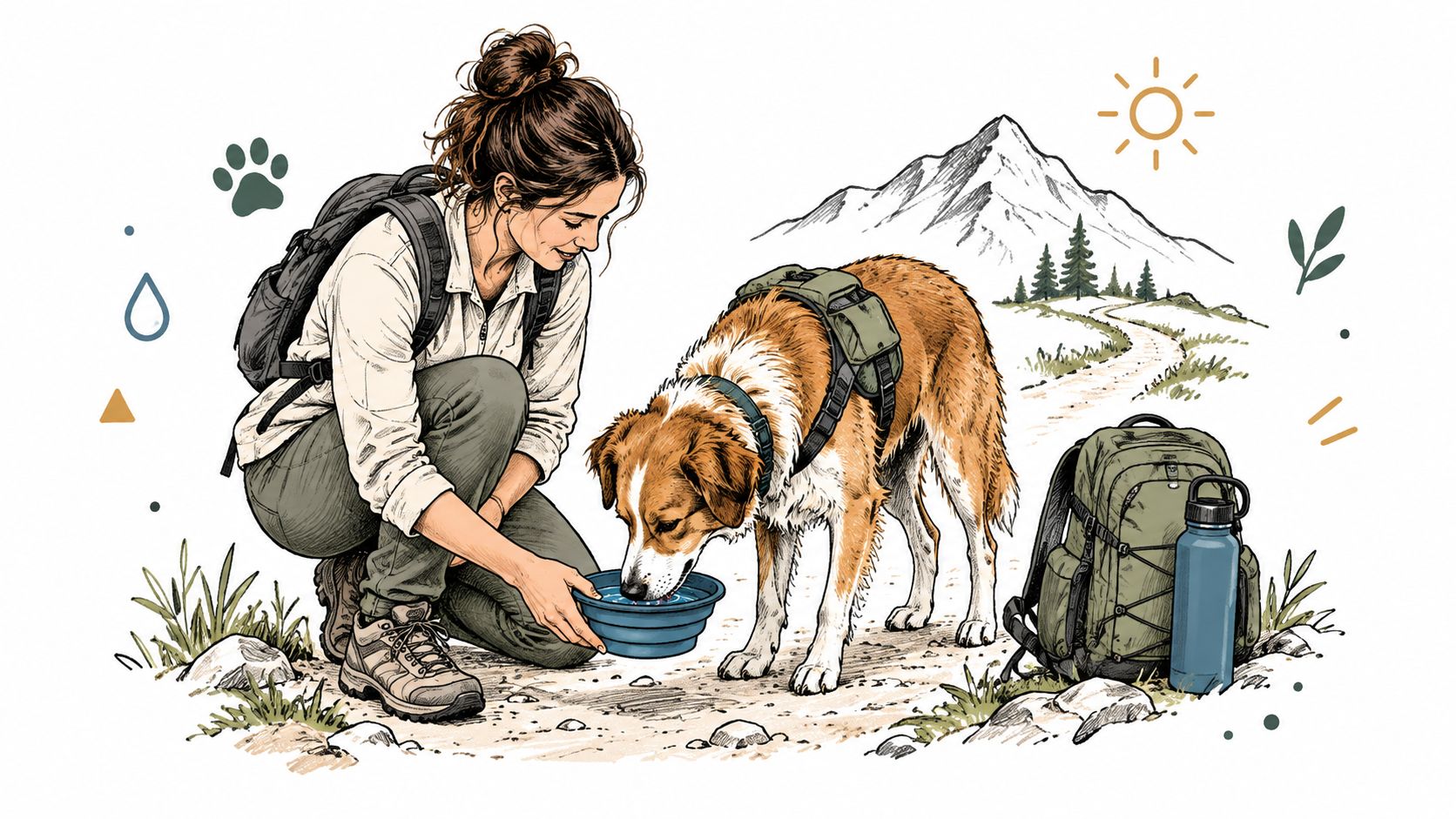
Carry enough water for the dog, the handler, and an unexpected delay. The exact amount depends on your dog's size, pace, weather, terrain, and hike length, so don't treat a generic container size as a guarantee. A collapsible bowl makes controlled drinking easier than pouring water onto the ground or asking your dog to drink from your hand.
Offer small drinks during regular pauses. If your dog is panting heavily, slowing down, or seeking shade, stop the hike and reassess instead of pushing toward a mileage goal. You can find more practical guidance on dog dehydration signs for Denver pet parents.
- Carry reserve water: Keep enough for a delay, a wrong turn, or a hotter-than-expected return.
- Use a bowl: A collapsible bowl reduces waste and lets you see how much your dog drinks.
- Treat streams cautiously: Don't rely on mountain water as your primary supply.
- Watch recovery: Resume only when breathing and behavior improve, not just because your dog has taken a drink.
The American Veterinary Medical Association recommends veterinary consultation before starting an exercise program, particularly for overweight dogs and brachycephalic breeds. Its warm-weather guidance also emphasizes cooler hours, frequent breaks, sufficient water, and watching for excessive panting, drooling, restlessness, unsteadiness, abnormal gum or tongue color, vomiting, or collapse ( AVMA warm-weather pet safety).
3. Protect Paws with Proper Conditioning and Paw Protection
Rocky Front Range footing changes the paw decision before you leave the parking area. A dog that walks comfortably on pavement may struggle on sharp gravel, loose stone, hot surfaces, or rough climbs. Winter adds another problem around Lakewood, Littleton, and Denver, where road salt and de-icing residue can irritate pads and cause painful licking after the outing.
Condition paws gradually. Short, frequent walks over varied surfaces build tolerance more reliably than one long hike followed by several sore days. Don't wait for a limp to tell you that the route was too much.
Inspect before, during, and after
Check pads, nails, and the spaces between toes before departure. Long nails can alter footing and make rocky descents less comfortable. Avoid a demanding hike immediately after a nail trim or while a paw injury is still healing.
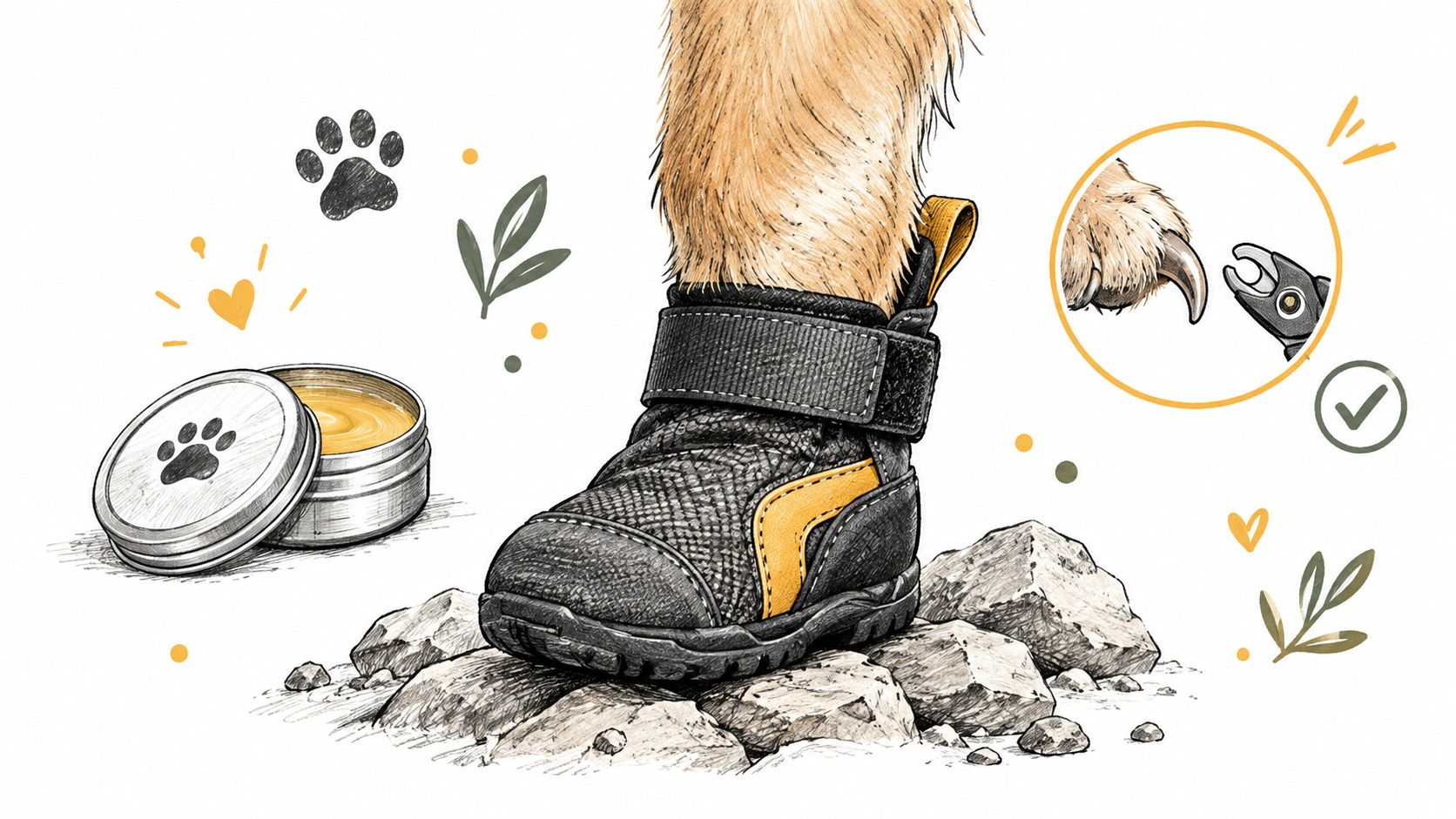
Booties can help on sharp or abrasive terrain, but they're not automatically better. Poorly fitted boots rub, twist, or make a dog change its gait. Test them at home first, then use them for short walks before committing to a longer trail near Golden or Englewood.
A boot that stays in the closet is not protection. Fit it, test it, and watch the gait before you need it.
After the hike, inspect for cuts, thorns, embedded grit, swelling, and excessive licking. Wash and dry paws after muddy trails or salty winter walks. Paw balm may help with cracking in Colorado's dry climate, but it won't repair an open wound or replace veterinary care.
A simple paw routine looks like this:
- Before departure: Check pads, nails, and between the toes.
- At the first rest: Look for lifting paws, altered steps, or repeated licking.
- At the vehicle: Wipe away grit, mud, and salt.
- At home: Recheck paws after your dog has cooled down and settled.
4. Use Proper Leashing and Control Equipment for Safety
A friendly dog still needs real trail control. Wildlife, cyclists, horses, children, steep drop-offs, and other dogs can appear with little warning. A reliable recall helps, but it doesn't replace a leash where regulations require one or where reaction time is limited.
Use a fixed six-foot leash as your standard. National Park Service guidance says dogs should remain leashed and separated from wildlife, while also emphasizing that rules can vary by trail and location ( National Park Service guidance on hiking with pets). Colorado state parks generally require dogs to remain under control and on a leash no longer than six feet. Chatfield State Park and Cherry Creek State Park have designated off-leash areas, but handlers must still carry a leash and at least one waste bag per dog ( Colorado state park regulations).
Fit the equipment to the dog
A powerful German Shepherd may need a properly fitted front-clip harness for better handling on Denver or Arvada trails. A nervous dog may do better with predictable leash tension and calm, consistent movement. Check for chafing, damaged clips, and worn stitching before leaving. Review this guide on how to fit a dog collar, and compare trail-ready dog harnesses before buying new equipment.
Before blind corners, narrow sections, or encounters with horses, shorten the leash. Move to the trail edge, keep your dog beside you, and let other users pass. Never allow chasing, access to carcasses, or contact with wildlife. Boulder Open Space also applies seasonal restrictions on some trails, including periods from May 1 through July 31 and August 15 through December 1 , so check route-specific rules before hiking there ( Boulder seasonal recreation guidance).
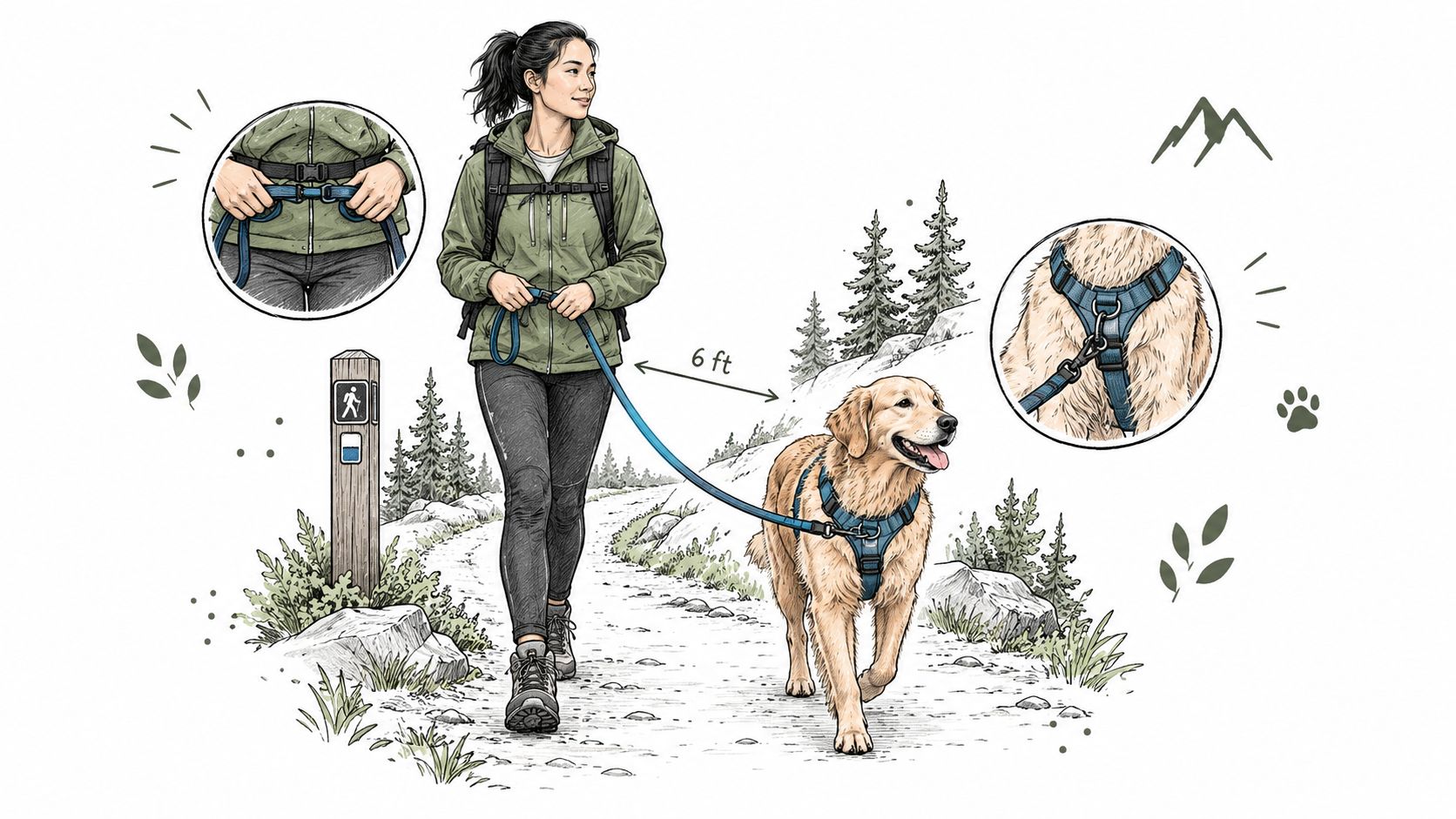
A hands-free system can be useful on moderate terrain, but it reduces your ability to react quickly if the dog lunges. Keep a direct grip available on steep sections or busy trails.
5. Apply Sun Protection and Weather-Appropriate Gear
At elevation, a comfortable morning can become a hot, exposed afternoon. Front Range weather can shift quickly, and summer storms may arrive after a clear start. At the trailhead, check the forecast, radar, wind, temperature trend, and route exposure. If the hike offers no easy exit and storms are building, postpone it.
Light-colored coats, thin fur, and exposed skin need extra attention. Use a dog-safe sunscreen that doesn't contain zinc oxide on vulnerable areas such as the nose and ear tips, but follow veterinary guidance for your dog's skin and product choice. Reapply according to the product directions rather than treating one application as protection for the entire outing.
Choose gear that solves a real problem
A lightweight reflective vest can improve visibility on crowded or dim trails. A rain jacket may help during a brief shower, but it won't make lightning, hail, or a rapidly cooling ridge safe. An extra layer belongs in the pack when elevation and wind can change your dog's comfort quickly.
Use a cooling vest only if your dog tolerates it and the product remains comfortable. Gear should support good decisions, not justify hiking through unsafe conditions. Shorten the route when your dog is heat-sensitive, overweight, very young, senior, or brachycephalic.
Heat illness can develop during exercise even when the air temperature doesn't seem extreme. Exercise was the recorded trigger in 74.2% of canine heat-illness events with a known trigger in a large UK veterinary-record study cited by recent safety guidance ( Front Range dog hiking safety guidance). The practical response is to stop early, move to shade, cool your dog, and seek veterinary attention if signs are severe or persistent. Review this Denver dog heat-stroke prevention guide before a warm-weather hike.
6. Pack Essential Supplies and Maintain First Aid Readiness
A first-aid kit won't turn you into a veterinarian, but it can help you manage a minor problem while you leave the trail. At the trailhead, check that your pack includes supplies for cuts, thorn punctures, ticks, wrapped paws, and an unexpected delay. Pack items that are light, familiar, and easy to reach.
Bring gauze, antiseptic wipes, bandages, tweezers or a tick remover, prescribed medication, waste bags, and a collapsible bowl. Carry identification details and a current photo of your dog. Make sure tags are readable and microchip registration information is current before entering a busy or unfamiliar area.
Pack for the return, not just the summit
A headlamp, emergency blanket, and charged phone can matter if a slow dog, wrong turn, injury, or storm delays the return. Save the location of an emergency veterinary clinic near the route before cell service becomes unreliable. A protein-rich treat can help maintain routine on a longer outing, but food won't fix heat illness, injury, or exhaustion.
Give treats based on your dog's normal diet and tolerance. Don't introduce a new supplement on a demanding hike. Electrolyte products also need veterinary consideration because human formulations may not suit dogs.
- Treat minor wounds: Carry gauze, antiseptic wipes, and secure bandages.
- Prepare for separation: Keep ID information and a recent photo accessible.
- Plan for darkness: Pack a headlamp even when the hike begins in daylight.
- Protect the environment: Keep waste bags easy to reach and pack out every deposit.
- Check before leaving: Replace used, wet, expired, or damaged supplies.
For owners who want formal wilderness medical education, you can find WFR course options for nurses. A course can improve decision-making, but it doesn't replace veterinary advice or emergency care.
7. Monitor and Recognize Signs of Fatigue and Stress
At a Front Range trailhead, the key call is simple. Is your dog moving and responding like your dog, in these conditions, today? A fit dog can still struggle when Denver altitude, dry air, heat reflecting off rock, or a fast weather swing changes the workload.
Watch for a change in pattern, not just one dramatic sign. A dog that usually pulls uphill with purpose but starts hanging back, stopping often, drifting off the trail, or ignoring a familiar cue is telling you the hike has become harder than expected. On exposed routes, that change can show up early. On steep descents, it may not show up until the legs are already tired.
Use recovery, not mileage, as your rule
Stop where your dog can actually recover. Pick shade, move off hot rock, and wait long enough to see whether breathing slows, posture softens, and focus returns. Check gait when you start again. Check gum color as part of the picture too. Healthy gums are generally pink. Pale or white gums can point to a serious problem that needs immediate attention.
Heavy panting that does not settle, thick drool, limping, stumbling, unusual withdrawal, vomiting, abnormal gum or tongue color, or collapse all mean the plan needs to change. At the trailhead, that may mean choosing a shorter loop. Mid-hike, it usually means turning around.
I use one rule on mountain routes. If a short rest, cooler air, and less effort do not bring my dog back toward normal quickly, the hike is over.
The turnaround point is when your dog stops recovering normally, not when the map says you've done enough.
Keep watching after the drive home. Soreness, limping, vomiting, diarrhea, poor appetite, or unusual breathing can show up later, especially after rocky descents or winter outings where cold and road salt added stress earlier in the day. If recovery looks off or symptoms continue, call your veterinarian.
8. Schedule Appropriate Rest Days and Build Fitness Progressively
A dog that handled a flat park loop in Denver last week may struggle on a higher Front Range trail today. Altitude, loose rock, heat, and afternoon weather shifts change the workload fast. At the trailhead, decide whether this is a conditioning day, a maintenance outing, or a recovery day. That choice matters more than chasing a longer route.
Conditioning comes from repeated effort followed by enough recovery. Dogs need time to adapt through muscle, joint, paw, and confidence gains. A young Border Collie might grow into tougher mountain routes, but the right move is still to build up in stages instead of jumping from neighborhood walks to a long, steep climb.
Start with manageable outings. Then increase one demand at a time: distance, elevation, terrain difficulty, or pace. That makes it easier to spot what caused stiffness, fatigue, or tender paws when you get home. I like a simple log with route, surface, weather, behavior, paw condition, and next-day recovery. In Denver and along the Front Range, it also helps to note altitude, storm timing, and whether winter road salt or hot trail surfaces added stress.
Build a weekly rhythm
New hikers often do well with 2 to 3 structured hiking sessions per week , with easy walks or rest between harder efforts. A senior dog may do better with shorter, gentler outings and steady neighborhood movement instead of a schedule built around mileage. Rest days still count. Sniff walks, easy movement, and calm play keep routine without adding another hard effort.
Be careful with the 10% weekly increase rule. It shows up in common training advice, but dogs do not adapt on the same timetable. Age, body condition, health, breed traits, footing, and altitude all change the right pace. If recovery slips, scale back.
- Change one variable: Add distance or elevation, not both on the same week.
- Track recovery: Watch how your dog moves later that day and the next morning.
- Vary the week: Mix easy trails, neighborhood walks, and other tolerated activity.
- Protect rest: Skip another demanding hike if soreness is still present.
- Ask your veterinarian: Get clearance before a major increase, especially for overweight, senior, brachycephalic, or medically complicated dogs.
Denver Dog service options can help busy owners keep exercise more consistent across Arvada, Denver, Englewood, Golden, Lakewood, Littleton, and Wheat Ridge. The key decision stays the same. Match the outing to the dog in front of you, the trail conditions that day, and how the last hike went.
8-Point Dog Hiking Tips Comparison
| Item | 🔄 Implementation Complexity | ⚡ Resource Requirements & Efficiency | 📊 Expected Outcomes | 💡 Ideal Use Cases | ⭐ Key Advantages |
|---|---|---|---|---|---|
| Choose Appropriate Trails Based on Your Dog's Fitness Level | Moderate, requires assessment and trail research | Time for evaluation; access to trail info; possible pro consultation | Safer, matched-difficulty hikes; gradual endurance gains | New hikers; mixed-fitness groups; route selection per dog | Prevents overexertion; tailored experiences |
| Maintain Proper Hydration and Bring Adequate Water | Low, routine planning and monitoring | Water (e.g., 2–3 L per medium dog/5 mi), bowl, filter/electrolytes | Reduced heat risk; sustained performance and recovery | Warm or high-altitude hikes; long-distance outings | Prevents heat stroke; maintains endurance |
| Protect Paws with Proper Conditioning and Paw Protection | Moderate, progressive conditioning and gear fitting | Booties, paw balm, grooming tools, cleaning supplies | Fewer paw injuries; improved comfort and mobility | Rocky terrain, hot pavement, winter salted trails | Prevents sores; enables continued hiking with minor injuries |
| Use Proper Leashing and Control Equipment for Safety | Low–Moderate, select, fit, and practice with equipment | Leash/harness options (6-ft, long-line, hands-free); reflective gear | Better control; compliance with trail rules; fewer wildlife incidents | Crowded trails, wildlife zones, reactive or strong dogs | Prevents loss/chasing; immediate hazard response |
| Apply Sun Protection and Weather-Appropriate Gear | Low, apply products and pack seasonal gear | Dog-safe sunscreen, cooling vests, rain jackets, extra layers | Reduced sunburn/heat incidents; improved comfort across conditions | High-altitude sun exposure; light-coated or thin-furred dogs | Prevents skin damage; extends usable hiking seasons |
| Pack Essential Supplies and Maintain First Aid Readiness | Moderate, assemble and maintain kit; learn basics | Canine first-aid kit, ID, GPS/phone, treats, emergency blanket | Rapid response to injuries; lower escalation of incidents | Remote trails, long outings, multi-hour hikes | Preparedness reduces risk and owner stress |
| Monitor and Recognize Signs of Fatigue and Stress | Low–Moderate, continuous observation and baseline knowledge | Training to recognize signs; water and rest options | Early intervention; fewer health emergencies | All hikes, especially hot/steep or unfamiliar routes | Protects health; preserves positive hiking experiences |
| Schedule Appropriate Rest Days and Build Fitness Progressively | Moderate, plan progressive schedule and rest | Time commitment, tracking (journal), varied cross-training | Improved endurance; reduced overuse injuries | Training programs; working/athletic breeds; long-term fitness goals | Sustainable fitness gains; long-term joint health |
Turn These Eight Tips Into Your Next Trailhead Routine
Safe dog hiking is a chain of small decisions. At the trailhead, first ask whether the route fits your dog's current fitness, age, health, and temperament. Then check the forecast and surface conditions. A shorter, flatter route is the right choice when the weather is changing, paws are tender, or your dog has not recovered from the previous outing.
Pack water for the dog and handler, plus a reserve for delays. Bring a collapsible bowl and don't rely on streams near Golden or elsewhere along the Front Range. Check the leash, harness, collar, tags, and booties before moving away from the vehicle. A fixed six-foot leash provides predictable control around wildlife, horses, cyclists, and crowded trail sections, while route-specific rules determine whether any off-leash access is legal.
Paw checks belong at both ends of the hike. Look for cuts, grit, swelling, salt irritation, and damaged nails before departure, then inspect again after the dog cools down. Weather checks also continue during the outing. Colorado's afternoon storms, intense sun, wind, and temperature changes can make a route unsafe even when the morning forecast looked favorable.
Fatigue monitoring is the final safeguard. Watch gait, breathing, gum color, focus, posture, and willingness to continue. Stop before your dog reaches visible distress. A rest break should improve recovery. If it doesn't, turn around, cool your dog when needed, and contact a veterinarian for concerning or persistent signs.
Write a one-page trailhead checklist before your next outing. Include the planned route, water, first aid, leash and paw gear, forecast, emergency veterinary contact, and your dog's normal recovery signs. Keep the list in the hiking pack so preparation becomes routine rather than something you try to remember while loading the car.
Denver Dog serves Arvada, Denver, Englewood, Golden, Lakewood, Littleton, and Wheat Ridge with weekday on-leash walking, running, and guided hiking services. Owners who prefer structured trail outings can review the available Denver Dog service options and choose care that matches their dog's energy level and temperament.
Denver Dog provides weekday on-leash walks, runs, and guided hikes for busy owners who want their dogs to exercise safely and consistently across the Denver Metro area. Visit Denver Dog to review service options and plan structured outdoor time around your dog's fitness, leash control, hydration, and recovery needs.
The Run Down