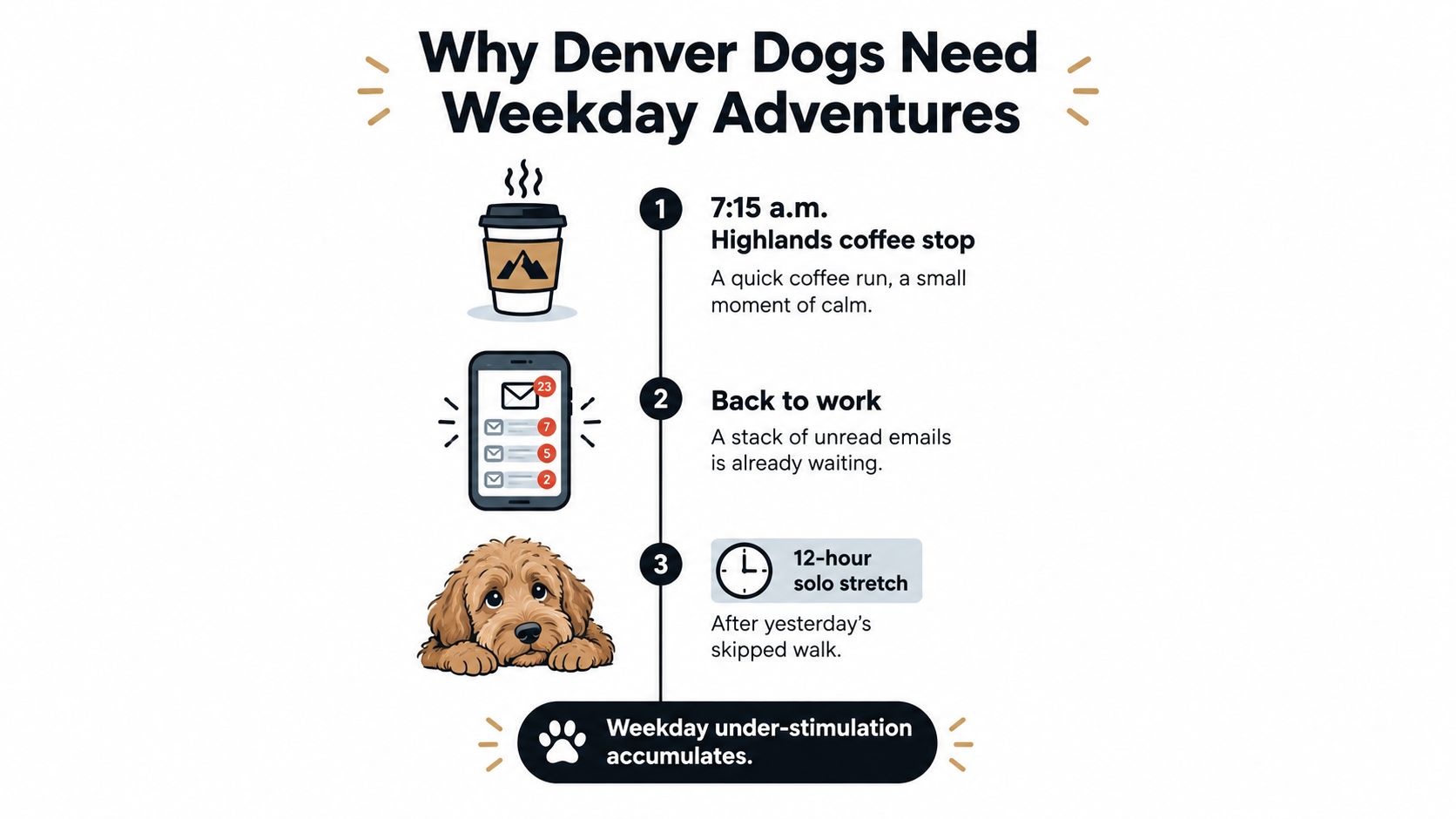
A 7:15 a.m. coffee in Highlands, a phone filling with unread emails, and a Labradoodle watching you leave for another long workday is a familiar Denver scene. Yesterday's walk was skipped, today's schedule is packed, and your dog is heading toward a long stretch with no meaningful movement, sniffing, or change of scenery.
By late afternoon, the symptoms show up. Your dog counter-surfs, pulls toward every distraction at the park gate, or launches into evening zoomies just when the household needs to settle. A neighborhood loop helps, but it doesn't replace sustained exercise and enrichment. Denver dog hikes work best when they become part of the weekday structure, not an occasional reward.
Why Denver Dogs Need Weekday Adventures
Denver gives dogs plenty of outdoor access, but access alone doesn't create a useful routine. A dog living around LoDo, Cap Hill, or Wash Park may get pavement, sidewalks, and a familiar loop while still missing the elements that make an outing physically and mentally satisfying: continuous movement, grade change, sustained sniffing, and new trail information .
The problem is especially obvious with athletic or high-energy dogs. A short morning walk may take the edge off, but it won't necessarily meet the needs of a dog expected to spend much of the day alone. When that unused energy carries into the evening, owners often experience the result as “bad behavior” rather than a predictable gap in the dog's schedule.
The weekday problem is larger than exercise
Unspent energy can change how a dog handles ordinary situations. A dog that normally passes calmly may become tense around cyclists, bark at dogs near a gate, or struggle to settle after dinner. A new or recently adopted dog may also need predictable exposure to different surfaces, sounds, handlers, and trail environments.
Colorado has a particularly large potential customer base for dog exercise services. Approximately 47% of Colorado households owned a dog , according to a 2025 Larimer County public-information notice citing national pet-ownership data. That figure doesn't prove that every household needs a paid hiking service, but it does show why structured dog recreation is a substantial part of the state's pet-care market.
Practical rule: If your dog is physically healthy but consistently arrives at bedtime unable to settle, examine the weekday routine before buying another toy.
A structured hike changes the shape of the day. It gives a dog a defined period of movement and investigation, then creates a better chance of calm during the hours when the owner is working. The right service doesn't just add distance. It matches the dog's energy, confidence, and leash behavior to a route that a handler can control.
For a deeper explanation of the role exercise plays in routine and behavior, see this guide to why dogs need exercise. The useful question isn't whether your dog likes hiking. Most dogs do. The useful question is whether your dog needs a reliable weekday adventure that your calendar can't provide.
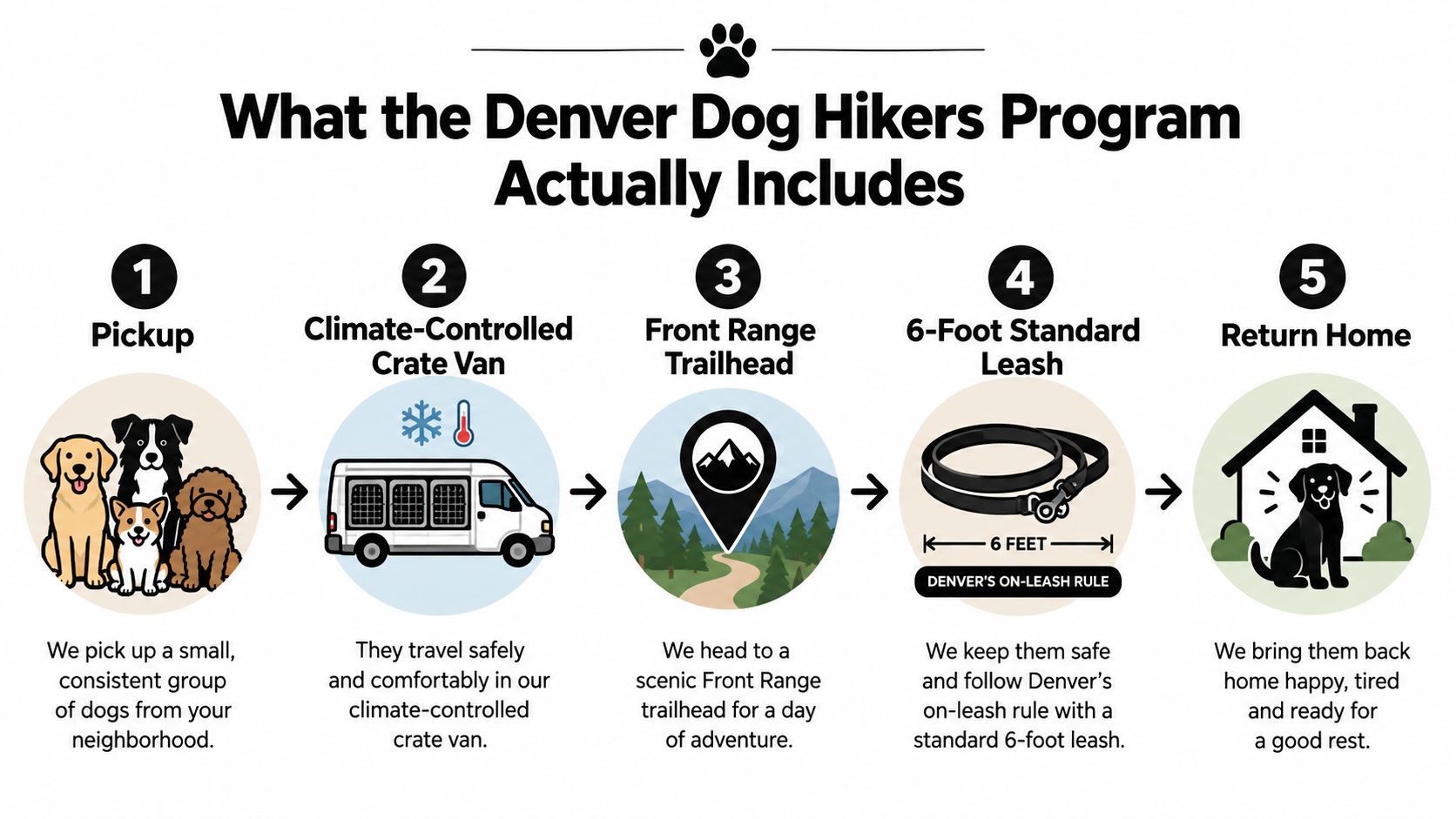
What the Denver Dog Hikers Program Actually Includes
A professional weekday hike should be easy to describe from the owner's point of view. The dog leaves home, travels safely to an appropriate Front Range route, hikes under physical control, and returns home with the owner receiving enough information to understand how the outing went.
The service is not just a longer dog walk. It combines scheduled weekday transportation, group management, trail selection, controlled hiking, and a return-home handoff . Small-group hiking can also provide social exposure, but the group should never take priority over a dog's safety or ability to follow the handler.
What the owner should expect
The operational backbone is Denver's leash rule. Dogs on city trails and park roads must be restrained by a leash no longer than six feet , while off-leash running is limited to officially designated dog-park areas. The Denver park regulations also require the handler to maintain physical control.
That rule should shape equipment, route choice, and staff behavior. A hiking service shouldn't treat a general trail like an off-leash field, even when a dog is friendly or has a strong recall. A standard six-foot leash gives the handler a consistent physical boundary around cyclists, runners, horses, wildlife, and unfamiliar dogs.
A clear service description should answer these questions before booking:
- Pickup and return: Is the dog collected at home and brought back after the trail outing?
- Group format: How many dogs travel together, and how are dogs paired by confidence and behavior?
- Trail discipline: Are all public-trail outings managed on leash, without mixing trail hiking and dog-park privileges?
- Owner communication: Does the report cover the dog's behavior, water intake, and general condition?
- Owner equipment: Does the dog arrive with a properly fitted harness, current health information, and effective tick prevention?
This is different from daycare, where the main value is supervised group time in one facility. It is different from a solo neighborhood walk, which may offer focused handling but limited trail immersion. It is also different from pet sitting, which provides presence without necessarily providing sustained physical work.
The practical test is the invoice and the handoff. You should know whether you're paying for transportation, trail time, handling, and communication, rather than receiving a vague promise of “adventure.”
Safety Protocols and Handler Vetting
Safety isn't one feature. It is a chain of decisions that begins before pickup and continues until the dog is back inside the home.
Start with the handler. A credible hiking service should explain how it evaluates staff, how it tests canine-handling judgment, and how it responds when a dog becomes frightened, overexcited, or reactive. Background checks matter, but they don't replace behavioral interviews, supervised trail work, and repeated training on leash handling.
The handler-qualification checklist for pet owners is useful because it turns vague reassurance into questions you can actually ask.
Three layers worth inspecting
Layer one is people. Ask whether handlers understand stress signals, can separate dogs safely, and know when a planned outing should be shortened. A handler who only knows how to keep a group moving may miss the early signs of fatigue or escalation.
Layer two is transport. Dogs need secure individual spaces, appropriate ventilation, and a vehicle setup that prevents loose movement during travel. Camera monitoring can give owners visibility into driving and transport conditions, while crate assignments should account for size, temperament, and tolerance of close quarters.
Layer three is trail control. The handler should use physical restraint consistently, select routes that fit the group, and have a defined response when a dog pulls, freezes, redirects, or tries to leave the trail. Redundancy in equipment and a clear pickup plan are more useful than a promise that every dog will behave perfectly.
| Safety Layer | Denver Dog Hikers Program | Typical Neighborhood Walker |
|---|---|---|
| Handler preparation | Behavioral screening, supervised trail practice, and ongoing canine-handling training should be inspectable | Preparation may focus on basic walking rather than trail-specific group control |
| Transportation | Secure, climate-controlled transport with individual dog management and owner visibility where available | May involve a personal vehicle, shared vehicle, or no transport |
| Trail handling | Six-foot leash compliance, route matching, and defined responses to escalation | Usually limited to neighborhood streets and familiar park loops |
| Group decisions | Dogs can be matched by energy, confidence, and leash behavior | Group composition may change with each visit |
| Owner responsibility | Full disclosure of reactivity, bite history, triggers, and medication needs | Owners may receive less formal intake questioning |
The comparison isn't about making a neighborhood walker sound careless. A simple walk can be exactly right for a dog that needs one-to-one attention. A trail program carries different risks, so it needs different controls.
Owners also have a duty to be direct. Disclose bite history, guarding, fear of cyclists or horses, medication, recent illness, and any trigger that could change a handler's decision. A service can only create a safe match when it has accurate information.
Front Range Trail Types and Route Selection
The best route is rarely the one with the biggest view. It is the route where the dog can move, sniff, and recover without forcing the handler into constant crisis management.
Front Range outings can be grouped into practical route types. Each one suits a different dog and creates different handling demands.
Match the trail to the dog
| Trail Archetype | Example Routes | Best-Fit Dog Type | Key Handler Constraint |
|---|---|---|---|
| Wide, busy greenways | South Platte and Bear Creek paths | Sociable dogs that can ignore passing runners and cyclists | The handler must manage frequent passes and keep the dog close |
| Rolling foothill singletrack | Apex, lower Green Mountain loops, and Mount Falcon's east trail | Confident dogs with reliable leash behavior and comfort around changing terrain | Narrow tread and grade changes leave less room for passing |
| Open-space mesa routes | Mesa routes above Golden | Dogs that remain responsive when scenery, wildlife, and open space increase stimulation | The handler must understand where physical restraint is required and never confuse open space with an off-leash area |
| Shaded creek corridors | Lower Waterton Canyon and Platte Canyon | Heat-sensitive, senior, or less-conditioned dogs that still enjoy outdoor movement | Rocky footing and water access require regular checks |
The order of decision-making matters. Choose for leash reactivity first , crowd density at departure second, and elevation tolerance third. A high-energy dog that reacts to bikes may get better exercise on a predictable, lower-conflict path than on a remote route filled with horses, narrow ledges, or blind corners.
Denver's general park guidance applies even to gentle, well-trained dogs. The official park rules and policies make physical control the foundation, not an optional upgrade for difficult dogs.
A dog doesn't need the most dramatic trail. It needs the trail where the handler can keep the dog successful.
Route selection should also account for exit options. A handler should know where to shorten an outing, turn around, move away from a conflict, or leave the trail if weather changes. Pre-walking routes and rotating groups can reduce predictable conflicts and limit pressure on fragile trail segments.
Use destination lists as starting points, not prescriptions. This Denver hiking guide for dogs can help identify possibilities, but your dog's temperament should make the final decision.
Heat, Weather, and the Modify Substitute Cancel Matrix
Temperature alone is a poor hiking decision tool. The dog's coat, airway shape, body condition, age, fitness, acclimation, shade, humidity, surface, and pace all matter.
Exercise is the major danger signal. A veterinary-record analysis found 1,259 heat-related illness events among more than 900,000 dogs , and exercise accounted for 74.2% of cases with a known trigger , with walking the most commonly recorded exercise. Those figures are detailed in this dog-hiking safety and conditioning guide.
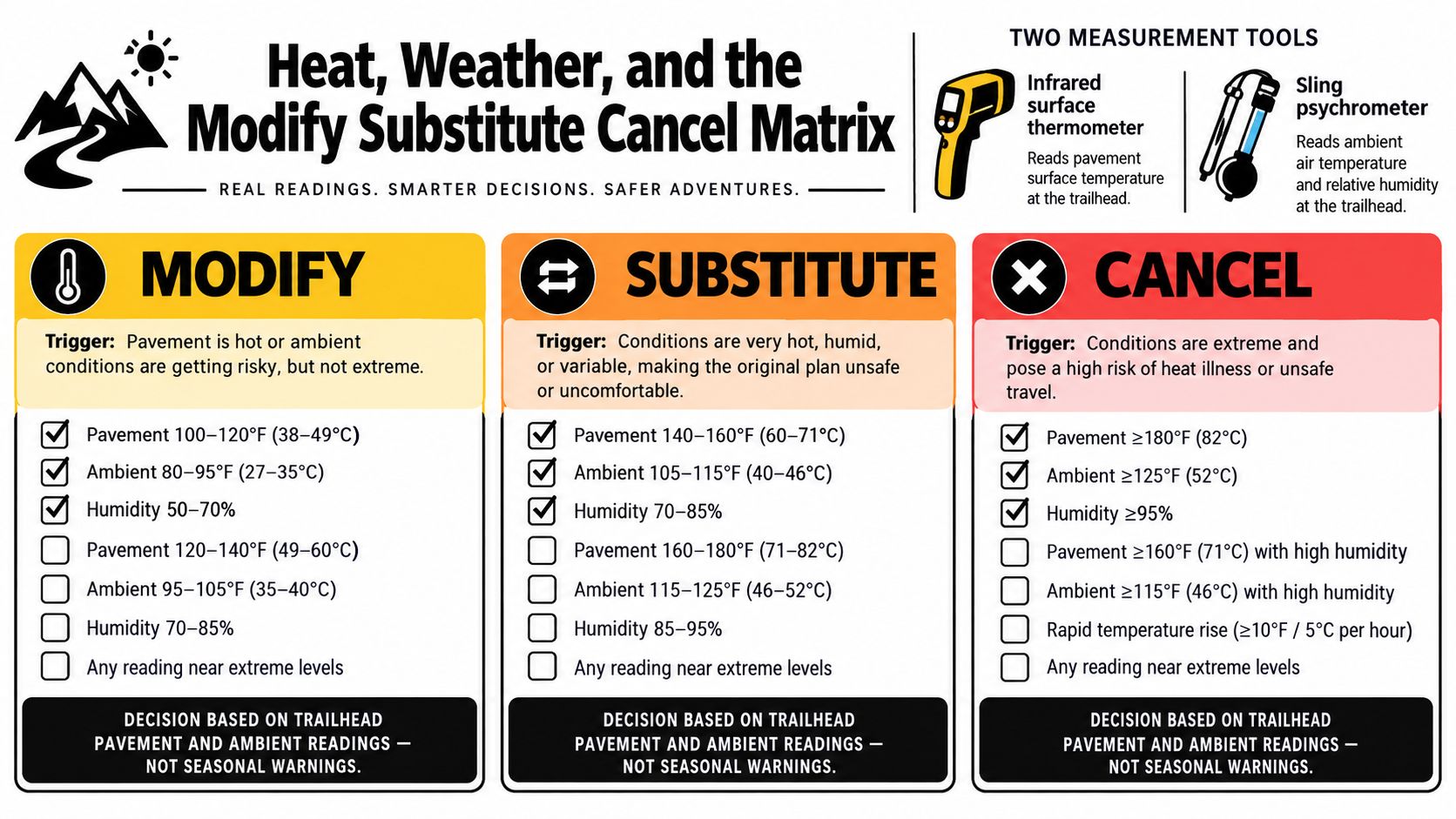
Use three decisions
Modify when the dog can still exercise safely but the original route is too exposed or demanding. Choose more shade, reduce the workload, add water and rest stops, and build in a short exit. Don't wait for collapse. Sustained heavy panting, unusual lagging, gait changes, weakness, vomiting, poor coordination, or collapse should end the outing.
Substitute when the dog needs a different environment. Replace an exposed climb with a cooler, shaded route, especially for brachycephalic, overweight, giant, very young, senior, or poorly conditioned dogs. A shorter outing on a forgiving surface can provide better enrichment than a long route that pushes cooling capacity.
Cancel when official alerts, wildfire closures, lightning, or trail conditions make the outing unsafe. Rescheduling is the correct decision when the handler can't guarantee a reasonable route, reliable shade, or a quick way out.
The Denver Dog hiking schedule provides one concrete example of weather-based planning. Mountain-hike pickups are listed between 6:30 a.m. and 9:00 a.m. , with drop-offs between 1:30 p.m. and 3:30 p.m. The stated hiking range is 15°F to 80°F , and hikes are capped at 60 minutes when temperatures exceed 80°F , as described in the company's hiking service FAQ.
Check closures, wildfire conditions, and the forecast before departure. Then check the dog, the route, and the surface again at the trailhead.
Booking Logistics, Pickup Windows, and Pricing
A weekday hike only solves the owner's problem if the logistics are dependable. Before reserving, confirm the pickup area, access method, expected return window, group format, weather policy, and what happens when your dog isn't a fit for the planned route.
Service coverage includes Arvada, Denver, Englewood, Golden, Lakewood, Littleton, and Wheat Ridge . Owners can review those neighborhoods on the Denver Dog service-area page.
Ask about the parts that affect your workday
The published hiking schedule lists morning pickups between 6:30 a.m. and 9:00 a.m. , followed by afternoon drop-offs between 1:30 p.m. and 3:30 p.m. Those windows are useful planning anchors, but you should still confirm the expected timing for your address and route.
Pricing information should be equally clear. If a provider doesn't publish a rate for your planned adventure, ask whether the charge is based on the outing, distance, transport, group size, or add-ons. Ask about cancellation terms and whether a weather cancellation becomes a credit or a lost booking.
A simple booking checklist prevents most weekday surprises:
- Confirm the address: Make sure the service covers your neighborhood and can access the home reliably.
- Prepare entry instructions: Provide a key, lockbox, or agreed access method, then explain where the dog's harness and records are kept.
- Describe the dog accurately: Share reactivity, medical needs, mobility limits, and past trail behavior.
- Clarify the return: Ask whether the dog receives water, a towel-off, or a written outing report.
- Check weather handling: Find out who decides to shorten, substitute, or cancel the hike.
For operators and managers comparing scheduling systems, top dog walking software can be a useful resource for understanding how route assignment, client records, and recurring bookings may be organized. Owners don't need the software itself, but they do deserve the reliability that good scheduling processes create.
Don't book a trail service as though it were an on-demand neighborhood walk. Reserve recurring weekday space when possible, keep your access instructions current, and use the intake call to establish a route and dog match before the first full outing.
Is This Program Right for Your Dog
A good candidate is not just a dog that loves running. The dog should tolerate a harness and leash, recover from ordinary distractions, and remain manageable around other dogs and people. Social, medium-to-high-energy dogs with a stable routine and a willingness to travel often adapt well to structured group hiking.
A different service may be safer for a dog with severe reactivity, resource guarding, intense fear of unfamiliar dogs, or small-dog anxiety in mixed groups. That doesn't mean the dog can't become a hiker. It means the first step may need to be private handling, gradual exposure, or shorter outings rather than immediate group trail work.
What the first week should answer
The first outing should establish information, not prove endurance. A handler should learn how the dog loads, travels, responds to the group, manages passing encounters, and settles after returning home.
Owners should watch the dog that evening for:
- Normal recovery: The dog relaxes, drinks normally, eats normally, and returns to its usual behavior.
- Excessive fatigue: The dog remains unusually weak, unsteady, distressed, or unwilling to move.
- Water and appetite changes: A marked change deserves a call to the provider and, when appropriate, a veterinarian.
- Behavioral feedback: The owner should know whether the dog was confident, overwhelmed, social, avoidant, or difficult to redirect.
Shy dogs may settle when the handler uses a predictable pace and a compatible group, but they shouldn't be forced into close interaction. Puppies need conservative exposure and careful conditioning, especially on routes with elevation or difficult footing. An active senior dog may still enjoy a trail, but the outing should be selected around recovery, mobility, shade, and exit options rather than pride in covering distance.
The right next step is simple: schedule a short intake call or trial hike and ask the handler to confirm the dog's group and route match before committing to a recurring weekday schedule.
Denver Dog offers weekday on-leash runs, walks, and guided hikes designed around a dog's energy level and temperament, with service coverage across the Denver metro area. Visit Denver Dog to review the hiking options and start an intake conversation before your next workweek fills up.
The Run Down