You're heading out before work, the dog is ready at the door, and your phone is already tempting you to turn the walk into a distance target. But the route on a map can't tell you whether your dog moved comfortably, had time to sniff, or came home ready to rest. A useful walk fits the dog in front of you, not the number on your screen.
How Long and How Fast to Walk Your Dog
A walk is judged by what it does for the dog: moving time, sniffing, and recovery matter more than the distance on your phone. Use the table to choose a starting point, then adjust for age, fitness, health, weather, and how your dog moves.
| Dog profile | Session length | Pace | Adjust when |
|---|---|---|---|
| Puppy | About 5 minutes per month of age, across two or three outings a day | Gentle, stop-and-explore | Tires quickly or sits down repeatedly |
| Adult, low energy | 20–30 minutes | Relaxed, loose leash | Lags or pulls to stop early |
| Adult, moderate energy | 30–40 minutes | Steady with brisk stretches | Panting doesn't settle within minutes |
| High energy, such as a vizsla, husky, or border collie | 40–60 minutes with 15-minute brisk blocks | Brisk, sustained | Gait changes or recovery is delayed |
| Senior | 10–20 minutes split into two outings | Sniff-paced, slow | Stiffness, reluctance to start, or lameness |
| New to exercise or recovering | 5–10 minutes, adding no more than about 10% a week | Easy, flat ground | Any breathing difficulty or unusual fatigue |
The time ranges are planning tools, not guarantees. In a controlled 2020–2022 study of 43 adults completing on-leash walks of at least 20 minutes, average speed was 4.29 km/h and average energy expenditure was 3.53 METs . The activity counted as moderate by speed and MET criteria, while heart-rate measures classified it as light. In the study's habitual-walking comparison, participants averaged 1.36 on-leash walks a day lasting about 39 minutes . Those results support a practical 20–40-minute reference range , but they don't prescribe the right walk for every dog. ( The on-leash walking study)
Build from the dog's baseline
Start by noting duration, pace, terrain, temperature, and how quickly your dog settles afterward. Increase only one factor at a time, such as adding a little time before introducing hills or a faster pace. Persistent lagging, excessive panting, repeated sitting, a changed gait, or slow recovery means the outing is too demanding.
GPS moving time is more useful than app distance on winding trails or routes with pauses. A route may look long on a map while offering little sustained movement, or it may cover less ground because the dog spent time investigating scents. If a person in your household has hip discomfort that makes walking harder, this overview of hip support options for walking may help with their own mobility planning. Before starting a new exercise program, especially for a dog with an existing condition, consult a veterinarian. ( AVMA guidance on walking your pet)
How to Leash Your Dog Safely on Every Walk
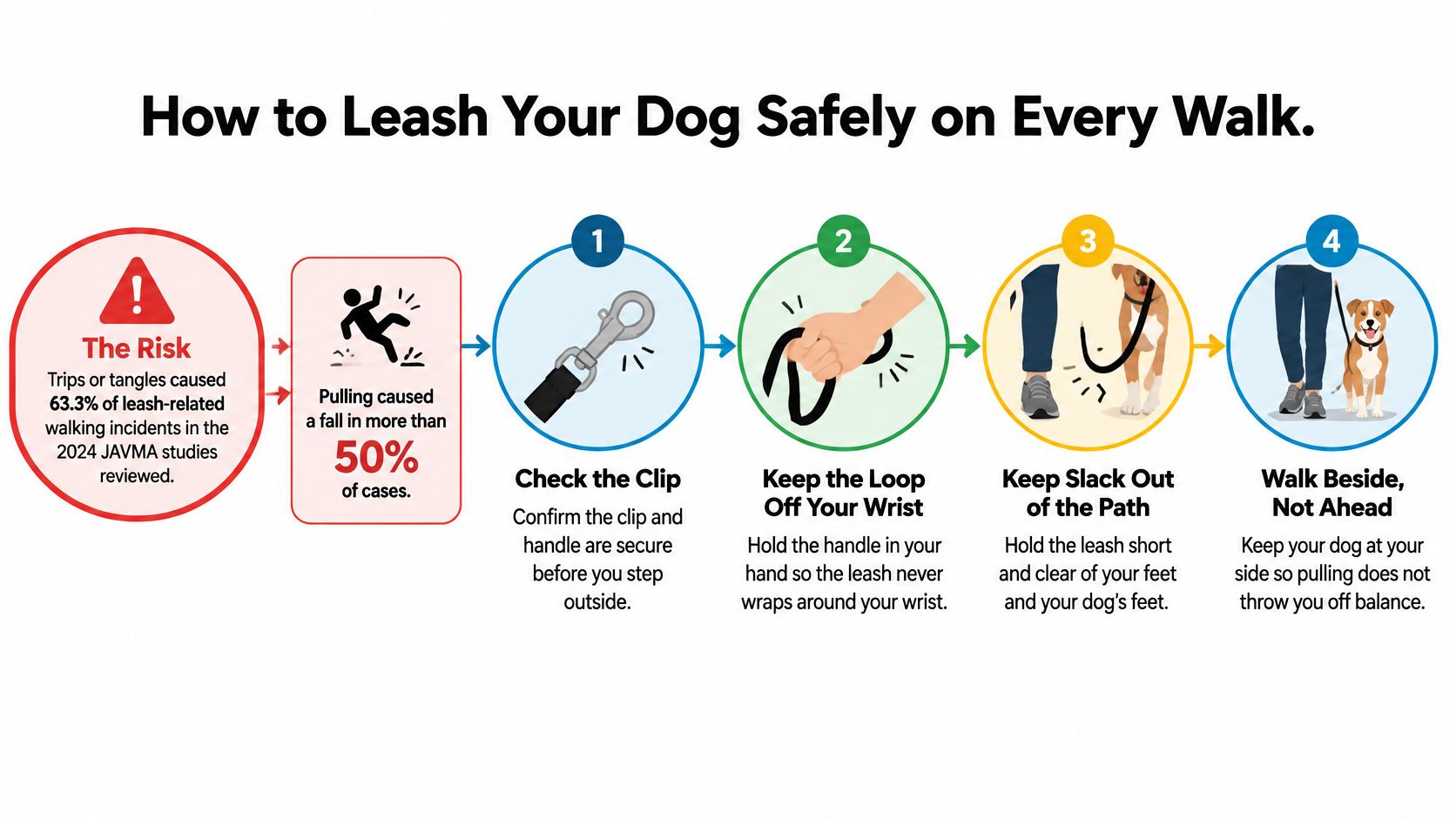
A leash routine protects the dog and the person holding it. In a 2024 paper in the Journal of the American Veterinary Medical Association , trips or tangles accounted for 63.3% of incidents in the studies reviewed; in more than 50% of cases in other studies , leash pulling resulted in a fall. Pulling can also injure a dog's throat, airway, esophagus, or eyes. ( The JAVMA review of leash-related walking injuries)
-
Check the equipment. Use a well-fitted flat collar or harness, and inspect the clip and handle before leaving. You should be able to slide two fingers beneath the strap; equipment that's too loose can slip, while a tight fit can rub or restrict movement.
-
Hold the leash securely, without wrapping it. Keep the handle in your hand and leave the leash off your wrist and fingers. Wrapping it can turn a sudden lunge into a hand or wrist injury.
-
Keep slack out of your walking path. Walk beside your dog so the leash doesn't trail behind your legs or cross in front of your feet. A taut leash can turn a small change of direction into a stumble, while too much loose line invites tangles.
-
Begin with an easy warm-up. Use a consistent cue to start, then walk gently for 5–10 minutes before asking for a brisker pace. Rushing straight out at speed can leave a dog unprepared for the effort.
-
Signal a turn before you make it. Pause or slow down so your dog can see the change, give a verbal cue, then turn together. A sudden switch in direction is an easy way to pull the leash across your legs.
-
Shorten the leash near crossings without tightening it. Keep your dog close enough to prevent a lunge toward traffic, but preserve a little slack. Pulling the leash tight as a default can add tension rather than helping the dog move calmly.
-
Cool down and check your dog. Ease the pace before ending the walk, then look over the paws and check whether your dog needs water or a chance to cool down. Don't mistake a dog's quietness after a strenuous walk for proof that the pace was safe.
For a deeper look at the local requirements behind leash handling, read this Denver leash-law guide for pet owners.
Choose Routes That Work for Denver Streets and Trails
Leash control is a legal requirement in Denver public spaces. Dogs must be leashed outside the owner's home or yard and outside a designated off-leash dog park, and the city lists an $80 civil penalty per violation under Denver's animal-law guidance. At a dog park, keep the leash on until you enter and clip it back on before leaving.
Judge a route by what it does for the dog: steady moving time, chances to sniff, and a calm recovery at the end. An app showing two miles tells you little if half of that distance was spent standing at crossings or weaving around obstacles.
Match the route to the setting
- Neighborhood sidewalks: Choose blocks with room at curb ramps, fewer driveways, and shade on hot days. A loop with grass verges or tree cover buys more sniffing time than a straight line past construction fencing and crowded bus stops.
- Public parks: Take the perimeter path when the middle is crowded, and enter through a quieter gate if one is available. Keep the leash on until you're inside a designated off-leash area.
- Trail access points: Confirm the trail permits leashed dogs and look over the parking area before unloading. Bring water for the dog, and skip exposed or rough routes when heat, snow, or ice make them unsafe.
Pick two routes for each dog , one short and one longer. A closed path or a rainy morning then costs you a quick decision instead of the whole walk. The Denver dog-walking trails guide can help you compare local outing ideas before choosing.
Surface and weather matter as much as the map. Hot pavement can hurt paw pads before a dog shows obvious discomfort, and heat stress can become life-threatening quickly, so favor shaded or softer ground in warm months. Uneven terrain and extreme cold put their own strain on joints and pads, especially on longer outings.
On any route, carry waste bags and pick up after your dog, and step off the path or keep your dog close when another walker or a cyclist needs room. For owners who want structured outings handled for them, Denver Dog serves Denver, Lakewood, Centennial, and Arvada with on-leash walks, runs, and guided hikes.
Handle Reactive Dogs and Crowded Sidewalks
A jogger rounds the corner on a narrow sidewalk; your dog lunges, and you're pulled toward the street. The safer response starts before the trigger appears, with a route and an exit plan rather than a last-second leash correction.
More social exposure isn't automatically better. A 2025 Dogs Trust survey found that 66% of dog owners supported keeping dogs on lead in public spaces except designated off-leash areas , and 60% supported separate on-leash and off-leash areas . A walk can meet a dog's needs without requiring greetings or close passes. ( Dogs Trust reactive-dog training guide and survey findings)
Start with predictable, quieter routes and avoid known triggers where you can. If a trigger appears, keep the leash soft and calmly create distance. As a practical starting point, move far enough away that your dog can take a treat and look back at you. On a quiet street, that may mean 15–30 metres ; if the space isn't available, cross early or step off the path.
On a narrow sidewalk, choose the side with the wider buffer, slow down before the pass, and place your body between your dog and the approaching person. A short phrase such as “my dog needs space” is often more useful than a long explanation. If the other person can't give room, turn away instead of trying to squeeze past.
If your dog reacts, leave the area at a steady pace, skip the planned loop, and head home. Note what happened just before the reaction, including the trigger and how close it was, so you can choose a more manageable route next time. Don't try to make up the missed distance by continuing while your dog is still highly aroused.
A sensible progression is quiet decompression walks, familiar routes, distance-based practice, then carefully selected trails. A dog may still enjoy a run or hike if the setting and handling are suitable, but exercise shouldn't force close contact. If reactions escalate or you can't safely create distance, seek help from a qualified behavior professional. This practical guide to on-leash aggression offers additional handling context.
Make Every Walk Count With Sniffing and Enrichment
A walk can be good for a dog even when it isn't a hard workout. In an observational study using activity diaries, pedometers, and heart-rate monitors, nearly 90% of dog-walking time was at light or very light intensity . Decide what the outing is for before you leave, then judge it by whether it met that purpose. ( The dog-walking activity study)
| Objective | What it looks like | Typical length | Signal it worked |
|---|---|---|---|
| Aerobic conditioning | Steady brisk movement with few stops | 20–40 min | Moving time and pace hold without lagging |
| Sniffing and exploration | Slow pace, nose down, frequent pauses | 15–30 min | Dog chooses the pauses and settles into the route |
| Decompression | Quiet street or greenbelt, low stimulation | 10–20 min | Loose body, soft tail, and easy breathing |
| Training practice | Short cues such as sit or recall between distractions | 5–10 min in bursts | Correct responses on most repetitions |
| Controlled social contact | Greeting one calm dog on a loose leash | 1–2 min | Both dogs stay relaxed, without stiffening or raised hackles |
For an anxious, newly adopted, senior, or leash-reactive dog, a shorter walk with room to choose where to sniff can provide more behavioral value than a longer forced march. In an urban neighborhood, pause at a tree line or planter every few blocks instead of walking straight from the door to a destination. Let sniffing be part of the outing, not a reward that only comes after a fixed distance.
Keep training brief. In a quiet spot, practice a sit or recall for 5–10 minutes in bursts , then let the dog return to exploring. For social contact, choose one calm dog and keep both leashes loose; end the greeting if either dog stiffens, avoids the other, or stops moving comfortably.
Watch the change, not the clock. A tired dog may slow down and sniff less. An overstimulated dog may fixate, stop sniffing, and ignore food. Give the dog more space or end the outing when those signs appear.
Decide Between a Walk, Run or Hike This Week
A walk app shows distance. It says nothing about what the outing did for the dog. Judge the choice by moving time, sniffing, and how quickly the dog recovers afterward. A steady adult that settles soon after exercise can handle a brisker walk. An athletic dog with reliable recall and sound joints may be ready for a neighborhood run, but build up from short jogs and get veterinary approval first, especially for a dog with a health condition.
| Dog type | Best fit | Watch for |
|---|---|---|
| Adult with steady energy and good recovery | Brisk walk with one extra stretch each week | Panting that lasts after the walk |
| Athletic breed with strong recall and sound joints | Neighborhood run, starting with 10-minute jogs | Lameness or reluctance to continue |
| Dog with reliable recall and steady footing | Guided on-leash trail hike, short first route | Heat exposure, missing water, or uneven footing |
| Senior or dog with a health condition | Gentle walk after veterinary approval | Breathing difficulty or rapid fatigue |
Trail outings add a variable sidewalks never do: uneven ground. Footwear matters for the person, too, and this practical overview of choosing trail shoes for day hikes can help you think through grip and comfort.
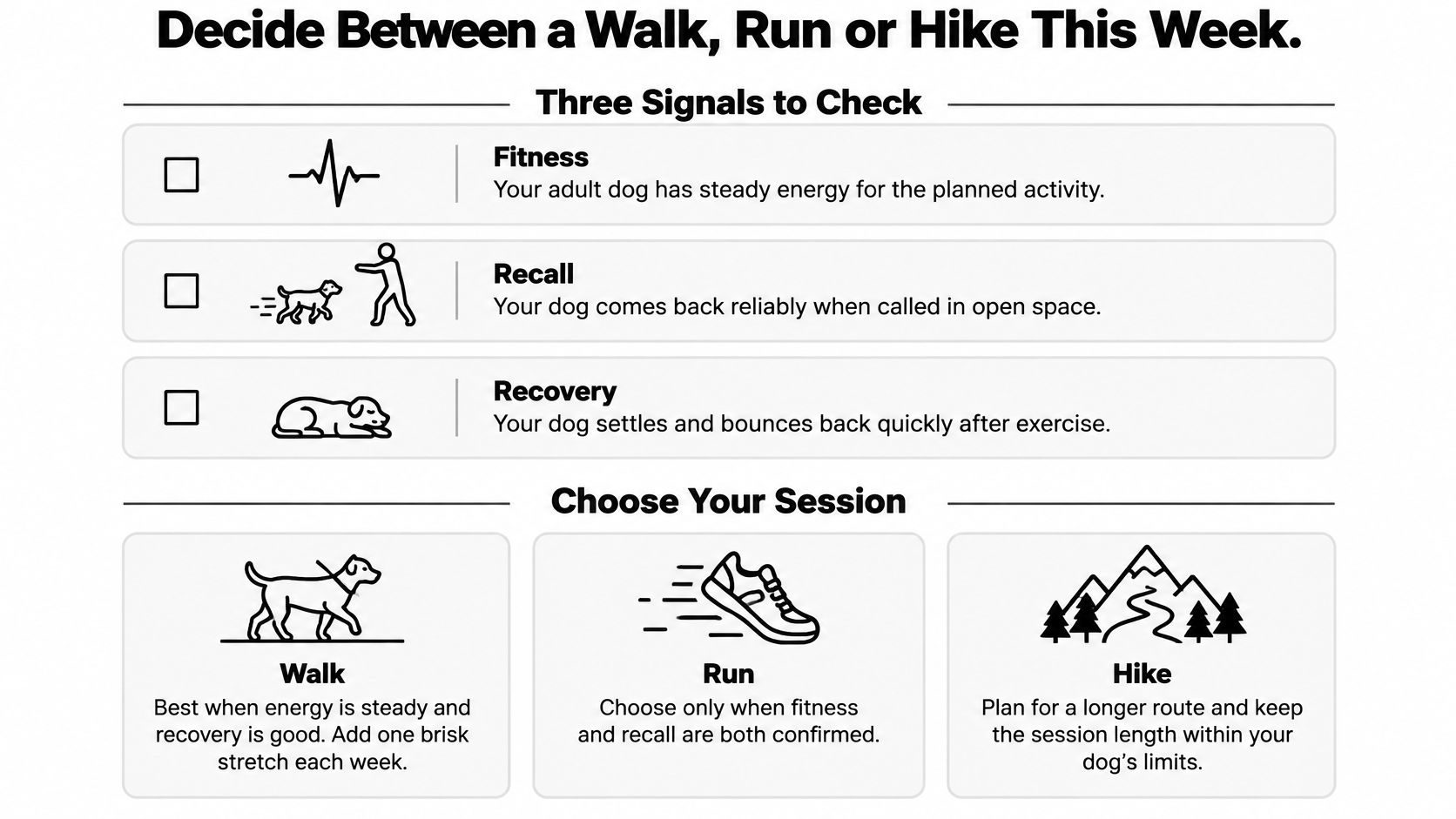
I treat the watch-for column as a stop checklist. If a sign appears mid-outing, end the session there. A short walk that finishes well beats a full distance that leaves the dog sore or limping. Talk to a veterinarian before stepping the intensity up again, and keep seniors and dogs with health conditions on gentle walks unless their vet approves a different plan.
Denver Dog offers on-leash walks, runs, and guided hikes across the Denver metro, including Denver, Arvada, Lakewood, and Centennial. Leisurely strolls fit puppies taking in their first sights and sounds and seniors that prefer a gentle, sniff-focused pace, while fast-paced walks give active dogs a lower-impact way to burn energy without a full run. Every outing is customized to the dog's energy level and personality, and new clients start with a free meet-and-greet at home. Review the available walking, running, and hiking services or visit Denver Dog to match an outing to your dog's fitness, recall, and recovery.
The Run Down