You check a driving record online and see no points, so you assume the old ticket is gone. Then an employer's screening report shows a conviction, or your insurer still rates you for it. The mismatch can happen because the court, the state motor-vehicle agency and the insurer keep separate records, with different rules for updating and displaying information.
If you're figuring out how to clean your driving record, start by identifying what you need changed: points, a conviction, license status or incorrect information. There isn't one universal erasure process. The right fix depends on the jurisdiction, the entry and the record you need to correct.
How to Pull and Read Your Official Driving Record
The document that decides outcomes is a certified motor-vehicle record issued by your state DMV. Most state DMVs issue certified records, often with a choice of lookback length, and each state sets its own rules for when and how an entry can be corrected. Check your state DMV's website for the record types it offers and the correction process it follows before you order anything, because a summary viewed through an online account can show less than the certified copy an employer or insurer would pull.
Drivers in Colorado can follow this step-by-step guide to requesting a Colorado driving record for the mechanics of placing the order.
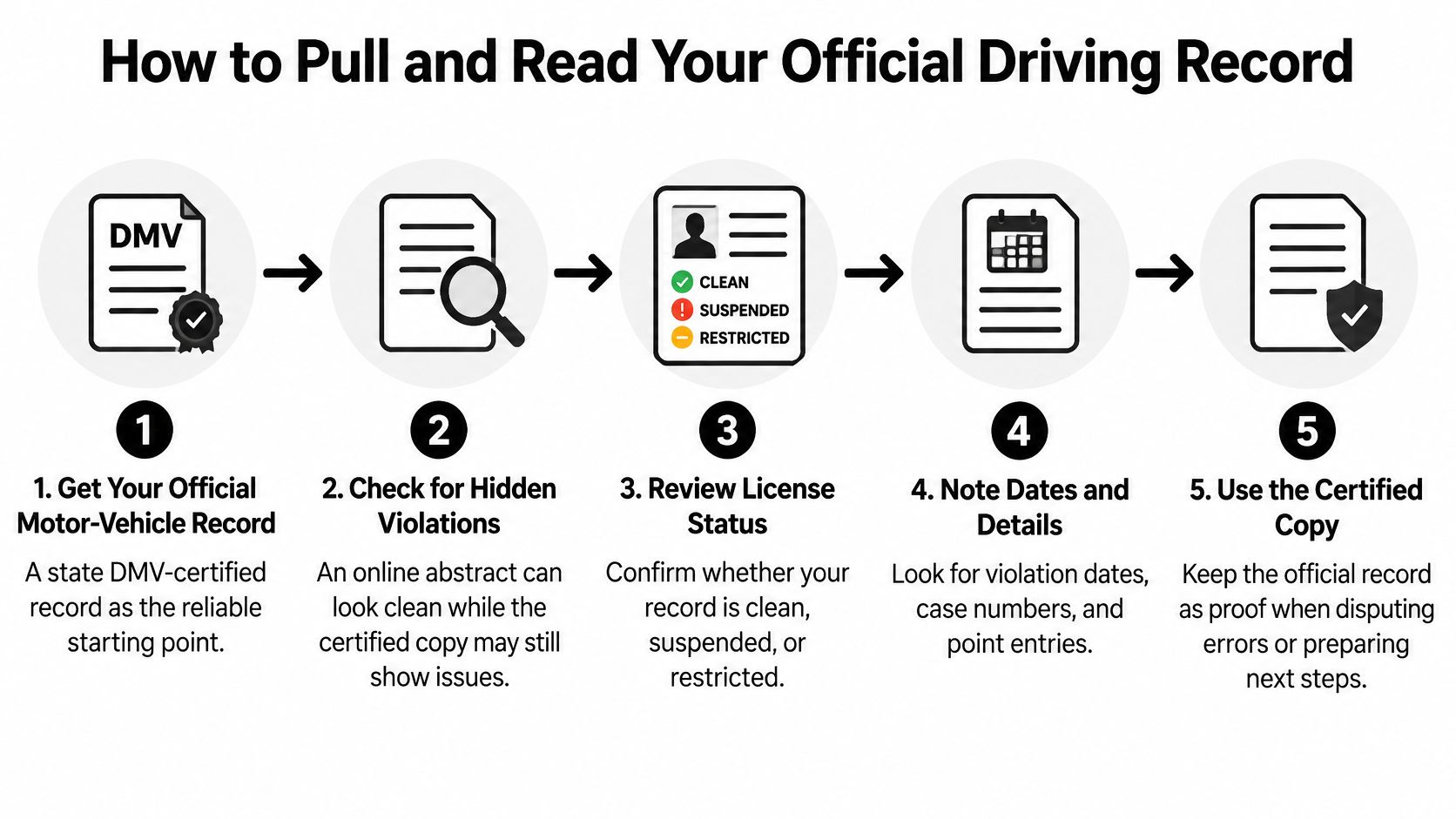
Match the record you order to the reason you need it. If a job application or an insurer applies a set lookback period, a shorter abstract may not answer the same question as a longer record, and that difference can decide whether an old conviction still shows.
- Request the right record. Order directly from your state DMV, and pick the lookback length your situation calls for rather than the cheapest or fastest option.
- Read every entry. Note the offense date, conviction date, points and any suspension or restriction. A point total and a conviction are different things: in New York, violations from the previous 24 months count toward the active point total, but the conviction can remain on the record ( New York's driver point-system guidance).
- Match the paperwork. Pull the court disposition, ticket record and payment receipt for each listed matter, then compare the court outcome line by line with the DMV entry.
- Mark discrepancies. Flag an unfamiliar ticket, an incorrect vehicle or date, or a name that does not match your identity documents, and gather your proof before asking any agency to correct its file.
The court file, the DMV record and the insurer's rating history are three separate documents, and each one needs its own verification step. Confirm the court outcome by requesting the disposition from the clerk's office. Confirm the DMV entry by ordering a fresh certified record after any correction is supposed to have posted. Confirm the insurer's view by asking which incidents it is rating and for how long. For a look at how one state approaches record cleanup, Georgia record guidance from Brian Hansford Law gives jurisdiction-specific context.
A defensive-driving course may reduce points or affect insurance in some states, but it does not erase a conviction. The certified record tells you which problem you have before you spend time or money on a remedy.
A record that looks clean online can still show a conviction on a certified copy.
The video below gives another overview of driving-record cleanup:
Sort Every Entry Before You Act
A record entry needs a remedy matched to what it is, so classify each item before contacting a court, DMV or insurer.
| Entry | What it means | Usual route | What may stay visible |
|---|---|---|---|
| Active demerit points | Count toward suspension thresholds | Let them expire or reduce them through an approved course | Conviction can remain on the record |
| Moving-violation conviction | Legal finding of guilt | Contest before conviction, or seek expungement where the state allows it | Stays visible for years; insurers may still see it |
| Dismissed charge still listed | Court outcome not reflected in the DMV file | Get the dismissal proof, then request a DMV correction or expungement | Listed until the DMV updates its file |
| Suspension or revocation | License status action | Reinstatement steps, not cleanup alone | Visible until resolved, and may appear on checks afterward |
| Clerical or identity error | Wrong driver, vehicle or date | Correction through the court or agency with supporting proof | Removed only after the correction is confirmed |
| Accident record | Crash report tied to the license | State correction form filed with the DMV | State rules and report status determine whether it remains |
New York shows why points and convictions shouldn't be treated as interchangeable. Its active point total uses violations from the previous 24 months. After that window, points no longer count toward the total, but the underlying conviction can remain visible if it's still legally recorded.
Colorado's adult-driver thresholds make the distinction consequential. Suspension may follow 12 points in 12 consecutive months or 18 points in 24 months ; thresholds for younger drivers are lower, according to the Colorado DMV motor-vehicle-record guidance. A driver near a threshold needs to check points and license status, not just ask whether an old ticket can be removed.
For each line, ask: Is the problem the points, the conviction itself, a status such as suspension, or a data error? That answer determines whether you're pursuing point relief, a court remedy, reinstatement or a correction request. Don't file a general “clean my record” request when you can name the entry and the result you're seeking.
Expungement Timelines and How Long Entries Stay
Point expiration and conviction removal are separate events. Points can stop counting toward a driving total while the conviction itself stays visible, so check the rules for both before deciding whether to wait or apply for relief. Use the table below as a lookup tool: find your state, note which column describes your problem, then confirm the current figures with the agency before you act.
| State | Points last | Conviction stays visible | Relief route |
|---|---|---|---|
| New York | Violations from the previous 24 months count toward the total | Remains while legally recorded | Point and Insurance Reduction Program |
| Nevada | 12 months from conviction date | Permanent | Approved course once every 12 months, for 3 points |
| Wisconsin | Points are assessed under the state system; most convictions may be eligible for removal after 5 years | Most removable after 5 years; alcohol convictions indefinitely | Removal after the retention period |
| Virginia | 2 years from offense date | Serious offenses such as DUI and reckless driving remain far longer than minor speeding | Wait for the applicable retention period; check eligibility for any separate remedy |
| Nebraska | Point accumulation can trigger revocation | Retained for a set period under state rules | Monitor the point total and license status; no removal route specified here |
| Washington, D.C. | Generally 2 years | Stays visible after course; points do not appear | Approved defensive-driving course with prior approval |
| Pennsylvania | 3 points removed per 12 clean months | The record can return to zero; future points are treated as a first accumulation after another 12 consecutive months at zero | Special Point Examination or Driver Improvement School |
| Colorado | Thresholds vary by age and accumulation period | Request a seven-year or full-history record to verify what remains | Confirm with Colorado DMV and courts |
The Wisconsin Department of Transportation's point-system guidance shows how much offense type matters: most convictions may be eligible for removal after five years , but alcohol-related convictions remain indefinitely. Nevada is the opposite kind of reminder. Its points expire 12 months after conviction , yet the conviction stays on the permanent driving record. Expiring points lower your risk of suspension; the entry itself remains.
Virginia scales retention by offense severity, so a DUI or reckless-driving conviction outlasts a minor speeding ticket by a wide margin. Nebraska retains convictions for a set period and can revoke a license once the point total crosses the state threshold. In both states the practical move is the same: pull the record, see exactly what is still listed, and treat "points stopped counting" and "conviction removed" as two different questions.
Court relief adds a third layer, because expungement is a court-file remedy and a cleared court file does not rewrite what the DMV keeps. A guide on how to expunge Illinois criminal records illustrates how separate that court process is from motor-vehicle retention, which runs on its own schedule. After any expungement or disposition change, verify the entry changed on the motor-vehicle record. The court order alone does not update the state file.
As a broad benchmark, five years is common for many ordinary convictions , while high-risk offenses stay much longer or permanently. The lookback that matters is the one your checker uses. An employer screening seven years of history can see a conviction your recent clean points have outgrown, and an insurer rating at renewal may pull a different window than the court clerk's file shows. Check all three records, the court file, the DMV history, and the insurer's version, against the specific lookback requirement before treating an old entry as erased.
How to Contest a Ticket or Correct a Bad Entry
Decide before the court date whether to contest, pay, or seek an eligible course or deferred outcome. Paying usually accepts the conviction, so do not pay first and assume an accurate entry can be removed later because you regret the choice.
- Act before the ticket deadline. Request the hearing or trial using the method and deadline printed on the citation. Missing it can produce a default conviction.
- Ask for a specific result. At the hearing, request dismissal, a reduced charge, or a deferred outcome if the court allows one. Get the final disposition in writing before you leave.
- Confirm the report was sent. Ask the court whether it reported the outcome to the DMV, when, and in what form. Keep a certified copy of the order or disposition.
- Submit proof if the DMV entry is still wrong. Many states offer a DMV correction form or review request. Attach the certified court order, amended judgment, or identity documents that establish the error, then ask for written confirmation of the change.
- Check the updated record. Order a fresh motor-vehicle record after processing and compare line by line with the original. If the insurer already rated you on the old entry, send the corrected record and ask for a re-review.
The court file, DMV history, and insurer record are maintained separately, so a dismissal can exist in one place and still appear in another. Verify each record directly: the disposition from the court, the MVR from the state, and the report the insurer used.
A court win is not proof that the DMV updated its file. Verify the result on a new official record.
A DMV generally cannot delete an accurate conviction because an employer or insurer dislikes it. Target real discrepancies, and reserve formal legal remedies for jurisdictions and outcomes that allow them.
Defensive Driving and Point-Reduction Courses
A course usually reduces active points , not the underlying violation. Eligibility, timing and approval rules differ, so check the exact program before paying for a class.
New York's Point and Insurance Reduction Program can reduce up to four points used in suspension calculations , but only for violations from the 18 months before course completion . A driver can use it once every 18 months ; it can't reduce points below zero or undo an existing suspension. A provider may take up to 10 weeks to notify the DMV, so keep the certificate and order a fresh record after processing ( New York's program rules).
Nevada lets eligible drivers with 3 to 11 points remove 3 points through a DMV-approved course, once every 12 months . The course must be voluntary. If a plea bargain requires it, the driver receives no point credit ( Nevada DMV point guidance).
Pennsylvania offers a different choice once a record reaches six or more points : a Special Point Examination removes two points, while Driver Improvement School removes four. Separately, the state removes three points for each 12 consecutive months without a point-producing violation or a suspension or revocation-triggering violation ( Pennsylvania's point-system guidance). For a Georgia-focused overview of course and point issues, driving record tips from Georgia DUI Schools provide another jurisdiction-specific reference.
Before enrolling, ask:
- Is it voluntary? A court-required course may not earn point credit.
- Does it need approval? Check whether the court or DMV must authorize it first.
- When will the DMV process it? Keep your completion certificate until the updated record confirms the change.
- Will the conviction still show? Don't mistake point relief for deletion.
Colorado-specific course credit isn't confirmed here. Check the Colorado DMV and the court handling your case before enrolling; a New York or Nevada rule doesn't automatically apply in Colorado.
How Insurers and Employers Read a Cleaned Record
A point dropping off your active total doesn't automatically lower your insurance premium. Insurers can consider the violation itself and may use a different history or lookback period than the DMV record you've checked.
LexisNexis Risk Solutions reported that U.S. moving violations rose 17% year over year in 2024 , and that loss cost associated with a distracted-driving violation was 108% higher than for a driver with no violations ( Insurance Journal's report on the findings). Those figures don't predict your individual premium, but they show why insurers may keep evaluating the underlying violation rather than the current point balance.
Before your next renewal, ask your insurer:
- Which violations count for rating, and what lookback window do you use?
- Does a completed approved course qualify for a discount or other rating adjustment?
- If the DMV or court corrected an entry, what documents do you need to review the rate again?
Send the corrected disposition or updated certified record to the insurer if it requests proof, then ask whether it has changed the rating. For an employer check, keep the certified DMV record, court disposition, correction confirmation and insurer correspondence together in one folder. That makes it easier to show which entry changed, who corrected it and what remains visible.
Build Your Clean-Record Plan Before Your Next Renewal
A renewal date gives you a deadline, so work backward from it and give each entry its own remedy instead of filing one generic cleanup request. Court files, DMV records and insurer histories update on different schedules, and a correction in one does not automatically appear in the other two.
- Pull a certified record this week. Choose the history length that matches your goal.
- Classify every line. Use the entry table to separate points, convictions, license status and data errors.
- Calendar deadlines and retention dates. A court response deadline can pass while you wait for an entry to age off.
- Choose one remedy for each item. Contest or correct an error, pursue an eligible formal remedy, or take an approved course when its rules fit your case.
- Verify the outcome in all three places. Order a new DMV record and compare it with the original, request the corrected disposition from the court, and confirm the insurer has applied the change within its stated lookback period.
Screening standards matter when someone else drives a family member or pet. Denver Dog serves Denver, Lakewood, Centennial and Arvada, and every team member must hold a pristine seven-year clean driving record before joining. Drivers are also monitored in the vehicle for speeding, following distance, distraction and drowsiness, with real-time coaching to keep scores high.
The certified copy is the foundation for every other step. Use it to decide what to challenge, what may expire and what you must verify with the court, DMV or insurer.
Denver Dog offers on-leash dog walking, running and hiking, with driver screening that requires a seven-year clean driving record. If your dog needs structured weekday exercise in the Denver area, visit Denver Dog to explore the service and start with the pre-screening questionnaire.
The Run Down