You're at your desk at noon, your dog has been home alone since 7:30, and the morning walk you planned turned into ten rushed minutes around the block. By evening you're tired, your dog isn't, and the same problem is waiting tomorrow. That's the exact gap dog walking packages are built to close. A package isn't just a discount for buying more walks. Done well, it specifies how long each visit lasts, how hard your dog works, what happens in heat or on ice, and which days are set aside. This guide judges packages by that work, not by price or walk count alone, so you can tell a real routine from a vague promise before you pay.
Three Package Types and What Each One Buys
A single visit is one booking paid per walk, with no commitment. A multi-visit bundle is a prepaid set of walks you book on dates you choose within a validity window. A recurring subscription is a standing weekly plan on a fixed weekday slot, billed on a schedule.
Think of a single visit as a taxi you hail when you need one. A bundle works like a punch card you draw down over time. A subscription is a standing reservation at the same table every week, held for you whether you remember to book or not.
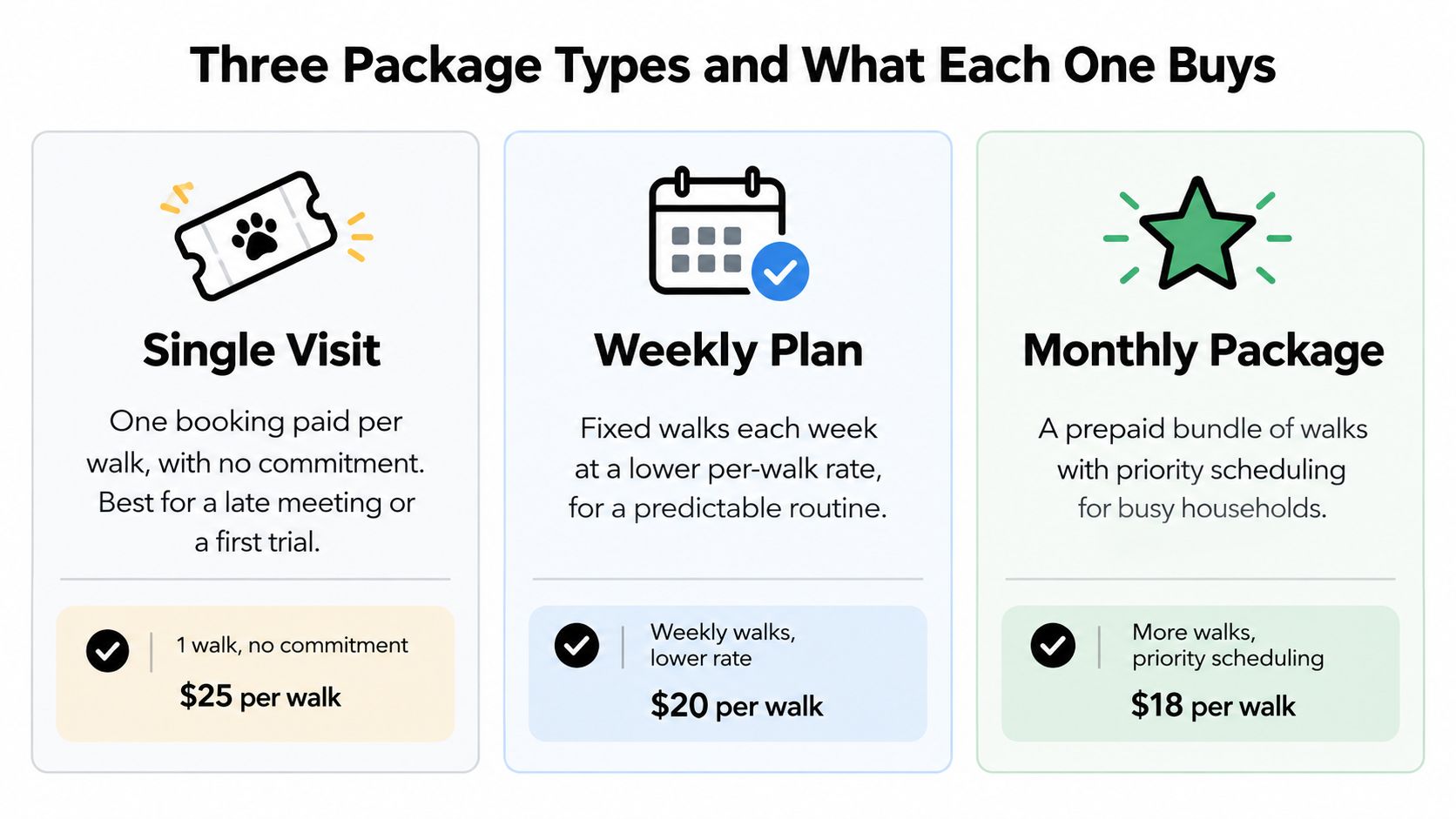
Dog Walking Package Types Compared
| Type | How you buy | Schedule | Commitment | Best for |
|---|---|---|---|---|
| Single visit | One booking, paid per walk | Booked on demand, subject to availability | None | One-off gaps, trying a provider, travel days |
| Multi-visit bundle | Prepay for a set number of walks | Book dates as needed within the validity period | Prepaid; check expiry and refund rules | Irregular weeks, guests, seasonal needs |
| Recurring subscription | Standing weekly plan, billed on a schedule | Fixed weekday slot | Ongoing; check the notice period for cancellation | Busy weekday schedules, dogs needing daily exercise |
Say your manager keeps you late on random Thursdays. A subscription wastes money on weeks you're home, while a bundle lets you spend a walk only when Thursday goes sideways. Say instead you're in the office Monday through Friday and your dog needs a midday outing daily. Booking single visits one at a time means competing for open slots every week, and you'll eventually lose one.
The two terms that surprise buyers most are bundle expiry dates and subscription notice periods . A bundle that looked cheaper per walk isn't cheaper if three walks expire unused, and a subscription you can't pause without long notice can charge you for a week you're on vacation. Read those two lines before you compare prices.
Practical rule: If your weekly pattern is known, choose a subscription. If your week changes often, choose a bundle. If you're testing a provider, buy one visit.
That rule handles most first purchases. Everything else, duration, intensity, cost, and safety limits, sits inside whichever structure you pick.
Why Packages Close the Gap Between Owning and Exercising
Owning a dog doesn't guarantee walking it. In a national survey of 4,010 adults cited in a CDC analysis of dog walking, only 42% of dog owners reported any dog walking during a typical week, and those who did walk averaged 4.3 walks and 128.8 minutes per week .
A booked slot replaces a plan that depends on memory, mood, or a long workday. It's closer to a class you've paid for at a set time than to a gym membership you keep meaning to use. The walker shows up because the visit is on a route, not because you found energy at lunch.
A package does three practical things. It creates a predictable routine on the same days each week, it outsources the time-intensive midday break a nine-to-five schedule can't cover, and it lets you choose a frequency that matches real life, from several short walks to one longer session.
The limit matters too. A package schedules exercise, but it doesn't make you or your dog fitter by itself. The walker delivers the outing, while you still decide what happens on evenings and weekends, so treat dog walking packages as both pet care and a practical exercise routine, not a guarantee.
Duration and Add-Ons Every Package Should Specify
Duration is the first thing to verify because it sets the work, not just the price. One Denver-area provider listing private walks in four defined lengths offers 30, 45, 60, and 90 minutes , with pricing set by both service type and visit length. Those increments make a promised visit easy to check against what your dog really got.
Visit Durations and What to Verify
| Duration | Typical use | What to verify |
|---|---|---|
| 30 minutes | Midday potty break and short sniff outing | Potty break, water, and rest included |
| 45 minutes | Standard daily walk | Route type and leash rules stated |
| 60 minutes | Extended walk or light run block | Rest intervals and intensity cap |
| 90 minutes | Long exercise session, enrichment, or hike-length outing | Heat and terrain contingencies and post-walk check |
A 30-minute visit suits a puppy on a potty schedule, a senior dog who tires quickly, or an adult who already ran with you that morning. It's a break and a sniff outing, not a full exercise session. If it's your dog's only outing, it'll usually fall short for a healthy adult.
45 minutes is the standard daily walk for an adult with moderate energy and no other outing that day. 60 minutes gives an under-exercised adult an extended walk or a light run block with room for rests. 90 minutes covers long exercise, enrichment, or a hike-length outing for a high-energy dog, and it needs the most planning because fatigue and weather have more time to build.
What Happens Inside the Minutes
Two 45-minute visits can do very different work, so write down what happens during the visit, not only how long it lasts. Ask for each of these in writing before you buy.
- Potty breaks: Confirm time is built in during longer sessions, not treated as an interruption. We provide potty breaks during our K9 fitness sessions, and any package should say the same plainly.
- Water and rest stops: Ask where rests happen, on grass or shade rather than hot pavement, and whether water is carried or only offered back home.
- Leash handling practice: A walk can reinforce loose-leash walking and calm passing, or it can practice pulling for 45 minutes. Ask which one you're buying.
- Enrichment: Sniff routes, varied streets, or puzzle time after the walk give a dog mental work that distance alone doesn't.
- Check-ins and photos: If updates matter to you at work, confirm they're part of the visit. We use GPS-tracked check-ins and photo updates, so you can see the visit happened as booked.
A 30-minute visit with a planned rest often serves a dog better than a 60-minute walk with no breaks.
That's the confusion to avoid. Longer isn't automatically better, and a package that only lists minutes hasn't told you what your dog will do with them.
What Dog Walking Packages Cost and Why Prices Vary
Use a market baseline before you judge any quote. According to Dataintelo's dog sitting service market report, average dog-walking rates were reported at USD 15 to 30 per 30-minute session in 2025 , depending on location and service customization. That's a comparison point, not a promise from any one Denver provider.
Cost Drivers for Dog Walking Packages
| Cost driver | How it changes the price | Reference point |
|---|---|---|
| Visit length | Longer visits cost more per visit | 30-minute session averages USD 15-30 (2025) |
| Service type | Running and hiking usually cost more than a leisurely walk | Higher than a 30-minute leisurely walk |
| Location within the metro | Price varies by neighborhood and route | Set by your location (2025) |
| Bundle or recurring plan | Prepaying or committing usually lowers the per-walk cost | Lower per-walk price than single visits |
| Customization and add-ons | Individual handling and extras add to the base rate | Service customization (2025) |
| Additional dogs in the household | Often priced per dog | Confirm the per-dog rate in writing |
Here's the arithmetic on a simple example. Ten 30-minute walks at USD 25 each cost USD 250 at the single-visit rate. If a bundle cut the rate by 10 percent , the same ten walks would cost USD 225 , saving USD 25 . We give a lower per-walk price to clients who buy walks in a package or sign up for a consistent weekly plan, which is the usual reason bundles exist.
The lowest per-walk rate isn't always the best value. A cheap visit that's too short for your dog leaves the problem unsolved, and a discounted bundle that expires unused costs more per walk taken. A 90-minute running package should cost more than a 30-minute midday break because the handler does more work over more time. Judge the price against duration and effort, not against the cheapest number on the page.
Before you sign, ask for the all-in monthly total including add-ons and extra dogs, plus the exact cancellation fee. Our Denver dog walking rates and 2026 pricing guide lays out how those pieces combine, and any provider should be able to give you the same total in one number.
Matching Package Intensity to Your Dog's Energy
A two-year-old border collie needs a hard weekday run. The 12-year-old beagle next door needs twenty minutes of slow sniffing around the block. Hand both dogs the same package and one of them goes underserved, which is why intensity matters more than the minute count printed on the plan.
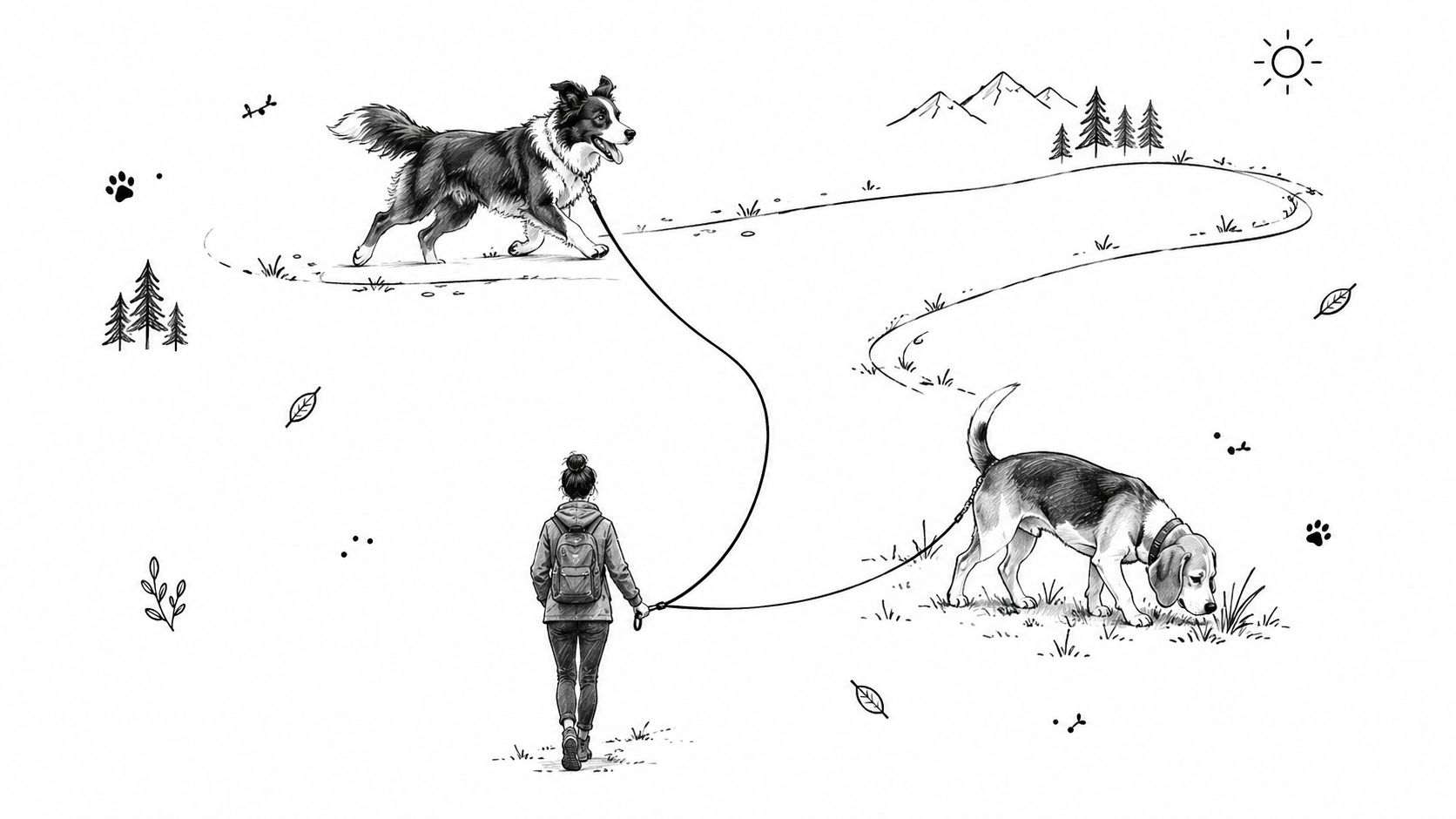
One handler, leashed dogs, a steady pace: the drawing is simple, but the pace in it is the variable you are paying for. A new runner does not open training with a marathon, and a newly adopted, overweight, elderly, or medically fragile dog should not open with the longest block on the menu either. The American Veterinary Medical Association guidance on walking your pet recommends building toward one or more 15-minute periods of brisk walking , followed by cool-down and recovery, so a well-built package scales up over the first weeks instead of locking in one fixed duration on day one.
Dog Profiles and the Package Intensity That Fits
| Dog profile | Suggested intensity | Package direction | Watch for |
|---|---|---|---|
| Puppy or newly adopted dog | Gentle, short, frequent | Leisurely walks in short blocks | Overexertion in growing joints; stress in new surroundings |
| Senior dog | Gentle, sniff-focused | Leisurely walks | Stiffness, shortened stamina, slower recovery |
| Adult already exercised daily | Light and supplemental | Leisurely walk as an add-on | Overlapping routine that adds little new exercise |
| Adult with average energy and no daily exercise | Brisk, building to 15-minute blocks | Fast-paced walk, 45 to 60 minutes | Pulling and overstimulation early in the program |
| Overweight or short-nosed dog | Low to moderate, with rests | Shorter fast-paced walks with schedule control | Breathing difficulty and heat intolerance |
| Athletic or high-energy dog | Sustained cardio with an intensity cap | Running program, 60 to 90 minutes | Exhaustion and fading focus late in a run |
| Trail-ready adult dog | Varied terrain at a steady pace | Guided on-leash hike | Leash rules, ice, wildlife and heat on exposed trails |
Two rows deserve a second look. The already-exercised adult is the profile buyers overshoot most often: a lower-cost leisurely walk fills the midday gap without stacking a second workout onto a dog that is already conditioned. At the other end, the athletic dog needs an intensity cap , which is what separates a run program from a long walk. A cap means a set workload limit, planned rest or sniff intervals, and observation afterward, with the dog's behavior as the measure of whether the dose was right. Heat, ice, and an exposed trail all change what the same pace costs, so the cap has to move with conditions on the day.
Sustained effort can also dull a dog's scent work before the dog looks tired. A scent-driven dog that starts missing cues late in a session is signaling that the outing ran long, so more minutes is the wrong fix.
The clip above shows what a paced outing looks like in practice. Treat your first few booked sessions as calibration: record baseline behavior, panting, gait, willingness to continue, and recovery time , then adjust the next booking up or down. Our complete guide to exercise for high-energy dogs covers how to read those signs over several weeks, and any provider should be willing to move a dog between leisurely, fast-paced, and running tiers as the pattern emerges. If you are also setting up space at home for an athletic dog, a dog run guide for Austin homeowners is a useful reference for sizing a dedicated run, though a yard run does not replace a handled outing with varied routes and sniffing.
Heat, Terrain and Leash Rules Denver Packages Need
A route name and a duration say little about what happens when conditions change, so a package has to name its limits. Denver trails require a leash no longer than six feet , and dogs stay leashed until they enter a designated dog park and again before leaving it. Our Colorado leash law guide for Denver pet owners explains where those rules apply. Since our walks, runs, and guided hikes are all on-leash, the question a package should answer is what the handler does when a route stops being safe.
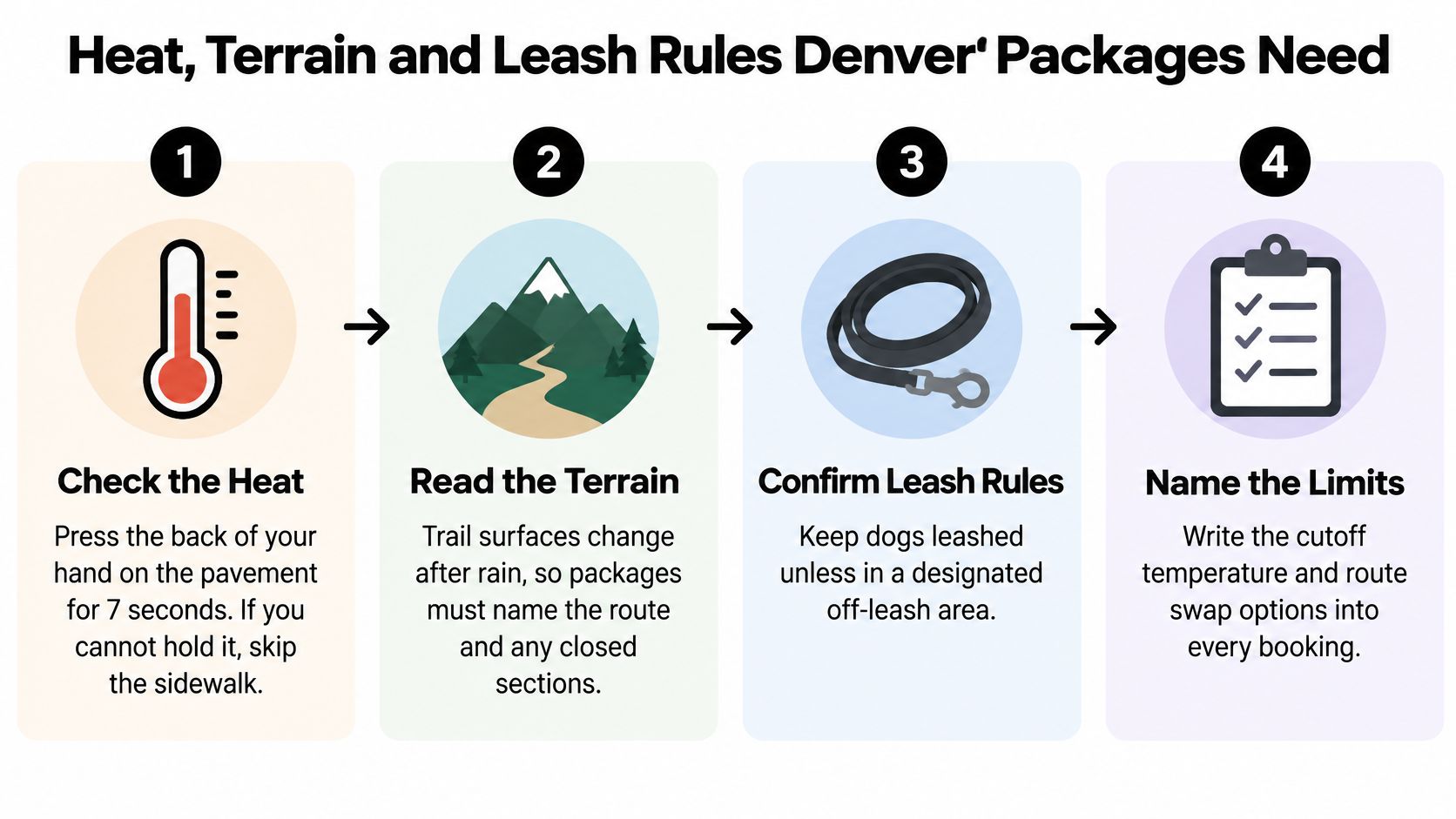
Heat is the first summer risk. The AVMA warm weather safety flyer recommends cooler hours, avoiding hot asphalt, frequent breaks, and carrying water, with overweight and short-nosed dogs at higher risk. That guidance supports short rest breaks in shade or on grass and ending a session at signs like pronounced panting, shade seeking, or reluctance to continue.
Timing matters just as much as the trigger. Our hiking services run Monday through Friday, 6 a.m. to 2 p.m., which puts trail time in the cooler early hours rather than the peak-afternoon heat.
Any package should publish this stop-work protocol .
- Check conditions first: Schedule cooler hours and check pavement, ice, and air quality.
- Check the dog: Note panting, gait, willingness to continue, and intake limits for breed and body condition.
- Rest and regroup: Pause in shade or on grass and offer water.
- Shorten or reroute: Move off hot, exposed, broken, or icy ground and away from wildlife or free-roaming dogs if recovery stalls.
- Stop and report: End the walk, notify you, record what happened, and adjust the next booking.
A good package collects breed, age, body condition, and acclimatization at intake, because the same route loads different dogs differently. We customize every session to the dog's age, breed, and preference, and the contingency rules above are what make that customization hold up on a bad-weather day rather than only on a mild one.
Frequently Asked Questions for Denver Pet Parents
Can a Weekday Package Fit a Nine-to-Five Job
Check the operating window first. We list weekday walking and running hours as Monday through Friday, 8:00 a.m. to 2:00 p.m. , so a midday visit fits an office day and a late-afternoon slot doesn't. Buy the slot that exists, not the one you wish existed.
Is a 30-Minute Visit Enough
It's enough for a dog who already exercised that morning or a puppy on a potty schedule. A high-energy adult with no other outing usually needs 60 or 90 minutes . Match the visit to the rest of the dog's day, not to the cheapest option.
What if I Pause for a Holiday or Trip
Ask whether a subscription can be paused, how much notice is required, and whether missed visits can move inside a bundle's validity window. Get the answer before you prepay, because unused walks are where bundles lose value without anyone noticing.
Does a Package Work Near the Edge of the Route
Confirm your exact address against the service area before you buy, since coverage is location-specific and a nearby neighborhood isn't the same as being on the route. A two-minute address check beats discovering a gap after payment.
Who Handles a Walk Cut Short by Heat or Ice
Ask for the stop-work rule in writing, including whether you still pay for a shortened visit. A provider who can't state the trigger and the charge in one sentence hasn't finished designing the package.
Confirm the Terms and Book a Trial Walk
Before the first booking, get one written page that says what the package will do. It should name the recurring days, the arrival window, the longest visit length and intensity cap, the leash rule, the heat and trail cutoff, the way schedule changes are handled, and the cancellation and payment terms. A package is a promise of work, so judge it by minutes, exertion, safety limits, and what happens when weather or a closed trail changes the plan.
Then test the fit with one visit. We offer a trial session you can schedule, plus a free meet-and-greet at your home, so the handler can meet your dog and check intake details such as age, breed, energy level, and any heat or leash limits. After you are in the system, walks, runs, and hikes are scheduled through the online platform, which makes the recurring pattern easier to see before it becomes routine.
Confirm coverage with your exact address; a nearby neighborhood can sit outside the route even when the town name sounds close. Our Denver Dog service areas include Denver, Lakewood, Centennial, and Arvada, so check the map before you choose a slot. Write down your dog's profile, your weekly pattern, and the package type you want, then book the trial walk before prepaying.
If your dog needs a dependable routine rather than another rushed ten minutes, we offer on-leash walks, runs, and guided hikes matched to energy, age, and limits, with packages and weekly plans priced lower per walk. Start with the meet-and-greet and trial session, then visit Denver Dog to book your first walk.
The Run Down