It's 7:40 a.m., your coffee's still hot, and your dog is already watching the front door. You need to leave before the pavement heats up, work all day, and somehow fit in feeding, a potty break, real exercise, and company. In home dog care solves that gap without moving your dog to a strange building. The care comes to your house, in your dog's own routine.
What In-Home Dog Care Covers on a Workday
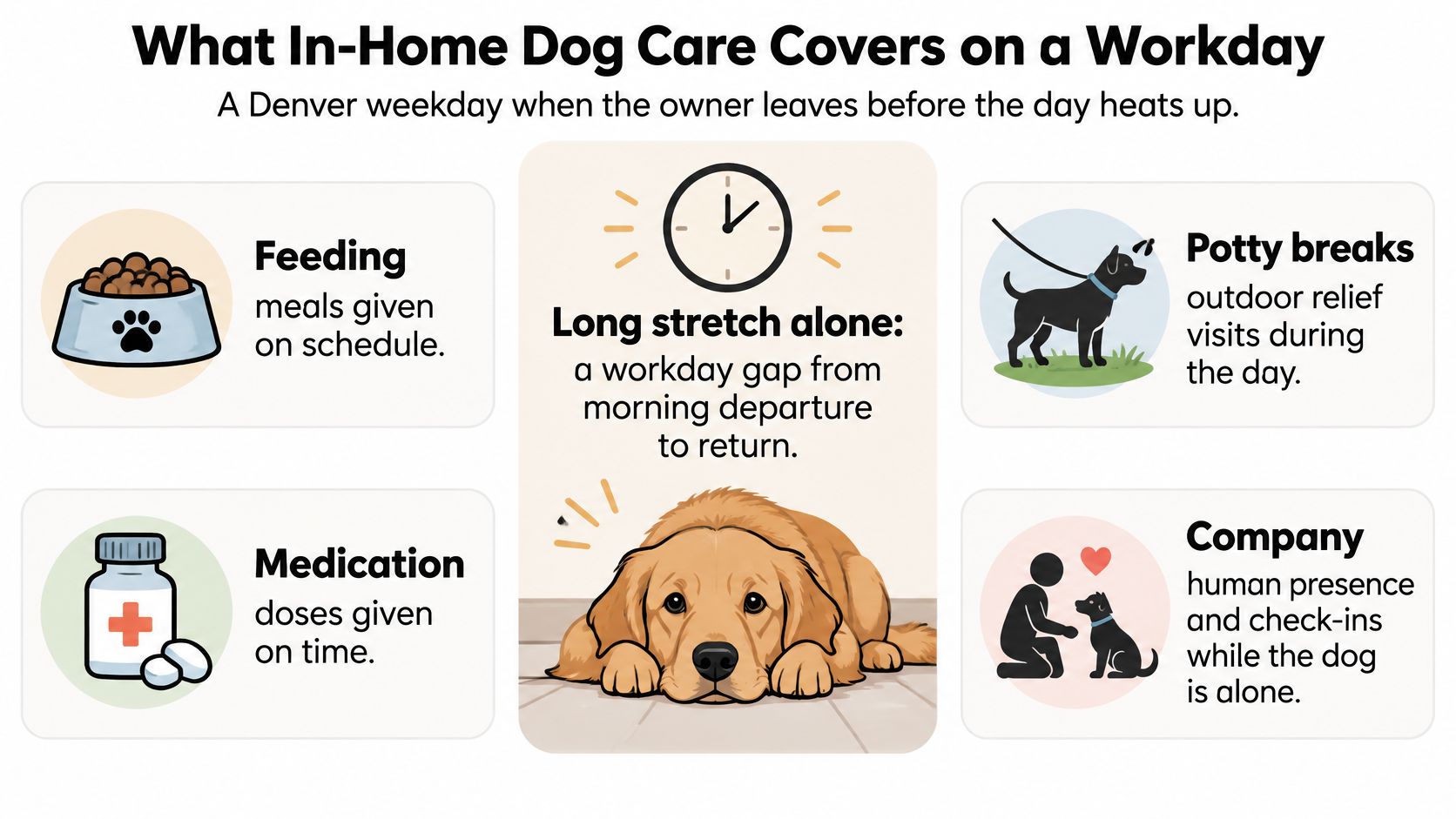
Say you leave a Denver house at 8 a.m. and return at 6 p.m. Your dog hasn't just missed a walk. She's missed feeding on schedule, medication on time, outdoor relief, water checks, and human company across a long, quiet stretch.
That's what in-home dog care covers. A caregiver comes into the dog's own house to handle those basics where the dog already eats, sleeps, and knows the doors. It's not care in a kennel lobby, and it's not the same as someone stopping by to clip on a leash.
The Three Home-Based Formats
- Drop-in pet sitter: A caregiver stays for a timed visit, feeds, gives medication, offers a potty break, refreshes water, and spends time with the dog.
- Overnight stay: The caregiver sleeps in your home, so evening, night, and morning routines stay in place.
- In-home boarding: Your dog remains home for several days while someone manages the house and the full daily routine.
None of these automatically means minute-by-minute supervision . A drop-in covers its booked window and then the caregiver leaves. If your dog needs constant presence, you have to book that level explicitly and confirm it in writing.
A walk is an outing. In-home care is coverage for the day inside the house, and an outing may be only one part of it.
This is now a repeating household job, not an occasional favor. The American Veterinary Medical Association pet ownership statistics show 45.5% of households owned at least one dog in 2024 , representing approximately 59.8 million dog-owning households and 89.7 million dogs overall . Dog-owning households averaged 1.5 dogs each, after the U.S. dog population rose from 52.9 million in 1996 to 89.7 million in 2024.
That average matters for planning. Many homes aren't arranging care for one animal on rare trips. They're repeating meals, medications, and breaks for more than one dog every workweek. Choose the format by the gap you need covered first, then compare price and personality.
Care Formats Compared With Walks Daycare and Hikes
Start with the row that matches the gap in your day, not the service that sounds busiest. A dog who needs company and medication needs a different purchase from a dog who is calm at home but under-exercised. Buying the wrong row leaves the original problem untouched.
| Care option | Where it happens | Cost pattern | Best fit | Main limit |
|---|---|---|---|---|
| Drop-in pet sitter | Dog's own home for a timed visit | Per visit; meds and extra pets add cost | Midday potty, meds or a check-in | Alone-time gaps remain between visits |
| Overnight in-home stay | Caregiver sleeps in the dog's home | Per night; holidays and constant care cost more | Travel and dogs who struggle alone at night | House access and a higher price |
| In-home boarding | Dog stays home for several days | Nightly rate plus house-sitting duties | Multi-dog homes that do poorly in kennels | Trusting someone with the house |
| Dog walk or run | Neighborhood route, then home | Lower add-on, often cheaper in a weekly plan | Supplemental exercise on workdays | Does not feed, medicate or cover the day |
| Dog daycare | Facility away from home | Day rate plus transport | Dogs who enjoy a supervised group | Commute, germs and overstimulation |
| Guided hike | Trail time, then home | Session rate; weather can cancel | Athletic dogs that need a real workload | Not full-day care or supervision |
When Staying Home Fits Best
A drop-in sitter suits the workday gap. Your dog gets relief, food or medication, and a check on water, accidents, and behavior without leaving home. The limit is honest and simple. Between visits, your dog is still alone.
An overnight stay extends that continuity through the night. It fits travel and dogs who pace, vocalize, or stop eating when the house is empty after dark. You pay per night for that presence, and you are trusting someone to sleep in your home.
In-home boarding stretches the same idea across several days. It can work well for multi-dog households and dogs who do poorly in kennels, because crates, beds, yards, and feeding spots don't change. The trade-off is broader house responsibility, from mail and trash to doors and alarms.
When an Outing or Facility Fits Better
A neighborhood walk or run is a lower-cost add-on for exercise. Our Leisurely Dog Walks, for example, are a lower cost service for dogs that enjoy an easy stroll or already get daily exercise and only need a supplemental outing. A walk doesn't become full-day care just because the dog comes home tired.
Daycare moves the dog to a group setting away from home. A social dog may enjoy supervised play, but you're adding transport, exposure to illness, and a higher-arousal environment. If you're weighing that move, our guide to deciding whether doggy daycare is good for your dog walks through the fit questions in more detail.
A guided hike gives an athletic dog a real trail workload and mental challenge. It's still a session, not supervision for the rest of the day, and weather can cancel it. Some dogs need both types of help, such as a hike for workload and a drop-in for an evening meal.
Visits bill per visit, overnights and multi-day home stays bill per night, daycare bills a day rate plus transport, and walks are often cheaper in a weekly plan. Avoid the classic mismatch. Don't buy mileage when your dog needed company, and don't buy a sitter to sit on the couch when your dog needed a structured outing.
Why a Tired Dog Is Not Always a Well Cared-For Dog
There's no single daily minute target that proves a dog was well cared for. A dog can come home exhausted and still be stressed, overstimulated, or sore. Another dog can have a shorter outing and return loose, interested, and ready to rest.
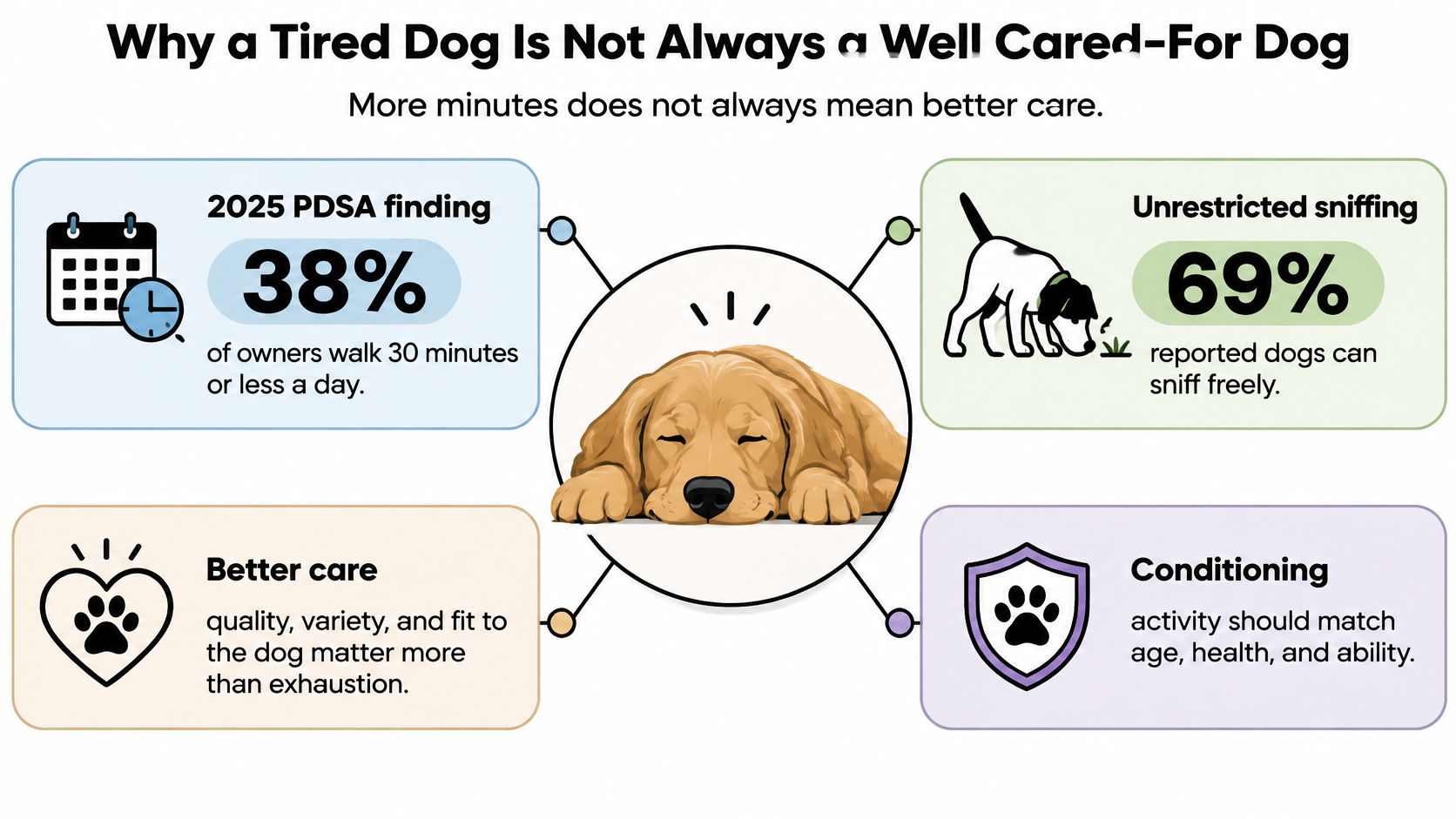
The 2025 PDSA survey found that 38% of dog owners walk their dogs for 30 minutes or less per day , while 69% reported unrestricted sniffing or exploration and 69% reported interaction with other dogs . Urban owners were less likely to have opportunities for several forms of enrichment. Those figures show why minutes alone don't describe what the dog got to do.
Judge the Outing by the Dog's Response
| Sign | Settled sign | Stop sign |
|---|---|---|
| Recovery | Back to normal breathing soon after the outing | Still panting or restless long after |
| Willingness | Keeps choosing to move and sniff | Refuses, freezes or wants to turn back |
| Pulling and scanning | Loose leash and relaxed scanning | Hard pulling and constant scanning |
| Avoidance | Approaches the route and people calmly | Avoids the route, hides or tucks tail |
| Settling | Lies down and rests afterward | Pacing or cannot settle |
A short, scent-rich loop can meet welfare needs better than a forced march. Letting a dog stop, sniff, and choose a line through the grass gives her information and some control. Dragging her past every smell to hit a distance goal removes much of that value.
The opposite mistake is also real. An athletic dog may need structured conditioning that casual wandering won't replace. Sniffing doesn't build the same cardiovascular workload as a run or hike, so fit the outing to the dog in front of you.
Use concrete adjustments. A newly adopted dog may need short, predictable routes near home. A fearful dog may need distance from triggers more than distance covered. A reactive dog may do better on quiet streets at off-peak times, while a senior dog may need frequent short outings on forgiving surfaces. An overweight dog needs gradual workload, and an easily wound-up dog often needs a calm sniffing finish instead of one last exciting game.
Response check: If your dog recovers normally, stays willing, and settles afterward, the outing likely fit. If she's wired, avoidant, or still panting long after, more mileage isn't the answer.
Maximizing mileage can worsen arousal or stress. Brief any walker, hiker, or sitter with the signs in the table, not just a target time. Tell them what a good finish looks like for your dog and when to shorten the plan.
A Sample Weekday Routine in the Dog's Own Home
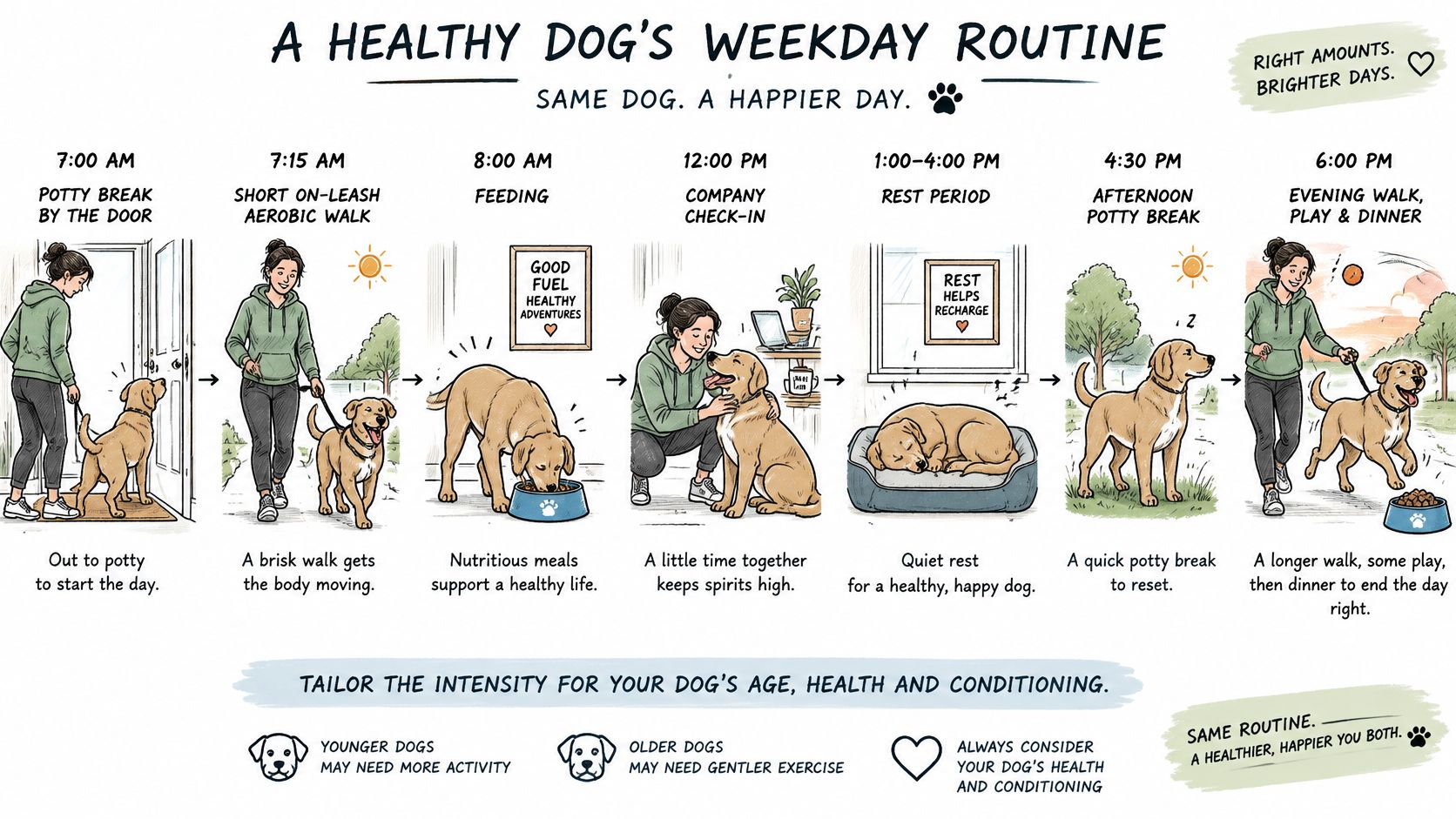
This sample day is for a healthy adult dog in a busy household. Scale the intensity for age, health, conditioning, and behavior, and clear vigorous exercise with your veterinarian when there's any doubt. The value is in the sequence, so you can hand it to a caregiver without guesswork.
A Day You Can Hand to a Sitter
- Before departure: Give a potty break and an on-leash aerobic outing, then allow time to settle before the door closes. For separation anxiety, the ASPCA separation anxiety guidance recommends at least 30 minutes of aerobic activity every day , giving running and swimming as examples, and advises exercising immediately before the owner leaves.
- At departure: Leave part of breakfast in a food-dispensing toy or scatter small portions of kibble for searching instead of using only a bowl. Supervise a new puzzle the first time, match difficulty to persistence, rotate toys, and discard broken pieces.
- Midday drop-in: Refresh water, give a potty break, take a sniff-heavy walk, and leave a short note on appetite, stool, and energy. This visit breaks up alone time and catches changes early.
- After the visit: Keep the house quiet so the dog can decompress and sleep. Don't stack another high-arousal game immediately after the caregiver leaves.
- On your return: Choose a slower exploratory walk if midday work was hard. Choose a second structured outing only if your athletic dog has recovered and settled normally.
That predictability matters because alone time isn't automatically easy for young dogs. A Generation Pup longitudinal study in Animal Welfare found 68 dogs, 46.9% of the sample , met its definition for separation-related behaviors at six months. A routine doesn't promise alone time is harmless. It gives the dog predictable company and gives you earlier warning when behavior changes.
Prepare the resting area as part of the handoff. Washable protection on the dog's usual couch spot can make accidents and muddy paws easier to manage, and you can browse waterproof sofa covers if your dog is allowed on furniture. Keep chew items appropriate to your dog, and remove anything that can break into swallowable pieces.
Write down meal amounts, medication timing, where the leash hangs, and which behaviors mean the sitter should call you. Add a simple home-monitoring step. Log appetite, stool quality, energy, and body condition at regular intervals, weigh on the same scale, and agree with your veterinarian which changes trigger a call.
Denver Heat Pavement and When to Cancel the Outing
Run the go or no-go check before anyone clips on the leash. Denver's dry heat, strong sun, elevation, hot pavement, and fast weather swings can make a pleasant-looking day unsafe. A fit dog is not heat-proof, and conditioning can tempt people to push intensity past what conditions allow.
| Check | Go | Stop or change the plan |
|---|---|---|
| Air and time of day | Cool morning and a dog already used to the weather | Midday sun, sudden heat or poor recent acclimatization |
| Dog type | Normal breathing and a healthy body condition | Brachycephalic, overweight, senior or not yet fit for the workload |
| Surface | Grass, shade or a tested cool path | Hot asphalt, broken glass, holes or very uneven ground |
| During the outing | Easy pant and the dog still willing to continue | Staggering, vomiting, diarrhea or obvious distress |
| After the outing | Drinks, settles and returns to normal | Will not settle, gastrointestinal signs, or any collapse risk; seek veterinary care |
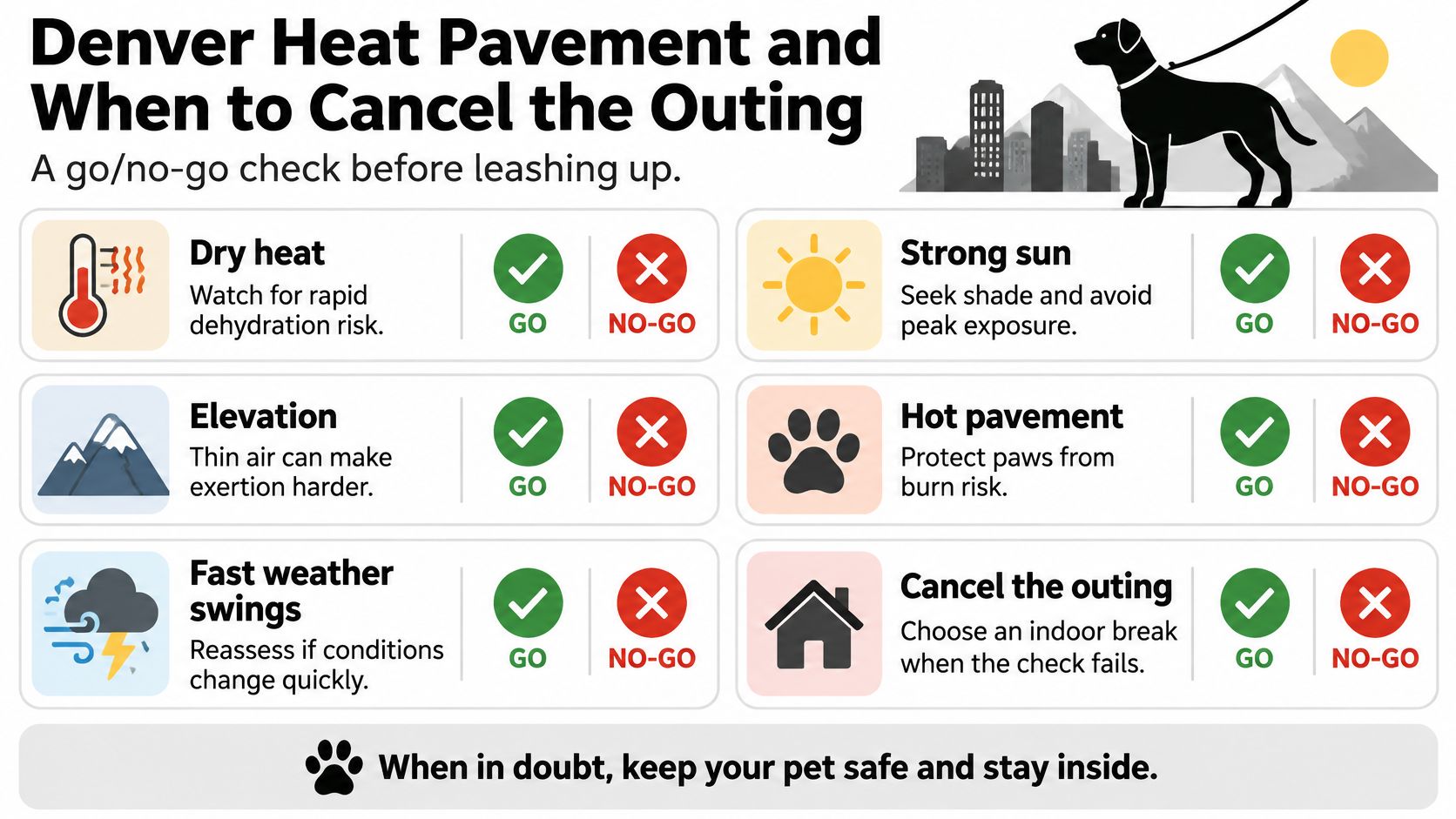
The American Veterinary Medical Association guide to walking your pet warns that brachycephalic, or short-nosed, and overweight dogs may need more frequent rests, shorter walks, or a schedule that avoids the hottest hours. It also cautions that hot sidewalks, roads, and other surfaces can burn paw pads and recommends grass when conditions are extremely hot. Heat stress can progress to heat exhaustion, heat stroke, and death without immediate veterinary care, with warning signs that include staggering, vomiting, or diarrhea.
How to Apply the Check
- Check the surface first: Choose grass, shade, or a tested cool path, and avoid broken glass, holes, and very uneven ground. Our complete guide to dog paw protection in heat covers surface choices in more detail.
- Carry water for both of you: Pack it before you leave rather than hoping for a fountain. These reusable travel bottle tips from HYDAWAY are useful if you need a compact bottle you will bring on short neighborhood routes.
- Shorten early: Reduce duration or intensity at the first change in breathing, willingness, or gait. Don't wait for the planned loop to finish.
After the outing, your dog should drink and settle back to normal. If she won't settle, shows vomiting or diarrhea, staggers, or seems at risk of collapse, call a veterinarian rather than offering another lap. Fitness doesn't override those signs.
Put the stop rules in the sitter notes next to the veterinarian's phone number, where the caregiver will see both before leaving.
Canceling the run doesn't mean canceling care. A caregiver can give a shaded potty break, fresh water, indoor enrichment, and a calm check-in, then reschedule the workload for a cooler window. That's safer than completing an outing just because it was booked.
How to Vet the Person Coming Into Your Home
Before handing over a key, make sure the caregiver can follow your dog's routine inside the home as carefully as they handle an outing. They may need to secure doors, follow medication timing, and respond calmly when plans change. Ask clear questions, then agree on the details in writing.
Six Checks Before the First Visit
- Background check and recurring training: Ask whether staff are background-checked and how often they receive training. Denver Dog staff receive recurring training in canine handling, fitness, and welfare. Use this dog handler qualifications guide for pet owners to help assess what a provider should be prepared to discuss.
- Bonded and insured: Ask what the policy covers inside a client's home. Denver Dog is bonded and insured, and specializes in canine fitness.
- Home walkthrough: Show the caregiver where you keep medication and food, how doors and gates latch, and where your dog tends to hide or try to escape. A walkthrough makes the home routine concrete.
- Access rules: Agree how keys, alarms, and entry codes will be handled and returned. In a gated multifamily community, an apartment gate entry app may help coordinate controlled entry.
- Written updates: Set a clear method for check-ins and photo updates, and agree who contacts whom if the visit runs late or plans change. Denver Dog emphasizes GPS-tracked check-ins and photo updates.
- Emergency thresholds: Write down the veterinarian's number and the signs that mean the caregiver should stop an outing and seek help.
Local rules are another practical test. Denver Dog works with pet parents across the Denver metro. The Denver Parks and Recreation park use rules require dogs to be restrained by a leash no longer than six feet on trails and park roads. Denver's general park policy also requires pets to remain leashed and under physical control. A reliable recall does not replace a leash where one is required.
Dog parks have their own entry and exit rules. The Denver dog parks page says dogs must stay leashed until they enter the designated park and be leashed again before leaving. The responsible person must keep the dog in view and under control. Unlighted dog parks are open from sunrise to sundown; lighted dog parks are open from 5 a.m. to 11 p.m.
For service-area details, check Denver Dog's service area page. A friendly first message cannot replace written answers. If a provider avoids clear answers about home access, updates, or emergencies, keep interviewing.
Costs, FAQs and Booking Your First Visit
The billing unit usually matches the care format. Drop-in visits are billed per visit, while overnight stays and multi-day in-home boarding are billed per night. Medication, extra pets, holiday care, and constant care can affect the total. For walks, Denver Dog offers a lower per-walk price when clients buy a package or choose a consistent weekly plan.
Before booking, ask for a written rate sheet . Check what the base visit or night includes, how medication and extra pets are priced, and what applies to holidays, constant care, and cancellations. Confirm the current rate directly with the provider.
Common Questions
- Can my dog be alone for a full workday? Plan for a drop-in or walker to cover the middle of the day. A visit provides a chance for relief, water, and exercise, but your dog may still spend part of the day alone.
- Does my dog need a sitter if she's calm alone? Not necessarily. If she eats, rests, and settles comfortably, a midday visit may be enough instead of overnight or all-day care.
- What if my dog has separation anxiety? Ask your veterinarian for guidance, then consider starting with a short trial. Denver Dog offers a trial session prospective clients can schedule, which lets you see how your dog responds.
- Do I need to be home for the first visit? You do not need to stay for the booked care, but attend the meet-and-greet. Use that time to review entry, feeding, medication, and emergency instructions.
Denver Dog offers a free meet-and-greet at the client's home and lists an Overnight Dog Sitter Service among its services. Bring your routine, medication schedule, veterinarian's number, and any care instructions. Watch how your dog responds to the person and the setting before relying on a new routine for a workweek or trip.
Denver Dog works with pet parents across the Denver metro. The free in-home meet-and-greet is the next step: use it to discuss your dog's needs and whether the service fits your household.
If a workday leaves your dog alone for a long stretch, Denver Dog offers walks, runs, hikes, and overnight care. Start with the free meet-and-greet and explain your dog's usual routine, energy, and recovery needs. A good care plan should fit the dog's life at home, not just fill the hours.
The Run Down