You've probably started with a simple idea: walk a few neighborhood dogs before or after work, earn dependable income, and spend more time outside. The first clients often arrive through friends, a neighborhood group, or a veterinarian's recommendation. The difficult part begins when several dogs need care at the same time, a leash slips on a public path, a storm changes the route, or a “quick walk” takes much longer than planned.
How to start dog walking in Denver is less about collecting bookings and more about building a controlled weekday service. You need a legal foundation, exercise-matching intake process, defensible pricing, safe routes, reliable communication, and clear limits on what you and your handlers can manage. Denver's parks, Front Range trails, traffic, weather, and driving distances make casual systems fail quickly.
What Starting a Dog Walking Business in Denver Actually Involves
A casual walker sells availability. A professional operator sells predictable care . That difference affects every decision, from the first phone call to the final visit log.
The local opportunity is substantial. In 2024, 45.5% of U.S. households owned at least one dog , representing approximately 59.8 million households , and the national dog population reached 89.7 million , according to the American Veterinary Medical Association's U.S. pet ownership statistics. The same source reports that 88.8% of dog owners consider their pet a family member . Owners may therefore evaluate a service on reliability, safety, communication, and welfare, not only on the lowest price.
A Denver-area business can start narrowly. Choose a practical service area such as Arvada, Denver, Englewood, Golden, Lakewood, Littleton, and Wheat Ridge , then design routes around a specific customer group. Busy professionals may need recurring midday walks. High-energy dogs may need structured runs. New adopters may need calm, consistent outings rather than maximum distance.
Practical rule: Don't accept every dog simply because your calendar has space. A poor-fit booking can consume the time and capacity of several suitable clients.
The first 90 days should be treated as a controlled launch. Establish the business and insurance structure first, test your intake form and agreement, then begin with a manageable number of dogs on one or two compact routes. Use daily debriefs to identify overruns, equipment problems, unsafe interactions, and communication gaps before adding capacity.
Your core decisions are straightforward, but none is optional:
- Legal setup: Confirm registration, tax, zoning, licensing, vehicle, and insurance requirements.
- Service design: Separate neighborhood walks, fitness-oriented runs, and trail hikes instead of selling every outing as the same product.
- Screening: Match exercise to age, conditioning, health, behavior, equipment, and weather tolerance.
- Operations: Build routes that reduce driving and protect time for handoffs, notes, and emergencies.
- Marketing: Favor recurring weekday clients and local referrals over broad attention that doesn't produce route density.
Legal Setup, Licensing, and Insurance in Denver and Colorado
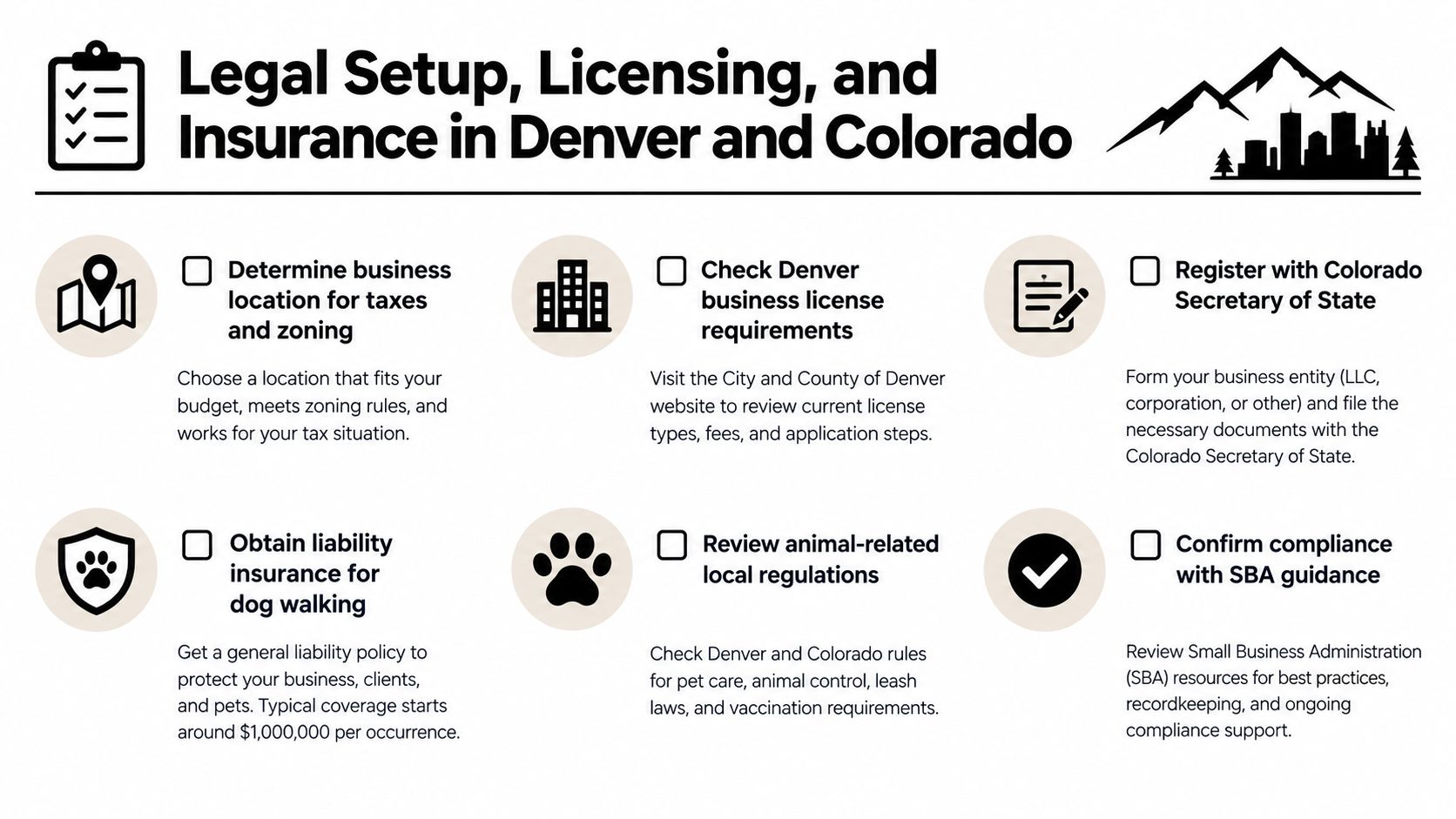
Registering a business name is only one part of becoming operational. The U.S. Small Business Administration explains that a business's location determines applicable taxes, zoning laws, and regulations, while registration, licensing, and permitting requirements and fees can vary by state, county, city, and business activity.
Start by identifying where the business is based and where services will be performed. Confirm the appropriate structure and registration with the Colorado Secretary of State , then check requirements with each municipality where you regularly operate. Denver, Lakewood, Arvada, Golden, Englewood, Littleton, and Wheat Ridge may have different local processes, so don't assume that one city's approval covers the others.
Verify the operating details
Use this checklist before advertising:
- Business registration: Confirm the required Colorado registration and any trade-name filings.
- Local licensing: Ask each relevant city whether a general business license, home-occupation approval, or pet-service requirement applies.
- Tax obligations: Check state and local tax responsibilities, particularly if you sell products or add taxable services.
- Vehicle rules: Verify commercial-use, registration, and insurance requirements if dogs are transported.
- Park and trail rules: Review leash, access, parking, hours, and animal-control requirements for every route.
- Animal-care regulations: Ask the relevant local offices whether additional rules apply to the number of animals handled or the way services are delivered.
Insurance should match the actual work, not an imaginary version of it. A policy for ordinary consulting work may not address animal injury, third-party property damage, lost keys, transportation, or incidents involving a dog in your care. If you also offer consulting or administrative services, resources such as protect your consulting business can help explain broader business-risk considerations, but dog walking still requires advice suited to animal care.
Create a written client agreement covering service scope, cancellations, access, emergency veterinary authorization, medical disclosures, equipment, payment, and incident communication. For a deeper operational review, see this dog-walking insurance guide for owners. If you hire staff, confirm obligations involving workers' compensation, unemployment, and disability insurance, which can vary by state.
The policy matters, but so do the controls behind it. Document hiring standards, driver checks, training, route procedures, equipment checks, and incident reporting. Insurers and clients can trust a system they can understand and review.
Pricing Dog Walks, Runs, and Hikes for Denver Operators
Copying another walker's price list is a fast way to inherit someone else's margins. Your rate must account for care time, driving, handoffs, equipment, communication, cancellations, weather, and risk , not just the minutes spent moving a dog down a sidewalk.
A solo neighborhood walk can use a simple per-visit price. Recurring clients may receive a package structure that rewards predictable scheduling without making every visit negotiable. Runs and hikes should command more because they can require conditioning expertise, route planning, transportation, trail access, equipment management, and additional recovery monitoring.
| Service type | Typical Denver range | Key cost driver | Best for |
|---|---|---|---|
| Solo neighborhood walk | Validate locally before publishing | Visit time, handoff, and route density | Dogs needing dependable weekday exercise |
| Recurring walk package | Validate locally before publishing | Schedule consistency and cancellation exposure | Busy professionals booking regular care |
| Structured run | Validate locally before publishing | Fitness matching, pace, recovery, and handler skill | Conditioned, high-energy dogs |
| Front Range hike | Validate locally before publishing | Driving, trail time, weather, parking, and equipment | Dogs ready for supervised trail activity |
The table intentionally avoids a made-up “standard” price. Research nearby competitors, then calculate the time from leaving one client to arriving at the next. A route with generous-looking visit prices can still lose money when appointments are scattered across the metro area.
Use add-ons only when they represent real extra work. A multi-dog fee may apply when dogs require separate handling or different paces. Holiday pricing can reflect limited availability. A sibling-dog discount may be reasonable when both dogs can safely follow one plan, but not when one dog requires a separate walk. Runs and hikes should be priced separately if they demand more time or transport.
A profitable rate is the amount that lets you deliver the promised care without rushing the next handoff.
Weather creates another pricing issue. If a hot afternoon turns a planned run into a short, slower walk, your policy should explain whether the visit is substituted, shortened, rescheduled, or charged as booked. Don't make the decision during a tense client call. Publish the rule before service begins.
For a more detailed framework, review this Denver dog-walking rates guide. Your final menu should be short enough to understand and specific enough to prevent custom negotiation on every booking.
Client Intake and Onboarding Without the Guesswork
A Denver inquiry can sound simple: a weekday walk, a weekend run, or a foothills hike. The operational decision is harder. Before accepting payment, determine whether the dog's health, behavior, equipment, conditioning, and route fit the service you sell.
Denver requires dogs and pets to be on a leash and under physical control at all times in general park areas . Handlers must also have a leash available inside designated dog parks, according to the City and County of Denver's dog-park rules. Leash control is therefore part of intake, not a skill to develop after a problem.
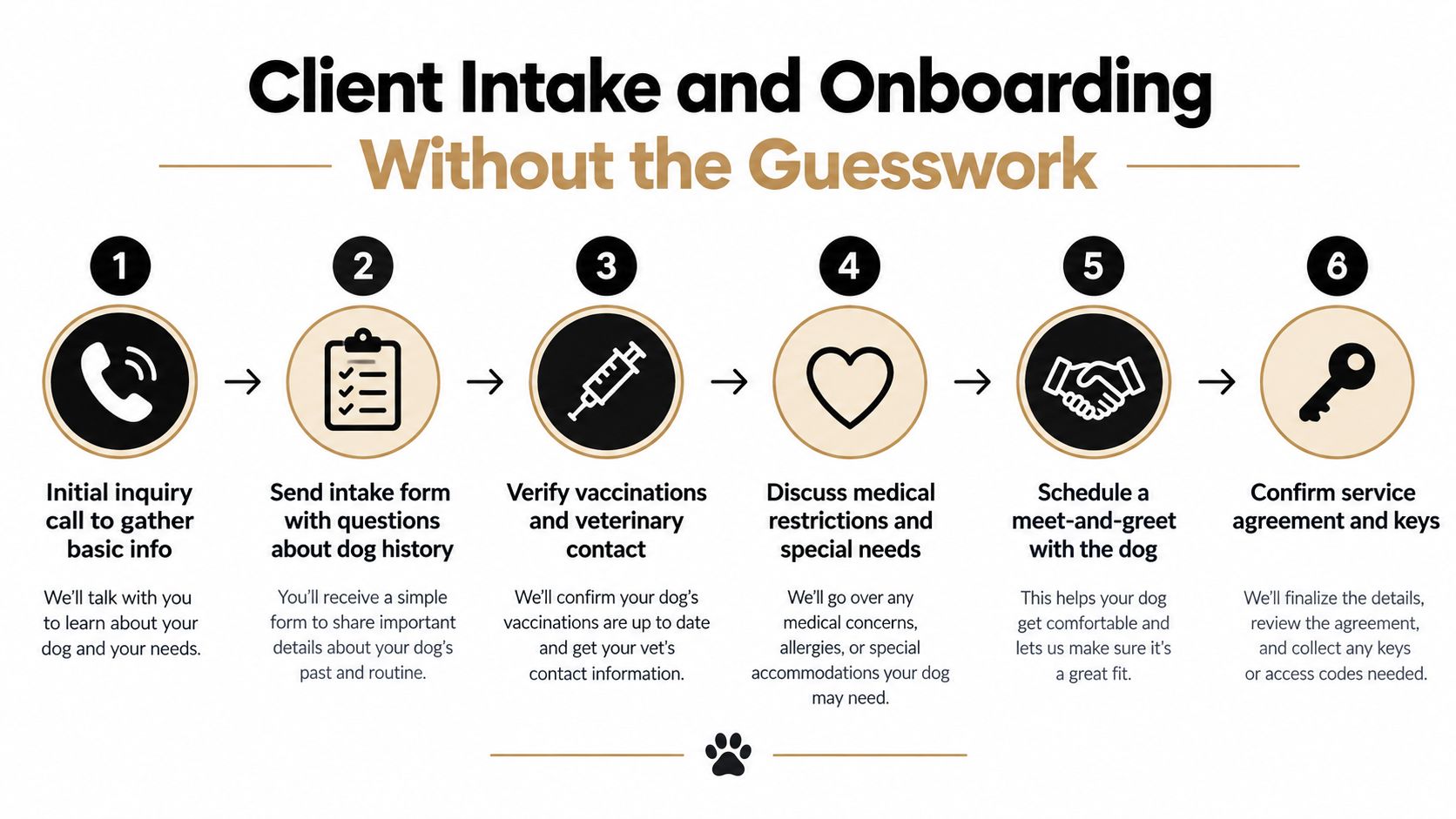
Start with a written form and a short conversation. Record vaccinations, medications, medical restrictions, veterinary and emergency contacts, current illness, and previous injuries. Ask directly about pulling, barking, lunging, resource guarding, bites, dog conflicts, stranger reactions, and escape attempts. Owners may minimize difficult behavior when they want a booking, so ask for specific examples rather than relying on labels such as “friendly” or “high energy.”
Document the collar or harness, leash type, backup identification, and any equipment the owner does not want changed. Establish the dog's normal pace, walk duration, recovery, bathroom routine, triggers, and response to heat or exertion. Those details matter on Denver's warmer sidewalks, higher-elevation routes, and exposed Front Range trails.
Meet in a low-distraction area for a brief, five-to-ten-minute evaluation, then complete a short solo walk. Approve the service, modify it, postpone it, or decline it based on what you observe and what the owner discloses. A dog that handles a neighborhood walk may still be unsuitable for a run, group outing, or rocky hike.
The American Veterinary Medical Association's walking guidance supports short, frequent walks at first, properly fitted collars or harnesses, safe footing, leash-law compliance, and monitoring for lameness, breathing difficulty, and rapid fatigue. Turn those principles into written go or no-go rules. Breed alone does not establish conditioning or behavior.
Postpone exercise for illness or injury. Keep dogs with aggression histories separate unless your training, staffing, equipment, and environment support the risk. Begin with one dog per handler until control, route familiarity, and emergency procedures are demonstrated. Record the owner's preferred communication method and the exact permission required for emergency veterinary care. Clear records protect the dog, the owner, and the person holding the leash.
Building a Safety System That Owners and Insurers Trust
A loose harness on a Denver sidewalk can become a traffic incident within seconds. Build safety controls around leash failure, dog conflict, heat exposure, vehicle movement, public interaction, wildlife encounters, falls, bites, and urgent veterinary decisions before accepting regular bookings.
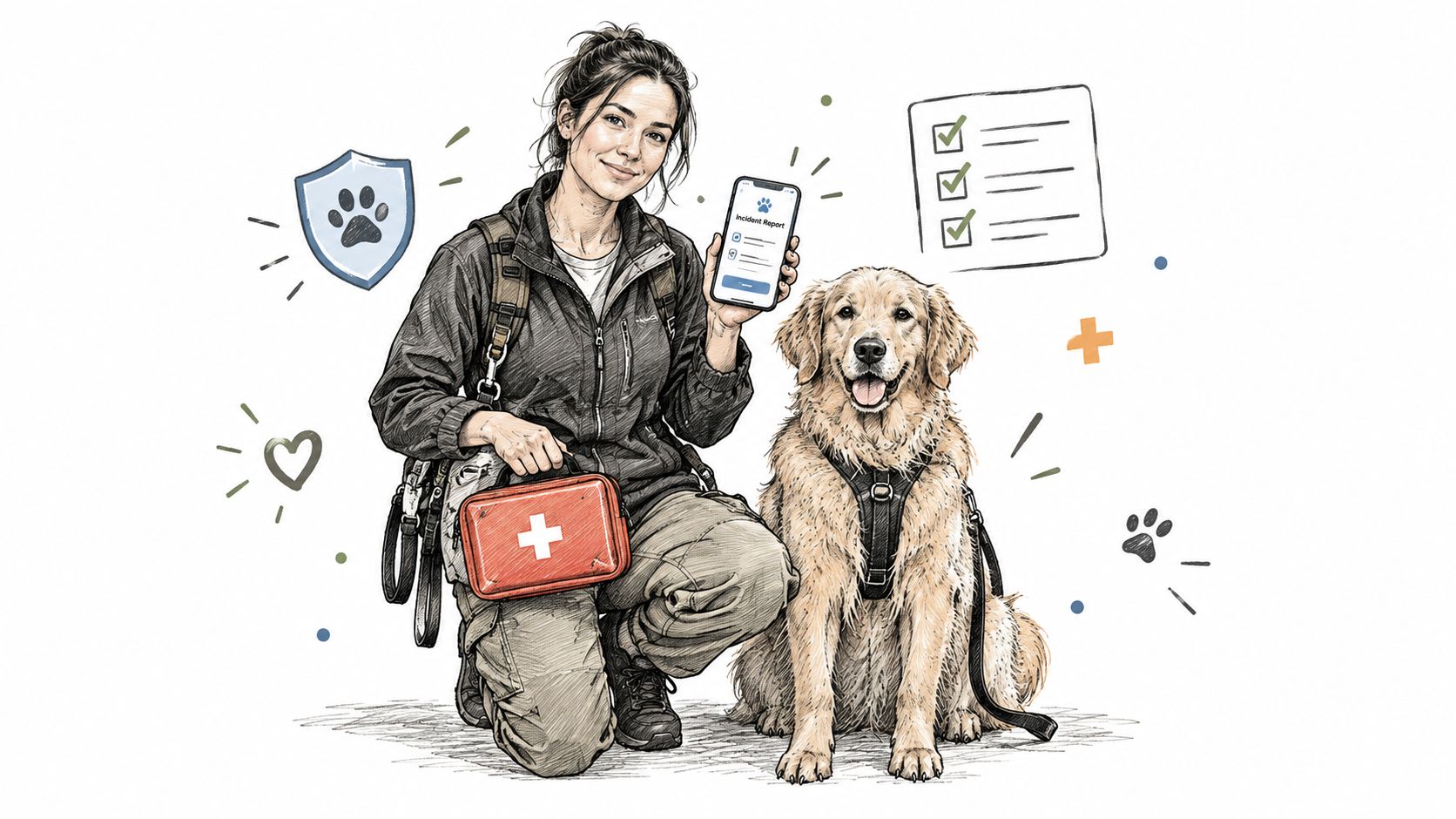
Screen every handler for practical competence, not just availability. Review driving history, references, canine-handling experience, training, first-aid capability, and comfort with written procedures. A criminal screening process, such as a volunteer background check, adds useful information, but it does not replace reference checks, driving review, a handling assessment, or supervised field training.
Give each handler a clear operating map: where equipment is stored, how keys are secured, how dogs move from home to vehicle or trail, and what to do if a harness slips. If vehicles use cameras or telematics, explain their purpose, who can access recordings, how long information is retained, and how consent works. Monitoring may support safer driving, while clear privacy policies protect client trust.
Use one incident record for every event, even when nobody appears hurt. Write down the time, location, weather, route, equipment condition, behavior observed, actions taken, witnesses, appropriate photos, and owner notifications while details remain fresh.
A practical response sequence
Start by securing the dog and moving away from traffic or conflict. Check people and animals for immediate injury. Call emergency services when someone faces urgent danger or needs medical care, then contact the owner and veterinarian according to the service agreement.
Control the scene by preventing further greetings and keeping unfamiliar people away. Preserve equipment involved in a failure. After the immediate response, pause the affected service and decide whether the route, equipment, staffing, screening, or training needs to change.
The CDC's dog-safety guidance reports that nearly one in five people bitten by a dog requires medical attention . It advises avoiding dogs while they eat, sleep, or care for puppies, and leaving alone dogs that appear to be hiding or seeking space. Handlers should not initiate greetings or allow client dogs to approach strangers or unfamiliar animals without permission.
For a practical visual explanation of routine and emergency handling, use this video as a discussion aid with your team:
Front Range routes demand a separate decision rule. Heat, altitude, exposed surfaces, sudden weather, wildlife, paw irritation, and distance from immediate assistance can turn a normal hike into an emergency. Write down when to shorten the outing, return to the vehicle, substitute a neighborhood walk, or decline the trail. That policy gives handlers a defensible choice when conditions change faster than the booking schedule.
Running a Reliable Weekday Schedule in the Denver Metro
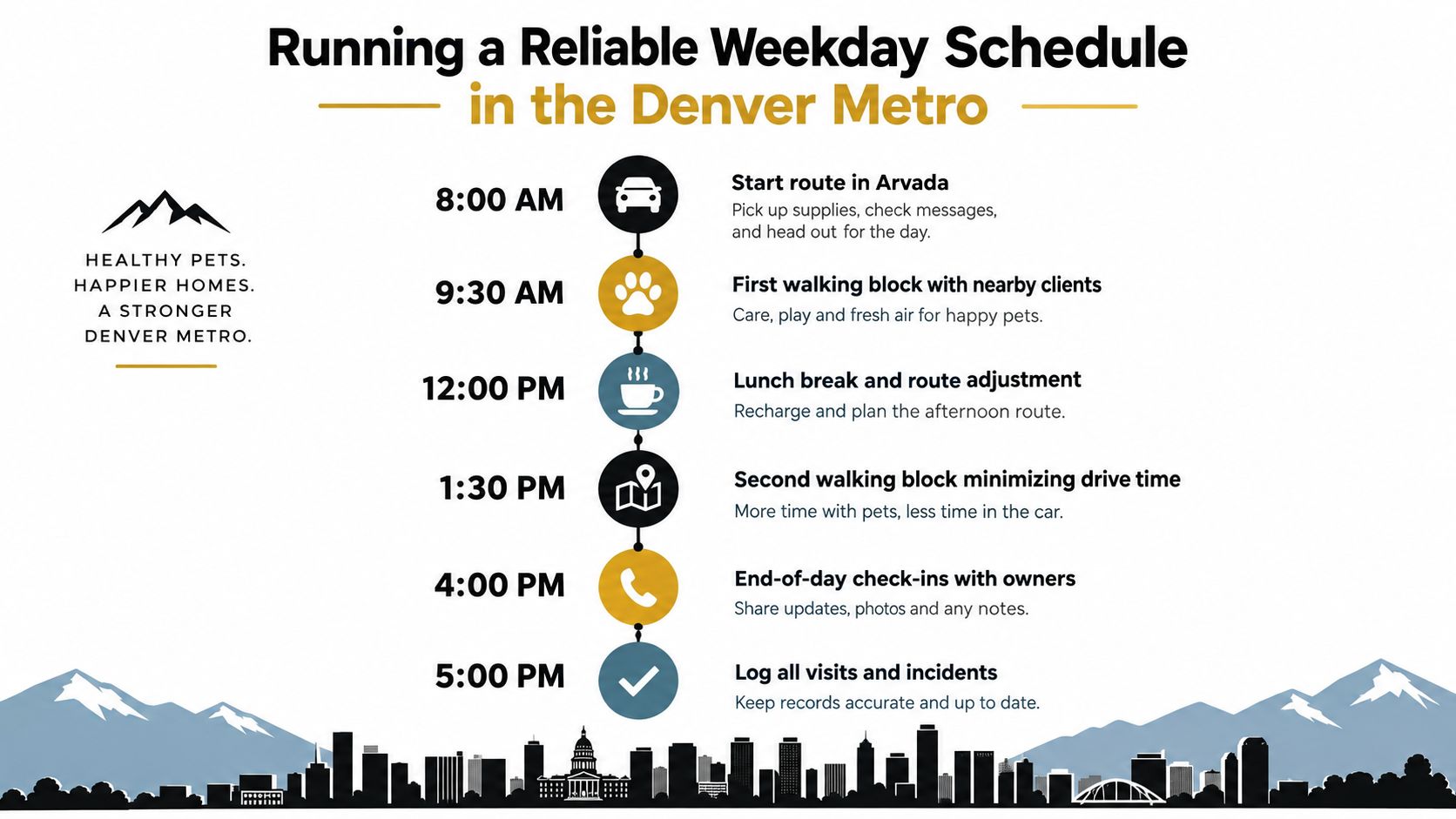
A busy weekday starts with a route that can absorb real delays. On-time arrivals, calm handoffs, complete notes, and recovery time protect client trust more effectively than a calendar packed with isolated bookings.
Group appointments by geography. An Arvada morning block could lead into central Denver, while Lakewood, Golden, Littleton, Englewood, or Wheat Ridge receives its own day or time window. Set clear service boundaries instead of promising every neighborhood at every hour. A compact route with fewer gaps usually produces better care and more usable capacity than hours spent driving across the metro.
Match the session to the dog
A conditioning walk or run has a different job from behavior support. Exercise may build steady fitness at an appropriate pace. Behavior work may require trigger distance, calm leash handling, recovery time, and safer route choices. Set the service around the dog's condition, behavior, and the day's weather, rather than promising a fixed distance.
Apply the same AVMA principles already cited: start with short, frequent walks, use properly fitted collars or harnesses, choose safe footing, and watch for lameness, breathing difficulty, or rapid fatigue.
Use five operating rules:
- Weather rule: Replace a run with a slower walk or enrichment visit when heat, storms, smoke, or poor footing raises the risk.
- Capacity rule: Set a handler limit that leaves time for delays, equipment checks, and incident response.
- Route rule: Keep recurring clients in repeatable geographic blocks instead of crossing Denver for isolated appointments.
- Recovery rule: Record fatigue, paw problems, breathing changes, or unusual behavior before increasing exercise.
- Communication rule: Send a concise completion note covering substitutions, delays, and concerns.
A dependable day also includes loading, water, traffic, owner messages, and equipment checks. The midday dog-walker guide for busy professionals can help shape weekday services around predictable coverage rather than last-minute availability.
Review the schedule each evening. Repeated overruns point to a route or capacity problem. Walking faster only transfers that problem to the next appointment.
Marketing That Fills Weekdays Without Burning the Budget
Local dog walking is a proximity business. A polished social profile may attract attention, but a recurring client who lives near three other appointments is more valuable than a distant inquiry that creates a long drive and an empty gap.
Start with a clear service-area message. Name Arvada, Denver, Englewood, Golden, Lakewood, Littleton, and Wheat Ridge where those locations fit your routes. Create a useful Google Business Profile, keep contact details consistent, publish service descriptions that distinguish walks, runs, and hikes, and ask satisfied recurring clients for honest reviews. Don't promise trail access, pickup, group handling, or advanced exercise unless your operating system supports it.
Veterinary clinics, trainers, groomers, shelters, and pet-care professionals can become strong referral partners. The AVMA reports that 86.8% of dog owners have a regular veterinarian or veterinary practice , and 74.2% had visited a veterinarian during the preceding year in its U.S. pet ownership data. Those relationships work best when you present a concise referral sheet covering service area, screening standards, emergency contacts, and the dogs you're equipped to handle.
Convert inquiries into recurring routes
A one-time walk can become a recurring appointment only if you ask useful questions:
- What days and time windows are consistent?
- Does the dog need exercise, behavior support, companionship, or a combination?
- Can the owner commit to an ongoing schedule?
- Does the route fit existing clients?
- What would make the service feel successful after the first few visits?
Avoid competing only on price. Explain what clients receive: documented intake, leash control, exercise matching, completion notes, weather substitutions, and a defined escalation process. Educational content can support that message. For broader ideas about local visibility and content planning, review ClipCreator.ai's marketing tips, then adapt the ideas to neighborhood-level demand rather than chasing broad reach.
Use a 30-60-90 day launch plan
Days 1 through 30, foundation
- Complete registration, local requirement checks, and insurance review.
- Write the service agreement, cancellation policy, emergency authorization, and incident form.
- Build the intake questionnaire and trial-walk checklist.
- Map compact routes and identify weather-safe alternatives.
- Contact local clinics, trainers, groomers, and relevant community groups.
Days 31 through 60, controlled launch
- Start with three to five dogs that fit your handling capacity.
- Operate one or two routes rather than serving the entire metro at once.
- Debrief every day and record schedule overruns, equipment concerns, dog conflicts, and owner communication issues.
- Ask recurring clients for reviews after you've delivered dependable service.
- Adjust pricing when driving, handoffs, or documentation consume more time than expected.
Days 61 through 90, steady state
- Fill open weekday slots near existing appointments.
- Publish clear limits on dog numbers, trail eligibility, weather substitutions, and service areas.
- Track recurring-client rate, route density, utilization, cancellations, and incident patterns.
- Add a handler only after the intake, training, driving, monitoring, and reporting systems are documented.
Pause growth if appointments repeatedly run over, dog conflicts are increasing, veterinary instructions are being missed, or one client represents too much of the schedule. More bookings won't repair a weak operating system. Fix the route, screening, staffing, or communication process first.
If you're building a Denver-area dog-walking service, start this week by writing the intake form, mapping one compact route, and checking the requirements for your operating municipalities. Then test the complete client journey with a small group of suitable dogs before you market for volume.
Denver Dog offers weekday on-leash walks, structured runs, and guided hikes through its Denver Dog Joggers and Denver Dog Hikers programs, with exercise matched to each dog's energy level and temperament. Visit Denver Dog to explore service areas and request professional care designed for safe, consistent exercise in the Denver metro.
The Run Down