You're halfway down the sidewalk with a six-pound terrier when a Labrador sweeps past, pulling confidently toward the next lamppost. Your terrier crouches at the curb, startled by the noise and size difference, while you call for both dogs to settle down. That moment captures why small dog walking needs more than scaled-down large-dog advice.
A small dog sees the neighborhood from a lower, busier vantage point. Shoes, wheels, storm drains, hot pavement, open gates, and off-leash dogs all occupy more of the route. The practical answer isn't “walk farther.” It's to build a controlled outing with the right equipment, shorter purposeful sessions, safer surfaces, and enough visibility for the dog to make good choices.
This guide shows how to create confident urban walks, preserve conditioning instead of carrying your dog everywhere, and troubleshoot the failure points that generic walking advice overlooks. If you manage walks for clients or coordinate a regular route, a dedicated walking tour payment system can also simplify scheduling and payment while you focus on the dogs.
Why Small Dog Walking Deserves Its Own Approach
Small dogs are often treated in two contradictory ways. Handlers may over-exercise them because they assume a tiny body can work like a miniature large dog, or under-protect them because they assume a small breed needs little movement. Both approaches miss the actual challenge: small-dog exercise must be controlled, visible, and appropriate to the individual dog .
At street level, a small dog can disappear behind parked cars, landscaping, or a person's legs. On a busy sidewalk, a passerby may not see the dog before stepping sideways. The San Francisco SPCA specifically warns that small dogs can be stepped on in city settings and recommends keeping them close to your side on a 4-foot leash . That's a route-management rule, not a cute accessory.
Pavement creates another problem. Asphalt absorbs heat, and small paws sit close to it. A route that feels manageable to an adult may expose a small dog to uncomfortable or unsafe footing, especially when shade disappears around midday. Carrying the dog avoids those immediate hazards, but carrying every difficult stretch can reduce conditioning and leave the dog less prepared for ordinary walks.
Practical rule: Don't ask whether the walk is long enough until you've asked whether the dog can see, breathe, move, and recover comfortably along the route.
The small-dog trade-off
A confident, athletic Jack Russell Terrier may need a more active outing than a quiet companion breed, while a senior dog may benefit from a flat loop with frequent pauses. The right plan balances movement with protection. More exercise isn't automatically better if the route increases escape risk, stepping risk, heat exposure, or fear.
For Denver-area owners, this matters on sidewalks, neighborhood paths, and busy mixed-use streets alike. A short route with predictable crossings and clear sightlines can produce better behavior than a longer route full of surprises. The goal is a dog that finishes engaged and comfortable, not one that is solely exhausted.
How Much Walking Small Dogs Actually Need
Population data shows that small dogs are commonly under-walked compared with larger dogs. In a UK sample of 5,006 dogs , 79% of small dogs received exercise at least once per day, compared with 85% of medium dogs and 88% of large dogs . The same dataset found that 55% of small dogs were exercised for more than 30 minutes, compared with 72% of medium dogs and 75% of large dogs . Small dogs represented almost half, 45% , of all dogs exercised for less than 30 minutes. These figures come from the reported UK dog-walking statistics.
That gap doesn't mean every small dog needs a longer walk. It means size alone shouldn't be used as a reason to skip regular movement. A Chihuahua, Lhasa Apso, Papillon, Pomeranian, or Yorkshire Terrier may commonly be recommended more than 30 minutes of daily exercise, and some small breeds may need more than an hour, depending on health, age, breed traits, and temperament.
U.S. National Household Travel Survey analysis offers a useful behavioral baseline. 67% of dog walkers took at least one walk of 10 minutes or more in a day, 20% walked a dog for at least 30 minutes in a day, and 28% took more than one dog walk that day, according to the peer-reviewed analysis of dog-walking behavior. Most outings are therefore relatively short, and multiple daily walks aren't universal.
Start with sessions, not a single target
Two or three short sessions often work better than one demanding outing. Separate brisk movement from sniffing. A slow sniff walk may be valuable enrichment, but it shouldn't automatically be counted as sustained conditioning.
| Weight Class | Daily Minutes | Sessions Per Day | Notes |
|---|---|---|---|
| Toy and very small | Short, repeated sessions | Two or more | Prioritize footing, visibility, and recovery |
| Small adult | Moderate daily movement | Two or three | Blend brisk walking with sniffing |
| Small athletic breed | Longer or more active work | Multiple sessions | Adjust for drive, fitness, and heat |
| Senior or medically limited | Brief, flexible outings | Several short sessions | Choose flat routes and stop before fatigue |
Treat the table as a starting framework, not a prescription. A young, energetic terrier may need more active play or a brisker pace than a calm Cavalier. A senior dog may need a shorter, flatter route even if the dog still wants to go.
Choosing the Right Harness, Collar, and Leash
Equipment should solve a specific handling problem. Start with the dog's walking behavior, neck sensitivity, escape risk, and ability to stay beside you, rather than choosing a product because it looks comfortable.
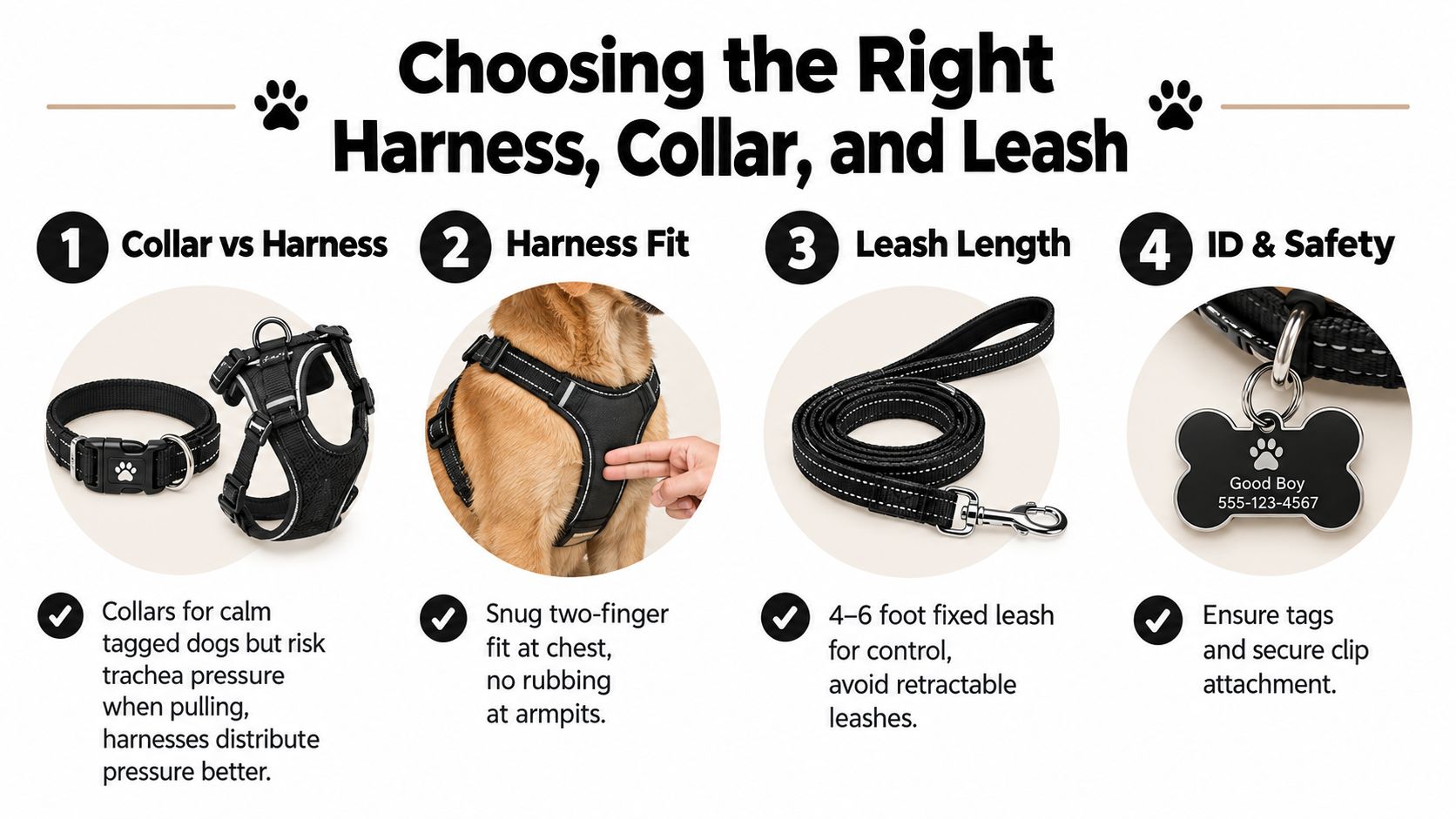
A collar can work for a calm, tagged small dog that already walks politely. It becomes a poor default when a Yorkie or other small dog repeatedly hits the end of the leash, because tension can place pressure around the throat. A well-fitted Y-front or step-in harness usually distributes pressure across the chest and torso more effectively.
Check the harness in motion
Fit the harness while the dog is standing, then watch the dog walk, turn, sniff, and step over a low curb. You should be able to slide two fingers beneath each strap without the harness shifting excessively. The chest section should sit above the sternum, and the straps shouldn't rub behind the front legs.
Look for these signs of a poor fit:
- Rubbing: Hair loss, redness, or repeated scratching behind the legs means the harness needs adjustment or replacement.
- Restricted movement: A dog shortening the front stride or resisting turns may be fighting the equipment.
- Escape gaps: If the dog can reverse out when you apply gentle backward pressure, the setup isn't secure enough.
- Loose identification: Keep tags attached and check that the leash clip is fully closed before leaving.
A fixed leash of 4 to 6 feet gives better control near traffic, corners, and doorways than a retractable lead. Retractable lines create changing distances and can cross a sidewalk before you have time to shorten them. A hands-free waist clip can suit runners, but only when the dog already moves predictably and the attachment point won't compromise your balance.
For a detailed collar fit reference, use this dog collar fitting guide. Groomers and pet-care businesses can also use reliable equipment education as part of efforts to boost pet grooming client referrals, especially when clients ask why a harness is safer for a pulling small dog.
Handling the Leash Without Getting Pulled or Tripped
Small dogs don't need much body weight to create a dangerous sideways movement. A sudden dart toward a squirrel, skateboard, or another dog can catch a handler with feet planted badly and eyes turned away.
A large U.S. emergency-department study recorded 422,659 adult leash-dependent dog-walking injuries from 2001 through 2020 . Being pulled or tripped by the leash accounted for 55% of the injuries, and upper-extremity injuries made up 51% . Most patients were women, at 75% , and adults ages 40 to 64 represented 47% , according to the study indexed by PubMed. The absolute risk remains low, with leash-related injuries reported at about 105 per 1 million people in 2018 and 0.04% to 0.06% of emergency-room injuries , but falls and fractures still deserve prevention, as discussed in the AVMA-linked analysis.
Use your body as the anchor
Thread the leash loop over your thumb, close your hand, and keep the leash hand near your hip or belly button. Don't wrap the leash around your wrist. If the dog surges, a closed grip connected to your body gives you more stability than an outstretched arm.
Maintain a soft J-shaped section of slack. The leash should be short enough to prevent tangling, but not tight enough to keep the dog braced against constant pressure. When passing a distraction, slide the loop lower toward belt height and shorten the working length without yanking.
Use a pre-emptive “let's go” cue before the dog locks onto a trigger. Turn smoothly, reward the dog for following, and create distance early. If the leash goes taut, become a tree. Stop moving, keep your hand anchored, and wait for slack before continuing. The dog should learn that tension pauses access, while a loose leash restores movement.
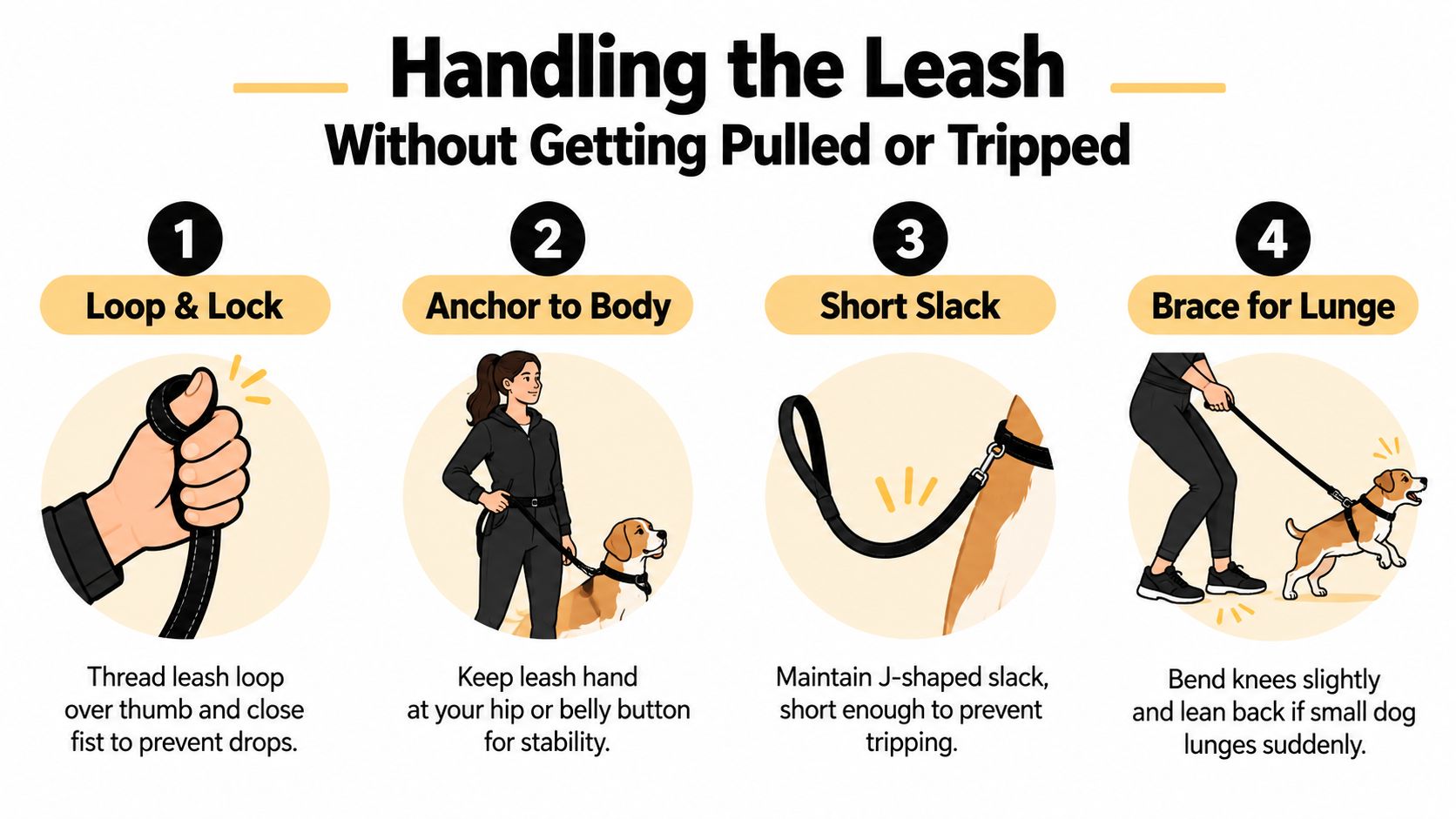
Before crossing a street or passing a narrow section, soften your knees, center your weight, and keep your eyes forward. Your forearm or hip can act as a bumper if the dog darts sideways. Don't stare down at the dog for the entire walk. Scan ahead so you can adjust before the environment forces a reaction.
This short demonstration can help you visualize safe leash handling:
Picking Routes, Surfaces, and Weather Windows
Distance is only one part of route quality. For a small dog, a quiet residential side street may be safer than a direct arterial route, even if the quieter option takes longer. A fenced park perimeter offers clearer boundaries than an open off-leash area, where fast dogs can approach from outside your control.
Choose routes with high visibility and predictable escape points . Keep the dog on the curb-side position away from gaps in fencing, open gates, and driveways. Avoid storm drains when paws or legs could slip through openings, and pause at corners where you can see cyclists, vehicles, and other dogs before entering the crossing.
Read the ground before the dog does
Grass is usually forgiving, but it can hide holes, burrs, or waste. Gravel may irritate sensitive pads. Pavement offers stable footing but can become harsh in heat or icy conditions. The AVMA recommends gradual build-up, safe footing, proper collar or harness fit, and avoiding risky surfaces or areas with free-roaming dogs in its pet walking safety guidance.
For heat, press the back of your hand to pavement for seven seconds . If you can't hold it there comfortably, choose grass or postpone the walk. One current guide identifies 10 to 20°C as ideal walking weather, 25 to 30°C as cautionary, and temperatures above 30°C as dangerous for pavement walking in its heat guidance for dogs. Other guidance advises limiting walks above roughly 29 to 32°C , with brief potty breaks only at 32°C or hotter , as outlined by Rover's hot-weather walking guidance.
| Surface | Cold under 0°C | Mild 0–25°C | Hot above 25°C |
|---|---|---|---|
| Grass | Check ice and hidden holes | Preferred for sniffing | Use shade and shorten exposure |
| Pavement | Watch for ice and salt | Fine when footing is stable | Test temperature and avoid hot stretches |
| Gravel | Avoid sharp, frozen sections | Use only if pads tolerate it | Choose grass when available |
| Asphalt | Keep sessions brief | Monitor traction | Skip hot sections and shift to cool routes |
Use the complete guide to dog paw protection in heat when summer conditions make pavement questionable. Carry water, schedule walks around rush hour and school drop-off, and favor early morning or shaded grass when temperatures rise.
Building Confidence and Burning Energy on Walks
A Chihuahua that once barked at every approaching dog may eventually pass calmly at a comfortable distance, but that change rarely comes from forcing close greetings. Start with parallel walking beside a known calm dog, keeping enough space for the Chihuahua to notice without fixating. Reward glances back, loose leash movement, and the decision to keep walking.
A shy rescue may spend the first outings pressed close to the handler. Letting that dog sniff a quiet patch of grass, rather than pulling forward toward a predetermined distance, can turn the route into a place for investigation. One rescue I've handled began sniffing within two weeks , but the important change was not the calendar. It was the repeated experience of having control over pace and space.
A senior dog that tires halfway through the route needs a shorter loop, not encouragement to “push through.” Begin nervous or senior dogs around 10 to 15 minutes , then build toward 25 to 40 minutes for steady adults when recovery, gait, and enthusiasm support the increase. These ranges are practical starting points, not universal requirements.
Mix movement with decompression
Use “find it” scatter games on grass, then ask for a three-second sit-stay at a quiet corner before crossing. A brisk section burns energy. Sniffing helps the dog process the environment and regain composure.
Watch for tail drop, lagging, heavy panting, or abrupt sitting. Those signals mean adjust immediately by slowing down, choosing shade, shortening the route, or heading home. A balanced outing often blends roughly 60% sniffing and decompression with 40% brisk continuous walking , but the split should change with the dog's age, confidence, and fitness. More confidence-building ideas are available in these dog confidence-building exercises.
Putting It All Together in a Simple Routine
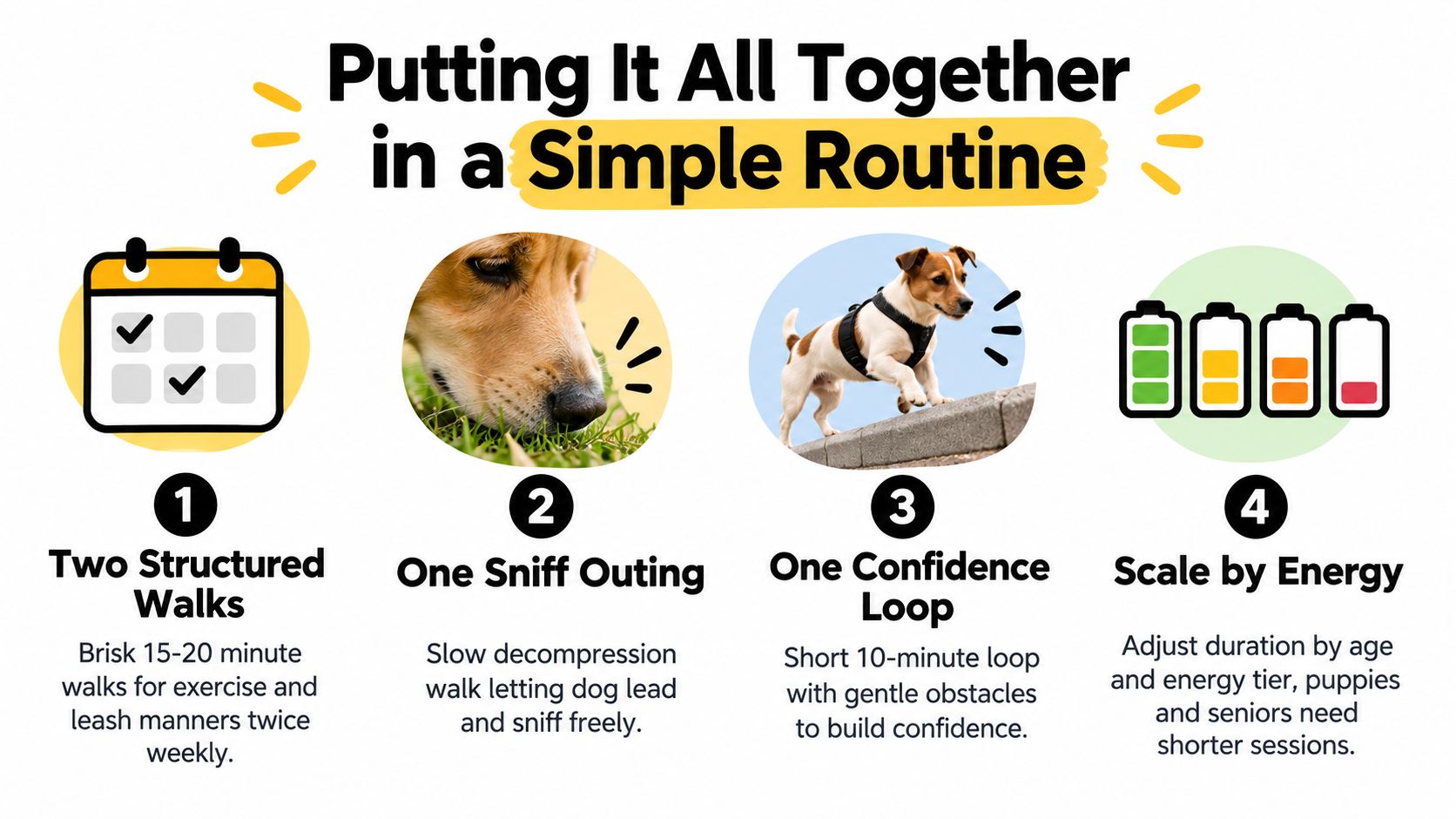
A repeatable rhythm works better than an open-ended promise to provide “more exercise.” Use two structured walks for movement and leash skills, one sniff-focused outing for decompression, and one short confidence loop for route practice. Scale every block to the dog's age, fitness, health, and energy tier.
The routine might look like this:
- Structured walks: Use a purposeful morning route and a second brisk outing when the dog is ready for movement.
- Sniff outing: Choose a quieter path, loosen the pace, and allow investigation without turning every pause into a training battle.
- Confidence loop: Take a short route with manageable corners, calm crossings, and gentle environmental challenges.
- Weekly reset: Check the harness at the start of the week, refresh leash handling midweek, and swap in a different safe route on the weekend.
Summer requires a weather-window adjustment, not stubborn consistency. Move walks earlier, select shaded grass, and cut duration when pavement or air temperature becomes uncomfortable. Winter may call for a coat and shorter sessions when temperatures fall below 0°C , while the 0 to 25°C range is generally a more comfortable planning window.
Consistency matters more than distance. Denver Dog provides weekday dog walking, running, and hiking support for dogs of all sizes, including small dogs that need structured, on-leash exercise. Service areas include Arvada, Denver, Englewood, Golden, Lakewood, Littleton, and Wheat Ridge , so owners can hand off a safe routine when work, injury, or puppy-life chaos disrupts the schedule.
Choose your dog's next safe route today, check the harness and leash before leaving, and commit to one calm, purposeful small-dog walk you can repeat.
Denver Dog offers structured on-leash walks, runs, and hikes suited to a dog's energy level and temperament, including practical support for small dogs that need controlled routes and consistent weekday movement. Visit Denver Dog to arrange reliable exercise in Arvada, Denver, Englewood, Golden, Lakewood, Littleton, or Wheat Ridge.
The Run Down