Most healthy adult dogs do well with 1 to 2 walks per day totaling 30 to 90 minutes , and in one studied group 77.9% of dogs were walked at least once daily while the most common single pattern was two walks a day . If you're standing by the door at 6:30 a.m. with a leash in your hand and a dog bouncing off the walls, that's the starting answer, but the right number for your dog depends on age, breed, and energy.
A lot of owners ask how many dog walks a day as if there's one clean rule. There isn't. A young Lab in a Denver townhome, a senior Shih Tzu in a condo, and a cattle dog mix in a yard all need different schedules, even if they live on the same block.
The better way to answer it is practical. Look at four things: your dog's life stage , energy level , total activity outside formal walks , and the Denver realities that change the day, like altitude, winter ice, and hot summer pavement. Get those four right and your schedule gets much easier.
The Short Answer Most Owners Need
At 6:30 a.m., a lot of Denver owners are doing the same thing. Alarm goes off, coffee starts, leash comes off the hook, and the dog is already spinning by the front door in a row house or apartment hallway.
For a healthy adult dog , the simple starting template is 1 to 2 walks a day totaling 30 to 90 minutes , which lines up with general veterinary guidance from Chewy's dog walking guide. In a studied population of dogs with clear frequency data, 32.4% were walked twice a day, 29.5% once a day, and 13.3% three times a day , while 77.9% were walked at least once daily , according to the benchmark summarized in these dog walking statistics.
That gives you a useful baseline. Daily walking is normal. Two walks a day is common. But it still isn't a rule.
The starting template I actually recommend
Use this as your first draft:
- Healthy adult dogs: Start with 2 walks if your schedule allows it.
- Short on time: One solid walk can work if the dog also gets potty breaks, play, and mental work.
- Puppies, seniors, and high-drive dogs: Expect the walk count to go up, even if each outing gets shorter.
Practical rule: Pick a total amount of daily movement first. Then split it into enough outings for your dog's body, bladder, and brain.
Four variables matter more than breed labels alone:
- Life stage
- Breed-driven energy
- Everything besides walks
- Denver routine quirks
A brachycephalic dog on hot pavement can't be handled like a young husky on a cool morning. A puppy may need more outings but much less mileage. A senior dog may need frequent bathroom trips and gentler loops.
By the end of this, you should be able to choose a defensible number for your own dog instead of guessing.
Why Walk Count, Length, and Total Activity Are Three Different Dials
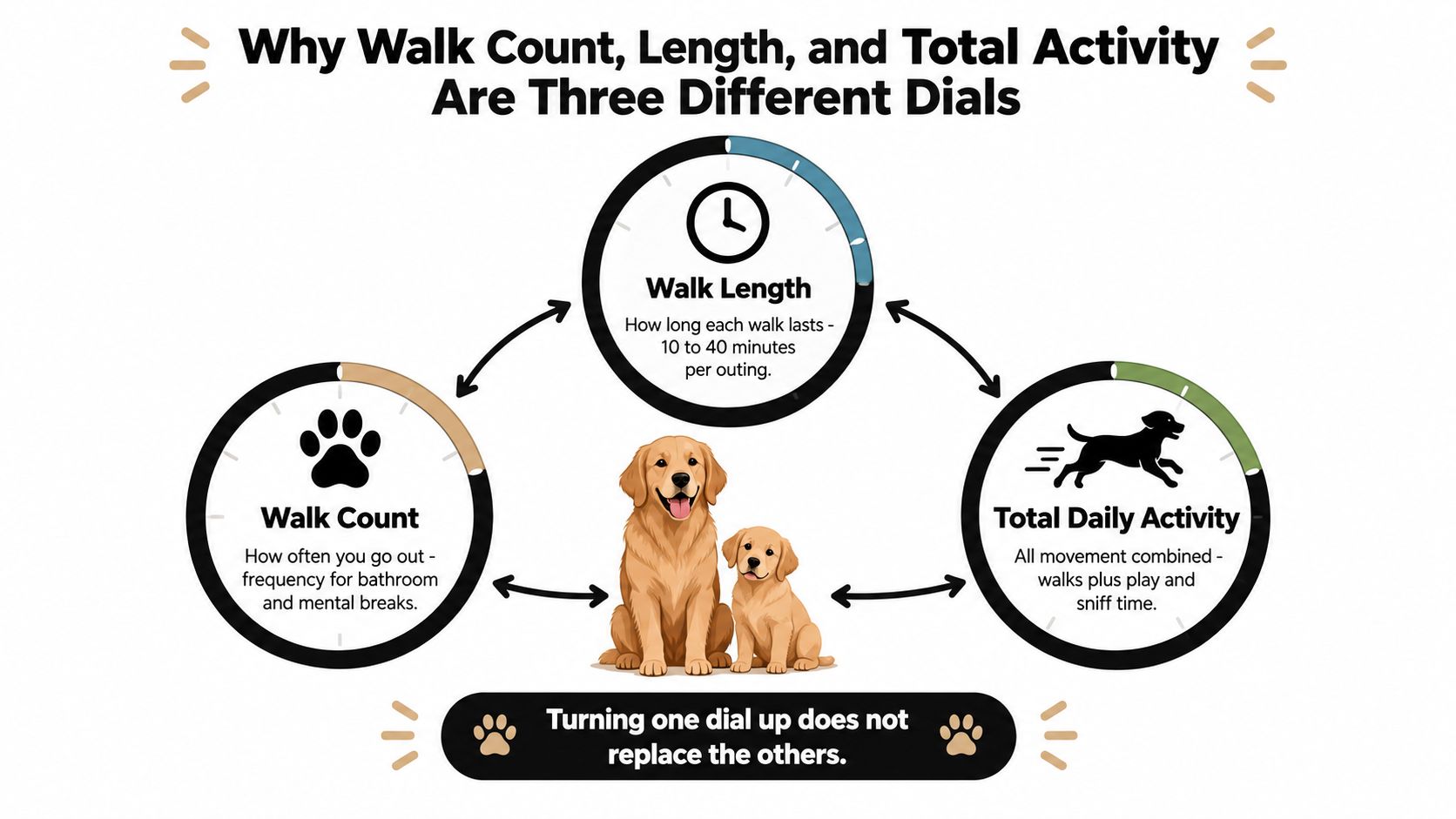
Most owners lump exercise into one bucket. That's the mistake. Walk count , walk length , and total daily activity are three different dials, and turning one up doesn't automatically fix the others.
Count is about rhythm
Walk count mostly solves bathroom needs, mental resets, and routine . Three short outings can be better than one long outing for a senior dog that gets stiff, or for a puppy that can't hold it long.
The puppy example makes this obvious. The five minutes per month of age, twice a day rule is widely cited in practical guidance discussed by Canine Journal's walking frequency article. That rule isn't about cramming in more distance. It's about protecting joints while still giving the pup enough exposure and structure.
Length is about load
Length controls physical strain. A young puppy may need several outings but not long ones. A fit, high-energy herding dog often needs longer sessions because short loops barely take the edge off.
A senior beagle is the opposite. Three short sniff-heavy walks may beat one longer march around the block. The dog gets movement, bathroom relief, and enrichment without paying for it later with soreness.
One long walk is not automatically better than two shorter walks. The right split depends on stamina, recovery, and what the dog is getting from the outing.
Total daily activity is the big picture
Walks are only part of the load. Training reps in the hallway, food puzzles, sniff work in the yard, tug, fetch, and decompression time all count. If you miss a formal walk, mental work can soften the loss , though it doesn't fully replace regular outdoor movement.
For owners who are also trying to save their own feet and knees, a good pair of shoes matters more than people admit. If plantar pain is making you cut walks short, these Swift Running walking shoe picks are worth a look.
If you want a deeper take on outing length in this climate, read how long to walk your dog in Denver.
Recommended Walks by Life Stage
Life stage changes the answer more than almost anything else. A puppy, an adult, and a senior can all live in the same home and still need different schedules.
Puppies need more outings, not tougher walks
Puppies under six months usually do better with 3 to 5 short walks a day . The point is potty training, exposure, leash skills, and calm repetition. It is not endurance work.
The practical benchmark many owners use is the five minutes per month of age, twice a day guideline already noted earlier. Keep those outings short, upbeat, and easy to recover from. Think sidewalks, grass, curb manners, and controlled novelty.
Warning sign: if your puppy flops down, lags, or turns into a biting tornado after walks, you're likely doing too much too soon.
Adult dogs need a total, then a split
For adult dogs, the useful evidence is broad, not magical. A 2025 UK National Dog Survey reported that owners spent an average of 67 minutes per day walking their dog, and in a separate cohort, dogs up to 15 months old were most commonly walked twice a day at all measurement points, with 9-month-old and 15-month-old dogs typically getting 1 hour on weekdays and 2 hours on weekend days according to these dog health statistics.
That lines up with real life. For most adults, 2 walks a day is the easiest working pattern. Some low-key adults do fine on one substantial walk plus shorter potty outings. Some athletic dogs need a third outing or added play to stay sane.
Warning sign: if your adult dog still paces, pesters, and explodes into evening zoomies after a decent routine, your current total probably isn't enough.
Seniors usually do better with gentler frequency
Older dogs often need 2 to 4 shorter walks a day instead of one big session. For dogs with lower stamina, senior needs, or mobility limits, guidance commonly points toward 2 to 3 gentle walks per day for seniors and 3 to 5 short outings for mobility-limited dogs , as summarized in this guide on walking frequency.
The priority shifts. You're protecting joints, preserving muscle, supporting digestion, and preventing accidents in the house. Softer ground helps. Slower pace helps. Predictability helps a lot.
Warning sign: if your senior seems fine during the walk but is stiff the next morning, the walk was too long, too hard, or on the wrong surface.
Dog Walking Recommendations by Life Stage
| Life Stage | Age Range | Walks Per Day | Total Minutes | Primary Focus |
|---|---|---|---|---|
| Puppy | Under 6 months | 3 to 5 | Short outings based on age and tolerance | Potty training, socialization, leash skills |
| Adult | 1 to 7 years | 1 to 3 | Moderate to longer daily total based on energy | Fitness, behavior, routine |
| Senior | 7+ years | 2 to 4 | Shorter daily total with easy recovery | Joint comfort, bathroom breaks, steady movement |
Matching Walks to Your Dog's Energy Level
Life stage tells you part of the story. Energy level tells you what the body and brain will demand after breakfast.
Low-energy dogs
Some adults are fine with less. Guidance summarized by Denver Dog's walking needs article notes that low-energy adults may be fine with about 1 to 2 walks totaling 20 to 40 minutes , while moderate-energy adults are often placed in the 30 to 90 minute daily range .
Think Bulldogs, Basset Hounds, and older companion breeds. These dogs often do best with short, predictable outings and a bit of indoor play.
Moderate-energy dogs
This is the biggest category. Most family Labs, Beagles, and many spaniels fit here. These dogs usually want 2 real walks and some kind of add-on, like fetch, training, or extra sniff time.
They're often the easiest to underserve because they don't always melt down immediately. They just get noisy, bored, or chunky over time.
High-energy dogs
Border Collies, Australian Shepherds, Huskies, Weimaraners, and a lot of working mixes need more than a stroll around the block. They usually need multiple substantial outlets plus a job. Walking alone may not be enough if every walk is just a tight leash and a lap around the building.
If you're living with one of these dogs, this guide to exercise for high-energy dogs is worth reading.
Breed is your opening guess. Your dog's behavior after the walk is the real answer.
Walk Plan by Energy Level
| Energy Level | Walk Count | Total Minutes | Typical Breeds | Add-On Activity |
|---|---|---|---|---|
| Low | 1 to 2 | About 20 to 40 minutes | Bulldogs, Basset Hounds, older small companions | Light indoor play, sniffing |
| Moderate | Usually 2 | About 30 to 90 minutes | Many Labs, Beagles, spaniels | Fetch, training, sniff breaks |
| High | 2 to 3 | Higher daily total, often beyond basic neighborhood walks | Border Collies, Aussies, Huskies, Weimaraners | Structured play, running, task work |
Pick the closest group, then fine-tune based on what your dog does after the walk. Calm and settled is the target. Wild-eyed and destructive means increase the plan. Flat, sore, or reluctant means pull back.
A Sample Weekday Schedule You Can Copy
If you've got a typical adult moderate-energy dog and a typical workweek, keep it simple and repeatable.
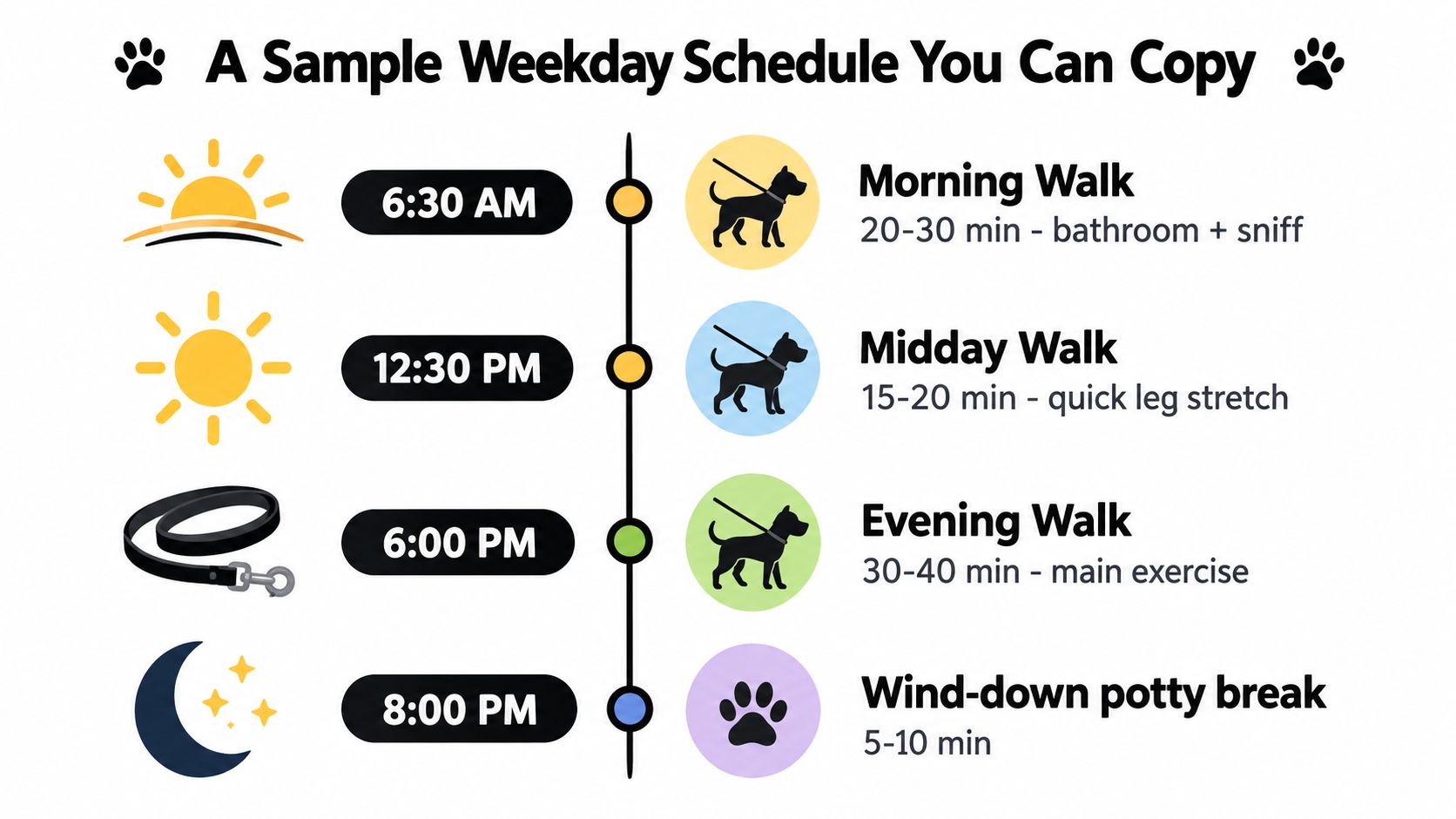
Monday through Friday template
Use this framework:
- 6:30 a.m. A 25-minute brisk walk for bathroom, movement, and a bit of sniffing.
- 12:30 p.m. A 10-minute midday potty and sniff break .
- 6:00 p.m. A 35-minute evening walk . Add fetch or safe off-leash time if your setup allows.
- 8:00 p.m. A quick wind-down potty outing if needed.
That gives a moderate dog a solid rhythm without turning your whole day into dog management.
For owners who need help in the middle of the day, a weekday walker solves the exact problem that usually breaks the schedule. One factual option is Denver Dog , which offers weekday on-leash walking, running, and hiking sessions for dogs with different energy levels. If you want to tighten your home routine around those visits, this guide to a daily and weekly routine for dogs is useful.
A short demo can also help if you're trying to make your outings more efficient without rushing the dog.
Weekend adjustment
Weekends don't need the same exact split. Many owners do better with:
- One longer adventure walk
- One shorter cleanup outing
- A little yard or play time later
That longer weekend outing often replaces some weekday pressure. It doesn't erase the need for weekday consistency, but it helps.
Two easy swaps
If your schedule is odd, use one of these:
- Runner's swap: Replace the evening walk with a controlled jog if your dog is mature, conditioned, and built for it.
- Workday swap: Keep the morning and evening owner walks, then outsource the midday break instead of trying to force it into a packed calendar.
The outing owners most often skip is the third small outing , especially on Tuesday through Thursday when work runs long. Track your actual minutes for one week. Guesses are often wrong.
When More Walks Help and When They Hurt
A lot of dog advice gets this wrong. More walks are not always better. Better walks are better.
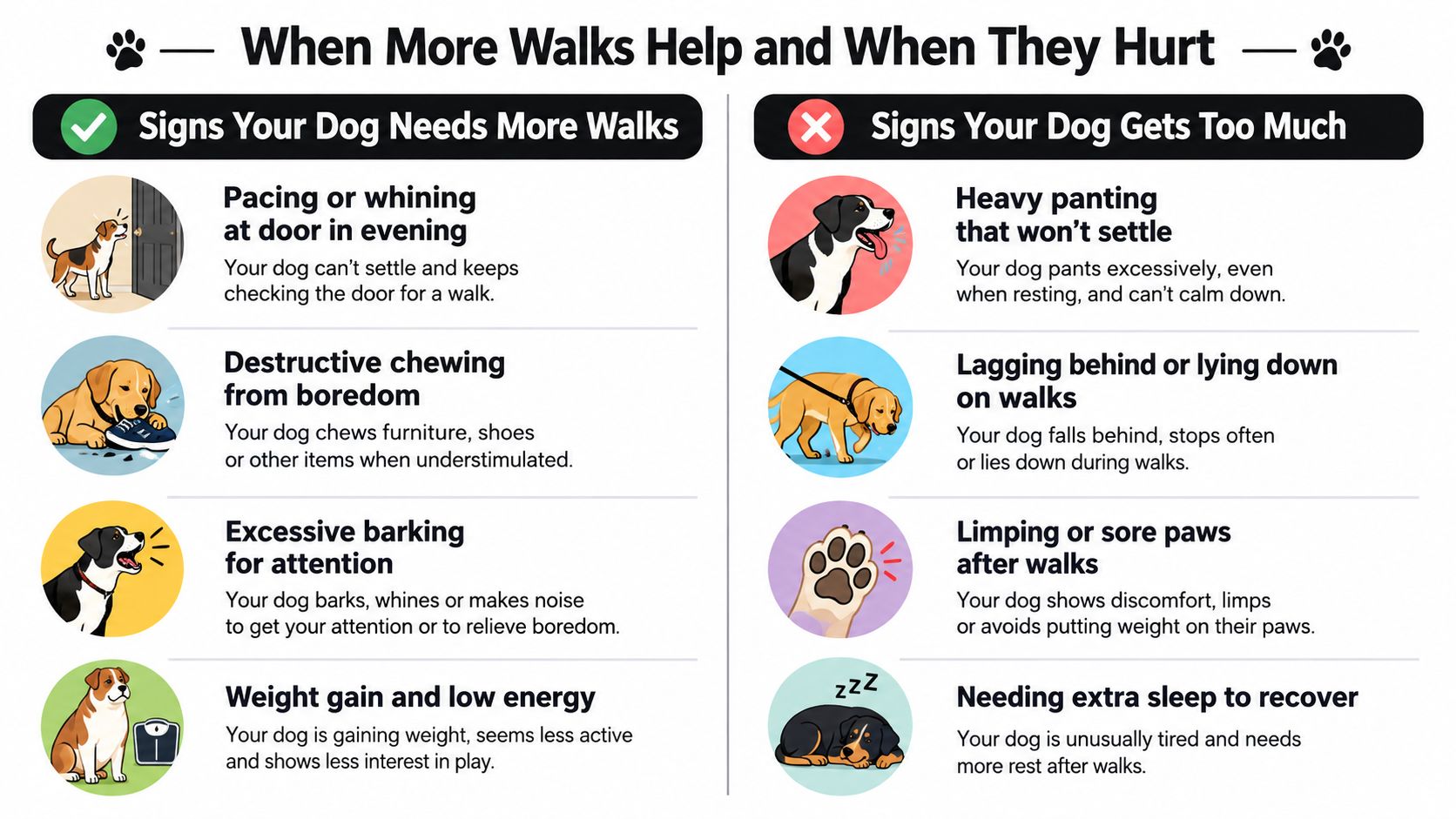
Signs your dog is under-walked
These dogs aren't being bad. They're under-occupied.
- Restless pacing: Especially in the evening when the household slows down.
- Barking for attention: The dog keeps asking for engagement because nothing drained the tank.
- Destructive chewing: Shoes, trim, blankets, couch corners.
- Night zoomies: Common when the dog carried excess energy all day.
- Weight gain: Not always from food alone.
- Frustrated leash pulling: The dog hits the end of the leash because every outing feels scarce.
The fix is straightforward. Add one structured midday outing, or if that's impossible, add real enrichment that makes the dog think and move.
Signs your dog is getting too much
This side sneaks up faster than owners expect, especially when they ramp up too quickly.
- Lameness or limping: Even mild limping counts.
- Refusing to get up after a walk: Recovery is poor.
- Excessive panting that doesn't settle: Especially outside heat-related situations.
- Sore paw pads: Common on hot pavement or abrasive routes.
- Lying down mid-walk: The dog is telling you something.
- Loss of interest in walks: A dog that used to light up now drags or resists.
If your dog is sore the next day, the problem usually isn't motivation. It's load.
Dogs with less room for error
Puppies, seniors, brachycephalic breeds, and dogs with joint or heart problems hit their upper limit sooner. Forced mileage on pavement is often the issue, not walking itself.
When you see overdoing signs, cut duration, pick softer ground, and lower intensity. If limping, heavy fatigue, or unusual recovery lasts more than 48 hours , call your vet.
The common mistake isn't laziness. It's adding too much too fast because the dog looked excited at the door.
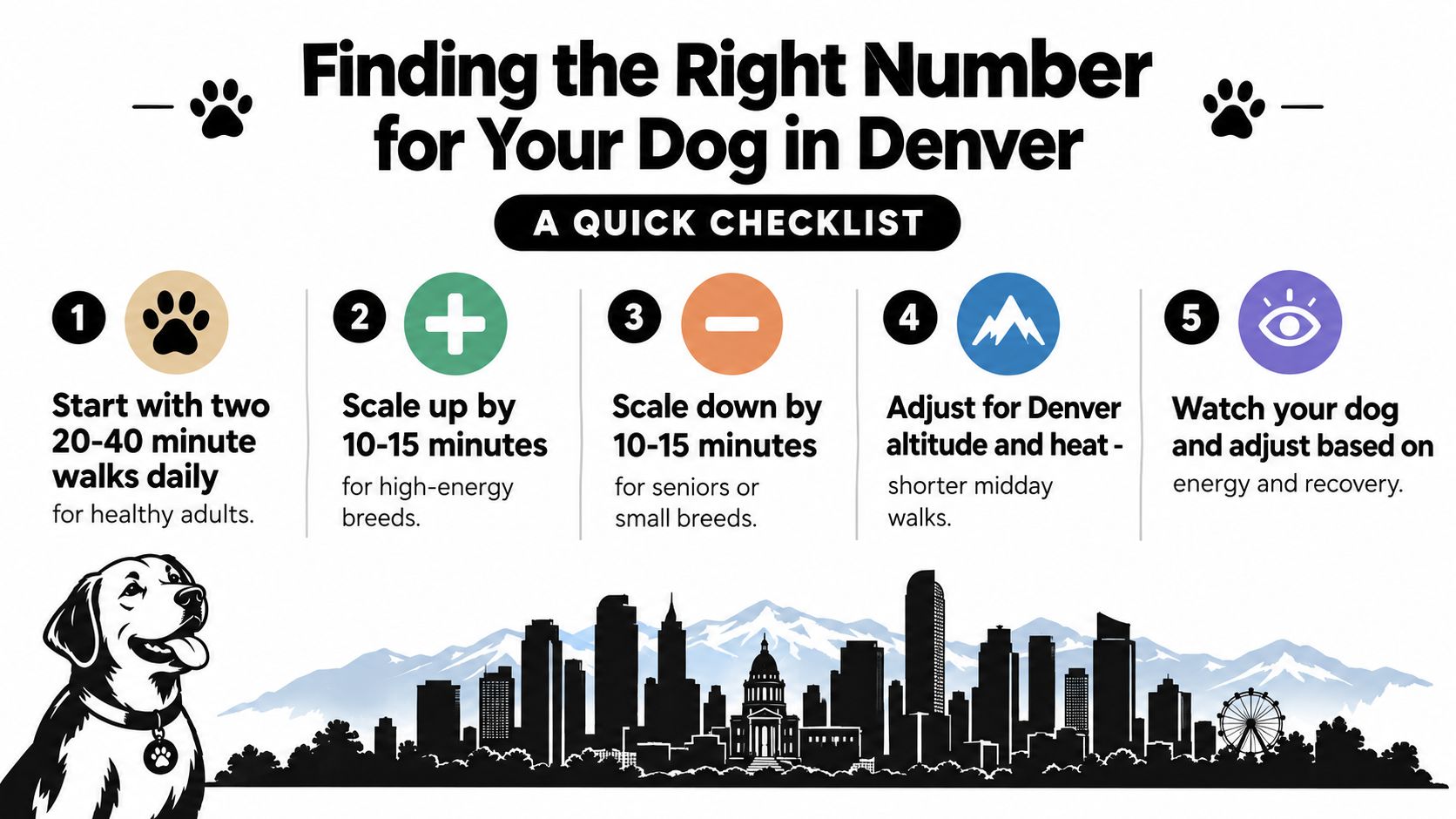
Finding the Right Number for Your Dog in Denver
Denver owners need a rule they can use today. Here it is.
Start a healthy adult dog at two 20 to 40 minute walks a day . Then adjust by 10 to 15 minutes based on energy, age, and recovery. Add a third short outing for puppies, seniors who pace or need extra bathroom breaks, and high-drive dogs that don't settle well with only two trips.
The Denver adjustment
Altitude, dry air, summer pavement, and winter ice all matter. Midday in July isn't the time for your hardest walk. Neither is an icy morning when your senior dog is already stiff.
My rule is simple:
- If total walking is under 30 minutes for a healthy adult , you're probably underdoing it.
- If you're forcing more than 2 hours of walking in one stretch on pavement , you're asking for trouble.
- If the dog is calm, eating normally, and recovering well the next day , you're close.
Busy owners in LoDo condos, Cherry Creek townhomes, and Tech Center commuter households run into the same weekday problem. The dog is alone too long for the ideal schedule. That's where a recurring midday walk pays for itself in sanity, house training, and behavior.
If you want to see whether your neighborhood is covered in Arvada, Denver, Englewood, Golden, Lakewood, Littleton, or Wheat Ridge , check the Denver Dog service area page.
Commit to one plan for two weeks. Then adjust based on your dog's behavior, recovery, and body condition, not guilt.
Quick Answers for Busy Owners
Hot or cold weather
Don't skip walks entirely just because the weather is rough. Shorten them and increase frequency. In summer, choose shaded grass over hot pavement. In winter, use a coat or paw balm when your dog needs it and keep the outing shorter but still consistent.
Puppies
Keep puppy outings short and structured. A practical rule is one short walk per meal block , using the earlier five minutes per month of age guideline as your ceiling for formal walking. Before vaccinations are complete, use your yard if you have one, or controlled carrying and exposure instead of full public walks.
Seniors
Go shorter, slower, and softer. Two comfortable outings are usually better than one ambitious one. Watch the dog the next morning, not just during the walk. That's when stiffness tells the truth.
Apartment dogs
A balcony break or hallway sniff is enrichment. It is not a replacement for exercise. Apartment dogs still need a real walking routine, and for most healthy adults that means at least a dependable baseline of outdoor movement every day.
Missed walks happen. Missed routines become behavior problems.
If your weekday schedule can't reliably cover the dog's needs, the cleanest fix is a recurring midday walk.
Denver Dog offers weekday on-leash walks, runs, and hikes for dogs that need more structure than their owners' calendars can provide. If your dog needs a reliable midday outing, extra exercise, or a steadier routine in Denver, Arvada, Englewood, Golden, Lakewood, Littleton, or Wheat Ridge, visit Denver Dog and see what fits your schedule.
The Run Down