Your phone says 9:58 a.m. The coffee is half-finished. You thought you had time for a longer walk, but the patio potty break turned into the whole morning plan because your 10:00 standup started early and then ran long. By 11:30, you check the doorbell camera and see your dog doing the same slow lap around the rug, then stopping at the window again.
That's the moment a lot of owners start searching for help.
Not because they don't care. Because the daily math stops working. A quick neighborhood loop before work can hold for a while, especially with an easygoing dog. Then schedules tighten, meetings stack up, weather gets ugly, or your dog's energy rises faster than your free time. What looked manageable starts feeling thin.
A professional dog walking service should solve that problem in a structured way. Not with vague promises, and not with “we love dogs” as the whole operating model. A real service has staffing, safety systems, scheduling discipline, handling standards, and a clear method for matching exercise to the dog in front of them.
Most buyers never get shown that side of the business. They get a rate, maybe a short bio, maybe a note that the company is insured. That's useful, but it's not enough to tell you how the walks run day to day.
The Moment Every Busy Owner Reaches
At first, it looks temporary.
Monday gets crowded, so the long morning walk becomes a quick potty break. Tuesday, lunch disappears into calls. By Thursday, your dog is standing by the door at 2:00 p.m., then circling the living room, then checking the window again. The change is small enough to excuse day by day, but over a few weeks the pattern becomes clear. Your schedule is running the dog's routine, instead of the other way around.
That point matters because many owners start shopping before anything has gone badly. They are not reacting to chewed baseboards or neighbor complaints. They are reacting to pressure in the daily system. The dog has energy to spend, bathroom needs that do not pause for meetings, and a routine that works better with consistency than improvisation.
For a first-time buyer, the confusing part comes right after that realization. On the surface, every option sounds similar. A neighbor can stop by. An app can send whoever is available. A local company can promise exercise and a photo update. But hiring help for your dog works a lot like hiring transportation for your child. The label matters less than the operating model behind it. Who is showing up, what standards they follow, how dogs are matched to outings, and what happens when the day goes sideways all change the result.
Owners usually notice the strain in ordinary ways:
- Indoor patrol loops: Your dog keeps rotating between the couch, the window, and the front door without settling.
- Missed midday relief: Bathroom breaks get pushed later, and the whole afternoon feels too long.
- Evening overstimulation: A dog who got too little outlet earlier often comes alive at the exact hour you need the house to calm down.
- Household friction: The plan for the day starts being built around guilt, guesswork, and last-minute fixes.
A lot of dogs do not "act out." They just get a smaller day than they can use well.
That is why a professional dog walking service often becomes relevant before there is a behavior problem. The trigger is usually operational. The owner can no longer deliver enough exercise, relief breaks, and routine predictability with the time blocks available.
Paid dog walking has been a normal solution for a long time. As noted earlier in Denver Dog's dog walker background article, the service grew from a niche urban convenience into a common part of pet care for working households. The useful question is no longer whether hiring help is reasonable. The useful question is how to tell the difference between occasional help and a real operation.
That distinction matters whether you are comparing a solo neighborhood walker with a structured local company in Arvada, Denver, Englewood, Golden, Lakewood, Littleton, or Wheat Ridge. Once you hit this stage, you need more than a friendly bio and an open calendar. You need a checklist for how the service runs.
What a Professional Dog Walking Service Really Is
A casual walker performs a task. A professional service runs a repeatable system.
That's the cleanest distinction.
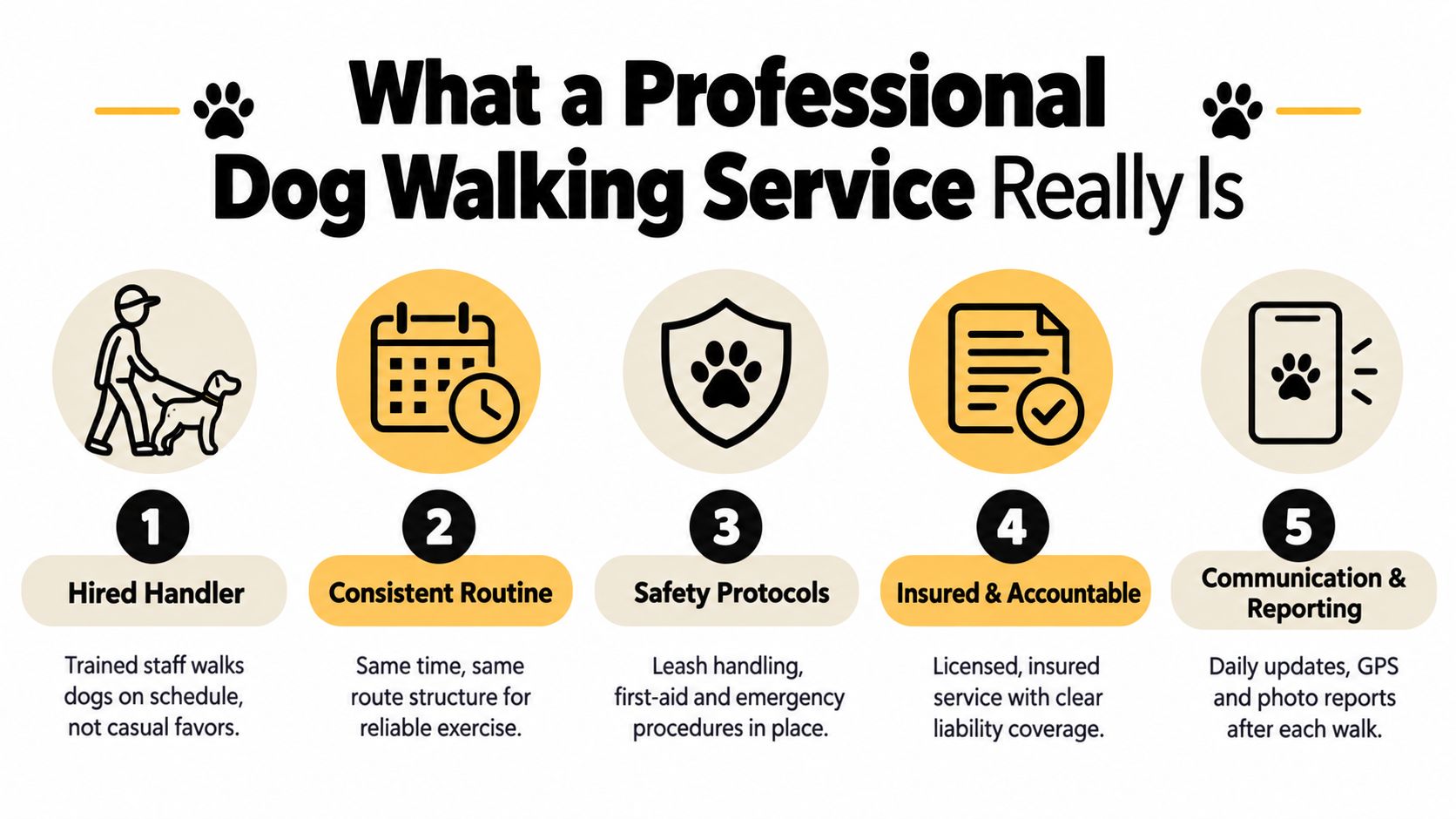
If you strip away the marketing language, a professional dog walking service operates more like a small field team. Dogs must be picked up on schedule, matched to the right type of outing, handled safely, documented properly, and reported back to owners. Someone has to own the workflow when a key is missing, a dog refuses to load, weather changes quickly, or a client needs a same-week schedule adjustment.
The operational signs that matter
Look for evidence that the company has structure behind the leash:
- Actual staff systems: The company trains handlers, assigns routes, and manages accountability.
- Written handling rules: Pulling, reactivity, door exits, greetings, and equipment use shouldn't be improvised.
- Documented sessions: Walks should leave a trail of time, route, notes, or both.
- Communication that works under stress: If something goes sideways, a real person should be reachable.
- Onboarding with details: Meet-and-greets, emergency contacts, access instructions, and dog-specific notes should be standard.
The industry itself has grown into a real service category. One industry summary reported the U.S. professional dog walking market at about $1.3 billion in 2023 with 63,412 active professional dog walkers and 5.3% worker growth that year. A separate estimate projected the U.S. dog walking services market at $1.5 billion in 2026 ( industry summary and projections).
Why consistency beats availability
A first-time buyer often asks, “Can someone come by this week?” That's fair, but availability isn't the hard part. Consistency is.
Dogs tend to do better when the service keeps the same routine, the same handling style, and familiar faces whenever possible. That's why you should ask how assignments are managed, how absences are covered, and how notes get passed between staff. Many of the headaches owners blame on “dog walking” are really handoff failures.
A lot of this is easier to run with purpose-built software for pet service appointment scheduling, because scheduling, route notes, and client records all need to live somewhere reliable. A professional operation shouldn't be held together by scattered texts.
Services That Go Beyond a Simple Loop Around the Block
Not every dog needs the same kind of outing, and that's where many services flatten the picture too much. They sell “a walk” as if exercise were one product.
It isn't.
A senior dog, a newly adopted adolescent, and a hard-charging working breed can all need midday support, but the structure of that support should look different. The American Veterinary Medical Association recommends building exercise progressively, starting with short, frequent walks and gradually moving toward one or more 15-minute periods of brisk walking , with cool-down and recovery. It also notes that walkers should stop for signs like lameness, rapid fatigue, or breathing difficulty ( AVMA exercise guidance).
Walking service tiers and which dogs they fit
| Service Tier | Typical Duration | Best Suited For | Key Benefit |
|---|---|---|---|
| Standard neighborhood walk | 20 to 30 minutes | Seniors, lower-energy adults, dogs rebuilding routine | Predictable relief, light exercise, sniff time |
| Brisk power walk | 45 to 60 minutes | Athletic adults, many working and sporting breeds | Sustained movement with a clearer fitness goal |
| On-leash hike | Longer outing with terrain changes | Dogs that need physical and mental variety | Elevation, new scents, and structured stimulation |
| Small-group pack walk | Varies by route and ratio | Social dogs that handle group movement well | Practice around other dogs in a managed format |
| Support visit with add-ons | Short practical visit or paired with walk | Puppies, dogs on medication, dogs needing feeding | Keeps care tasks tied to the same midday routine |
Duration is only one variable
Owners often shop by minutes because minutes are easy to compare. Dogs don't experience exercise that way.
A slow, stop-start neighborhood lap can be right for one dog and underpowered for another. A brisk, controlled outing on safe footing may do more useful work in less time. Route choice matters. Pace matters. Rest intervals matter. So does the dog's age, build, health history, and heat tolerance.
Practical rule: Buy the service tier that matches your dog's conditioning, not the one with the longest clock time.
A real operator earns trust. Instead of selling every client the same package, they sort dogs by fitness tier and build the session around manageable workload. A brachycephalic dog may need shorter bouts and more recovery. A deconditioned dog may need frequency before distance. A young, high-drive dog may need a route with purpose, not just extra minutes on pavement.
Add-ons that actually change the service
Some extras are cosmetic. Others change the usefulness of the visit.
Meaningful add-ons include feeding, medication support, puppy potty breaks, and detailed walk reporting. Those aren't just conveniences. They let the owner turn one midday stop into a stable care block instead of patching together separate solutions.
Safety Standards That Separate Operators from Hobby Walkers
Walking dogs seems simple until the first real problem hits. A leash clip fails. A dog panics at a passing truck. A handler slips on ice. A route runs long in rising heat. The difference between a professional operation and a hobby walker shows up right there, in the systems already in place before the mistake or surprise.
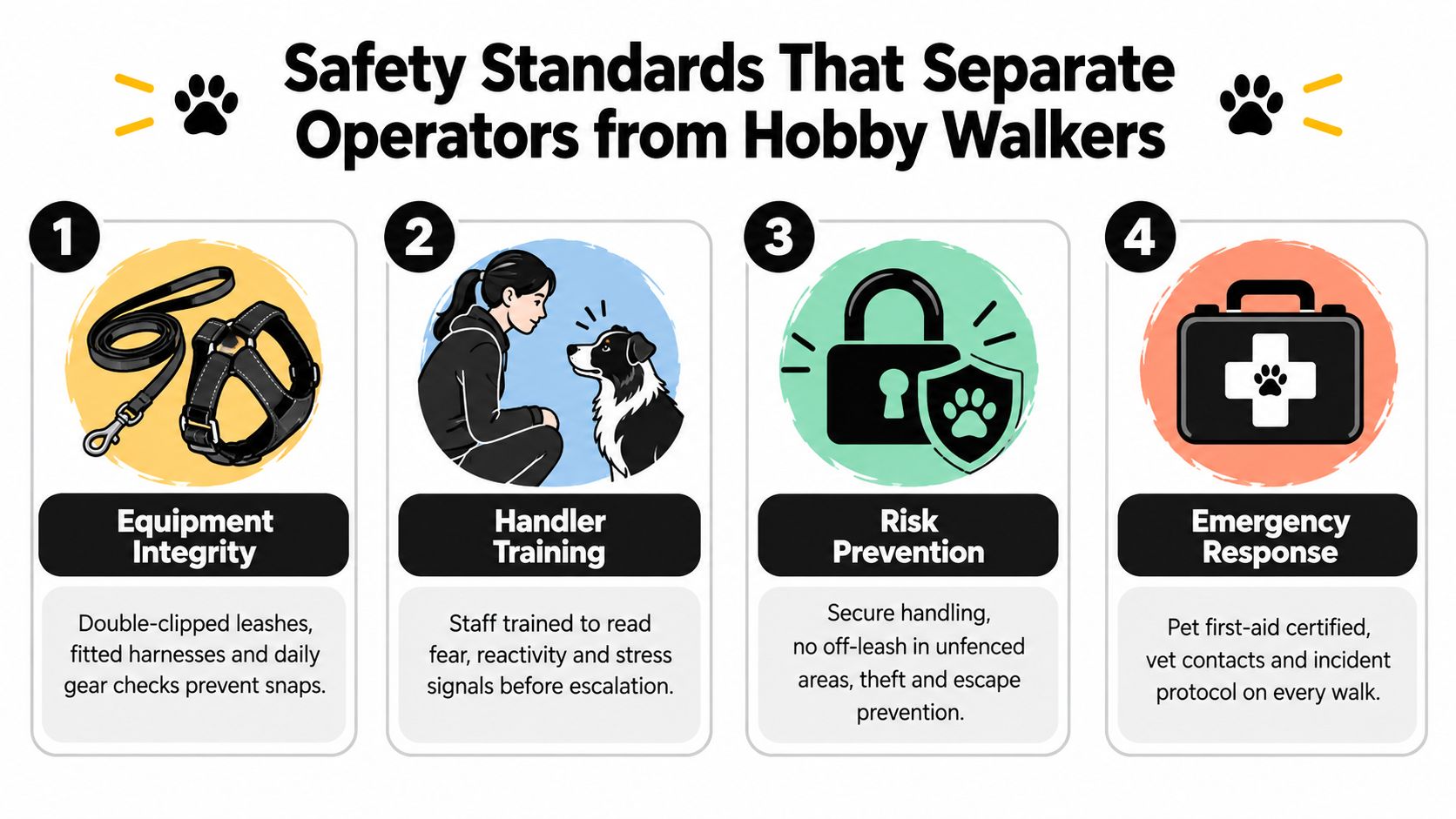
Four layers buyers should verify
Insurance and bonding come first. Insurance speaks to accident coverage and business responsibility. Bonding matters for a different reason. It addresses a trust gap around home access and theft claims. If a provider enters your home and handles keys, that question isn't optional.
Training is the second layer. Ask what the staff learns. You want dog body language, leash mechanics, group movement, entry and exit control, and emergency response. “Loves dogs” isn't training.
Live supervision is the third layer. Modern buyers increasingly expect route proof, timing proof, and confirmation that the service occurred as billed. Industry coverage has noted this shift toward GPS validation, live notifications, and tracking tech, while neutral guidance also says the number of dogs handled should not exceed the walker's insurance limit and local rules ( dog walking service expectations and supervision trends).
Incident protocols are the fourth. Weather cutoffs, injury response, lost-dog procedure, and communication chains should already exist before anyone clips on a leash.
A short visual overview helps, but you should still press for specifics:
The equipment piece owners overlook
A lot of safety begins with ordinary gear used correctly. The AVMA notes that leash pulling can increase the risk of permanent tracheal, laryngeal, esophageal, and ophthalmic damage in dogs. A 2024 review also found leash-related injuries among walkers have increased, especially in women over 65. The practical guidance is to use well-fitted harnesses for pullers, avoid risky footing and harsh surfaces, and stop if the dog starts limping or tiring quickly ( FOHA dog walker manual summary).
Safe handling isn't just about preventing escapes. It's also about controlling strain on the dog's body and reducing fall risk for the human on the other end of the leash.
If you want a deeper checklist for route choice, gear, and common field mistakes, this dog walking safety guide is a practical follow-up.
How Pricing Actually Works and Why Quotes Vary
The price of a walk isn't one thing. It's the result of labor time, route density, service structure, and operating overhead.
That's why two quotes for what sounds like “the same walk” can land far apart.
Independent 2026 pricing data shows that a 30-minute walk commonly runs $15 to $35 in the U.S., with a national average around $21.45 , while a 60-minute walk is often $25 to $50 ( 2026 dog walking cost calculator and pricing data). Those numbers are useful as a starting point, not as a final answer, because recurring packages and weekday bundles can change the total substantially.
Typical 2026 dog walking price ranges by service type
| Service Type | Typical Range | Main Price Driver |
|---|---|---|
| 30-minute walk | $15 to $35 | Length, local labor market, route density |
| 60-minute walk | $25 to $50 | Longer staff time and scheduling capacity |
| Recurring weekday bundle | Varies by provider | Package structure and frequency |
| Monthly package | Varies by provider | Commitment length and included services |
What usually changes the quote
Three owners can request “dog walking” and generate three different cost structures.
- Length of the session: More active minutes mean more labor time.
- Format of the outing: Solo walks and small-group outings are priced differently because supervision demands differ.
- Geography: Dense service zones are easier to route than spread-out pickups.
- Business overhead: Insurance, payroll, vehicles, software, and monitoring systems all sit behind the final rate.
A cheap bid isn't always a bargain. Sometimes it means the service cuts corners you can't see from the invoice. Sparse reporting, oversized groups, loose arrival windows, or minimal training often show up there first.
A simple way to read a quote
Use three questions:
- How many active walking minutes are included?
- What changes the rate for extra dogs, special handling, or schedule changes?
- Is travel between pickups built into the price model or hidden elsewhere?
For local context on how providers frame these variables, this Denver dog walking pricing guide can help you compare quotes more cleanly.
Questions to Ask Before You Hand Over the Leash
The interview doesn't need to be long. It needs to be sharp.
Most owners either ask too little, or they ask broad questions that invite polished non-answers. “Are you experienced?” rarely tells you much. Better questions force the provider to describe how the work is done.
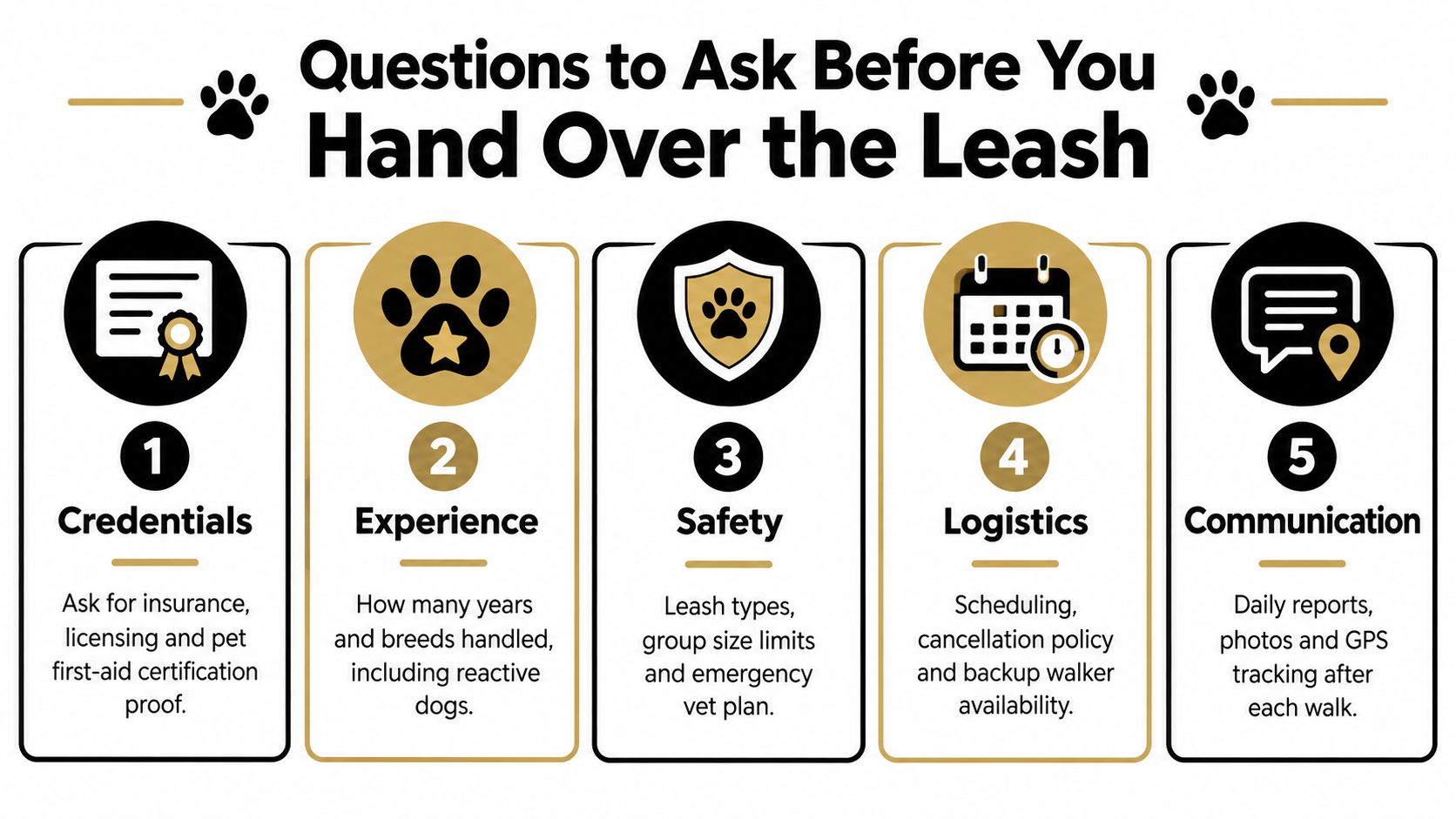
Start with credentials and staffing
Ask for proof, not reassurance.
- Insurance and bonding: Ask what coverage they carry and whether staff enter homes with key or lockbox access.
- Business legitimacy: Ask whether they operate as a formal business in your area.
- Staff model: Ask who will handle your dog and how backup coverage works if that person is out.
Move into the daily mechanics
Weak operations usually get vague.
- How are routes chosen for different dogs?
- What's your maximum group size, and how do you decide which dogs can go together?
- What weather conditions shorten, modify, or cancel a walk?
Ask for a sample daily report. If the company tracks walks well, showing you one should be easy.
Test communication and contingency planning
The strongest answers here sound plain, not rehearsed.
- Do you send GPS tracking, notes, photos, or arrival and departure updates?
- What happens if a dog is injured, refuses to walk, or slips equipment?
- Who is contacted first in an emergency, and what vet information do you carry on file?
Then ask one question that reveals whether the company really has operational depth: Can you show me how handler qualifications are verified? A useful benchmark is this breakdown of dog handler qualifications pet owners should verify.
End with the cheapest form of insurance
Request a trial walk.
A single session tells you things no phone call can. You'll see how the handoff feels, how your dog responds after the outing, how clear the reporting is, and whether the company's calm confidence is real or just polished intake language.
Inside Denver Dog's Approach to On-Leash Adventures
A first-time buyer often pictures dog walking as one person, one leash, and a loop around the block. A professional on-leash adventure runs more like a field service route. The handler is managing exercise load, timing, transport, spacing, equipment, and the dog's behavior from pickup to drop-off.
That difference shows up in the dog's outcome.
A casual walk can burn a little energy. A structured outing is built to do more than that. It aims to give the dog a repeatable amount of movement, a predictable level of stimulation, and enough handler attention to adjust before excitement turns into pulling, scanning, or frustration.
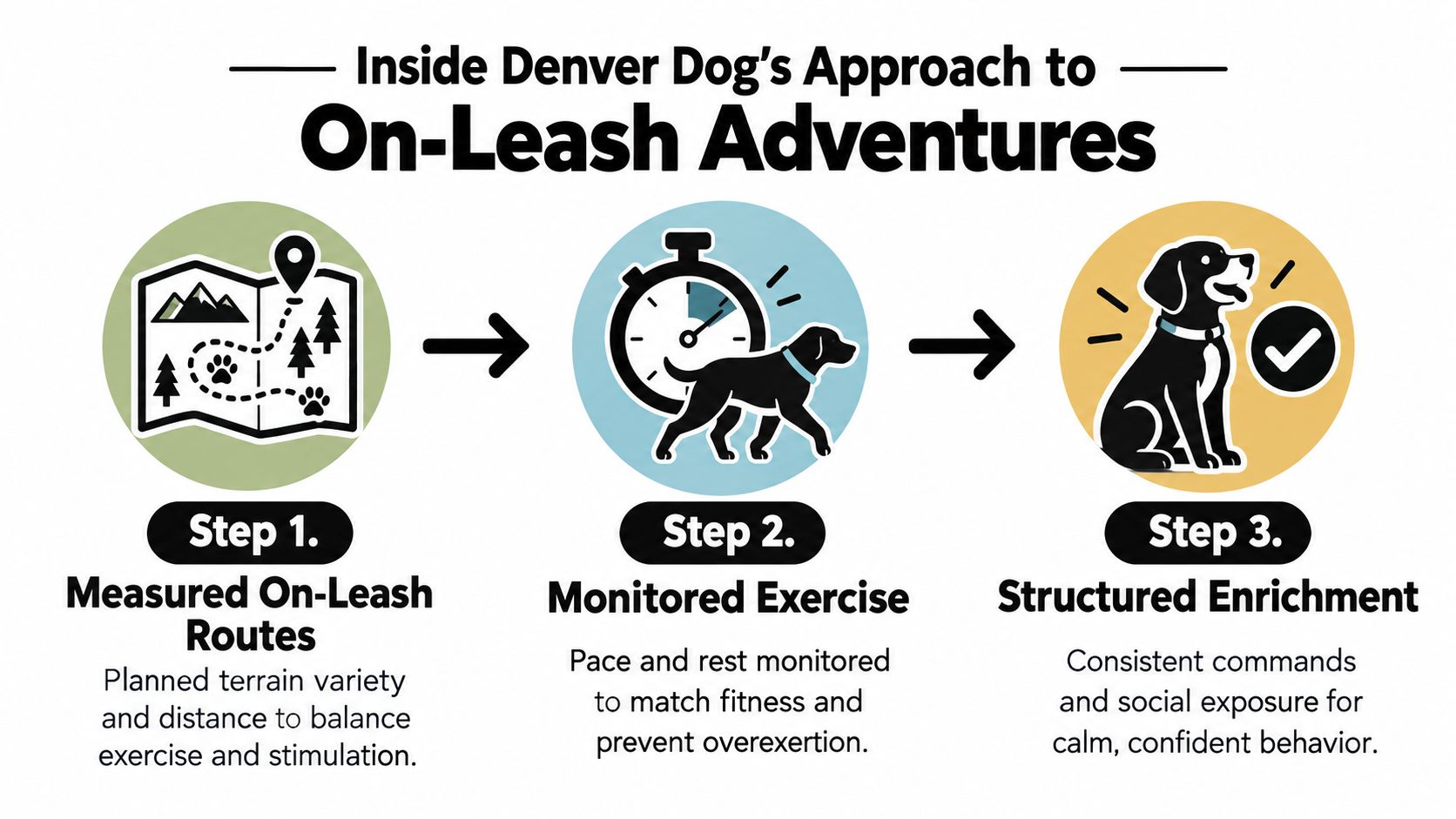
Three operational choices that change the outcome
First, measured on-leash routes create consistency. Route design affects more than scenery. Pavement, hills, footing, traffic exposure, and stop frequency all change the dog's workload. A handler who plans those variables can give a young high-energy dog a brisk conditioning session, or give an older dog a steadier outing with fewer spikes in effort.
Second, transport and session oversight matter because the service starts before the walk itself. Denver Dog describes its operation as an established, bonded, and insured canine fitness business, and it also explains that it uses in-vehicle monitoring for driving behavior plus ongoing staff retraining in handling, fitness, and welfare. For an owner, that matters for a simple reason. If pickup is rushed, driving is sloppy, or handoffs are loose, the walk can be well intentioned and still poorly run.
Third, tight handler-to-dog management gives the walker room to read the dog. That is where professional operations separate themselves from hobby help. If one handler is responsible for too many dogs at once, small warning signs get missed. A good operator keeps the load manageable enough that the person holding the leash can notice a stiffening posture, widening eyes, heat fatigue, or rising arousal early and change pace or spacing before the dog tips over threshold.
Why local operating range affects quality
Coverage area sounds like a small detail until you look at the mechanics. A tightly defined service map usually means shorter dead time between appointments, more repeat use of proven routes, and fewer last-minute changes that ripple through the day.
Denver Dog's listed neighborhoods include Arvada, Denver, Englewood, Golden, Lakewood, Littleton, and Wheat Ridge ( Denver Dog service locations). For buyers in those areas, the useful signal is not the list by itself. It is what the list suggests about route familiarity, scheduling discipline, and whether the company can keep service quality steady instead of stretching too far.
A good walk is a chain of controlled decisions, not just time outside.
Choosing the Right Service for Your Dog
The cleanest way to choose is to ignore branding for a minute and sort the decision into four checks.
First, match your dog to the right exercise tier . Think about energy level, age, conditioning, and whether your dog gets socially loose, overstimulated, or worried around other dogs. The best fit might be a short predictable walk, a brisk conditioning session, or a structured hike.
Second, verify the safety backbone . You're looking for insurance, bonding, handling protocols, sane group limits, and equipment choices that reduce injury risk. If the company struggles to explain those plainly, that hesitation tells you something.
Third, look for proof of operations . GPS reporting, clear appointment records, route documentation, and responsive communication all show that the company runs a system instead of a loose arrangement. Even outside pet care, strong best service page examples tend to make the offer, process, and trust signals easy to understand. Dog walking pages should do the same.
Fourth, judge pricing by what it funds , not by whether it's the cheapest line item on your week. You're paying for labor, reliability, supervision, and problem prevention as much as for the walk itself.
If a provider can explain who handles your dog, how the outing is structured, what happens when conditions change, and how they prove the work happened, you're probably looking at a real professional dog walking service.
If you want that kind of structure for your own dog, Denver Dog offers on-leash walking, running, and hiking built around fitness level, temperament, and monitored safety practices. Busy owners in the Denver metro can review the service and see whether it fits their dog's routine by visiting Denver Dog.
The Run Down