You're probably making this decision on a weekday morning, not while calmly comparing spreadsheets.
Your dog is already up. Your calendar is ugly. You've got meetings stacked, a commute or at least a full work block ahead, and a dog that still needs exercise whether your day cooperates or not. That's when you start looking at a dog walking subscription . Not because you love subscriptions. Because chaos gets expensive fast.
For busy owners in Denver, Arvada, Englewood, Golden, Lakewood, Littleton, and Wheat Ridge, this usually comes down to one blunt question: Is a recurring plan cheaper and better, or is it just cleaner branding on the same walks? If you want local coverage, you can see the neighborhoods served on the Denver Dog service area page.
The Monday-Morning Question Every Busy Dog Owner Asks
At 6:15 on a Monday, the math starts.
You're in a Denver townhouse or bungalow. Coffee in one hand. Slack already lighting up. Your Lab, doodle, shepherd mix, or young rescue is staring at the leash like it's your only real obligation today. You know you can book one walk. You also know this isn't a one-time problem.
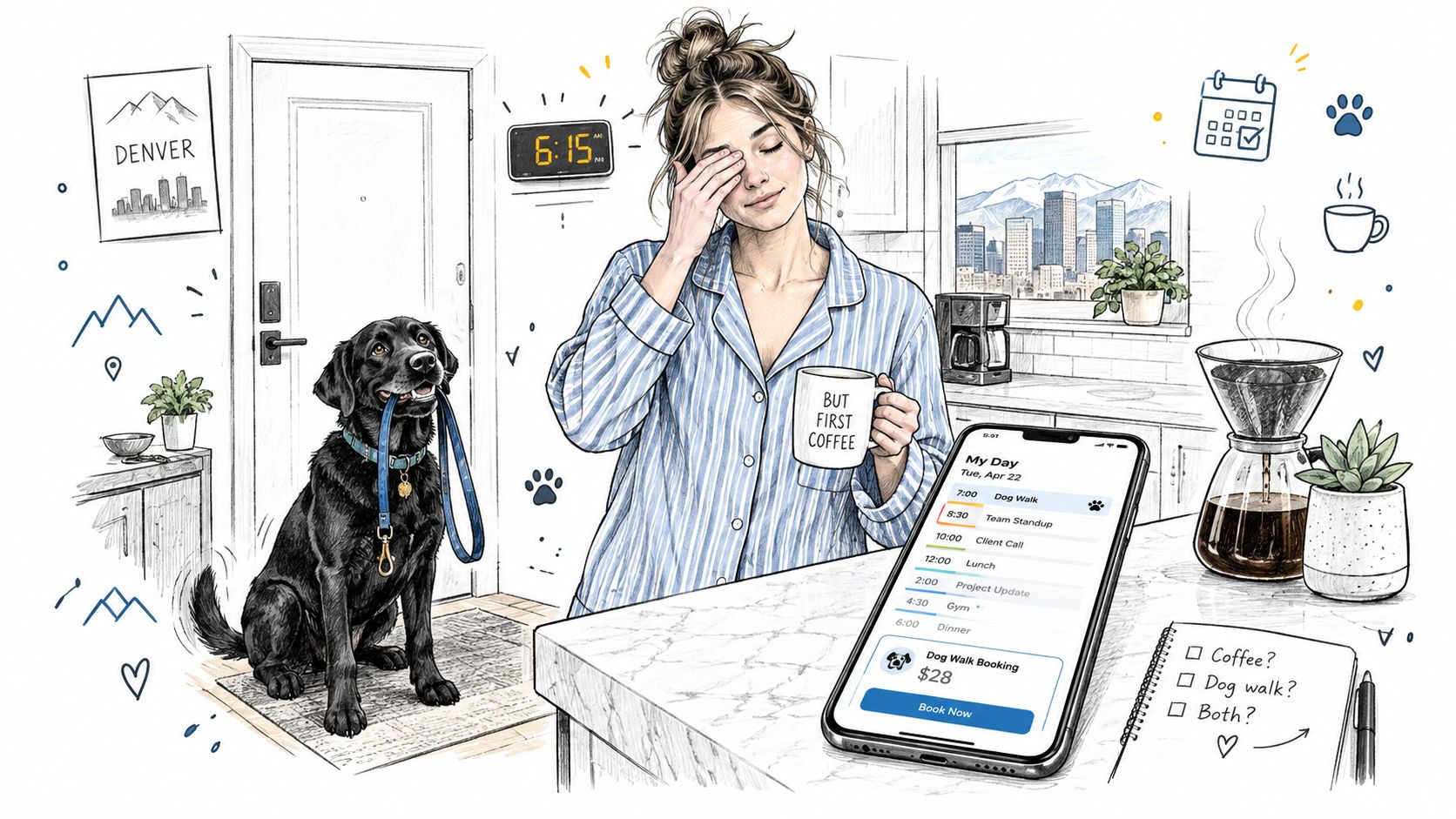
A lot of owners treat walking help like an occasional errand. That's usually the first mistake. If your dog needs weekday exercise this week, there's a good chance your dog needs it next week too. So the choice isn't one walk versus no walk. It's whether you're going to keep paying one-off rates, keep gambling on availability, or lock in a recurring setup that matches your schedule.
Why this turns into a money problem
National pricing gives you the rough frame. A typical 30-minute walk runs $15 to $35 , with a national average of $21.45 per walk . A 15-minute potty break often costs $10 to $20 , and a 60-minute walk often costs $25 to $50 , according to the 2026 dog walking cost calculator. Those are useful benchmarks, but in real Denver scheduling, convenience and consistency usually push your actual decision higher than the cheapest advertised rate.
Most owners don't overspend because they chose the wrong dog walker. They overspend because they keep making the same emergency booking three times a week.
Why recurring service is even on the table
This isn't a niche category anymore. The U.S. dog walking services industry is projected at $1.5 billion in 2026 , with 59,279 businesses , and industry revenue grew at a 6.3% CAGR from 2021 to 2026 , according to IBISWorld's U.S. dog walking services industry report. That tells you two things. First, owners are buying this service at scale. Second, the market is fragmented enough that pricing and quality vary a lot.
That's exactly why you need to understand the subscription math before you sign anything.
What a Dog Walking Subscription Actually Is
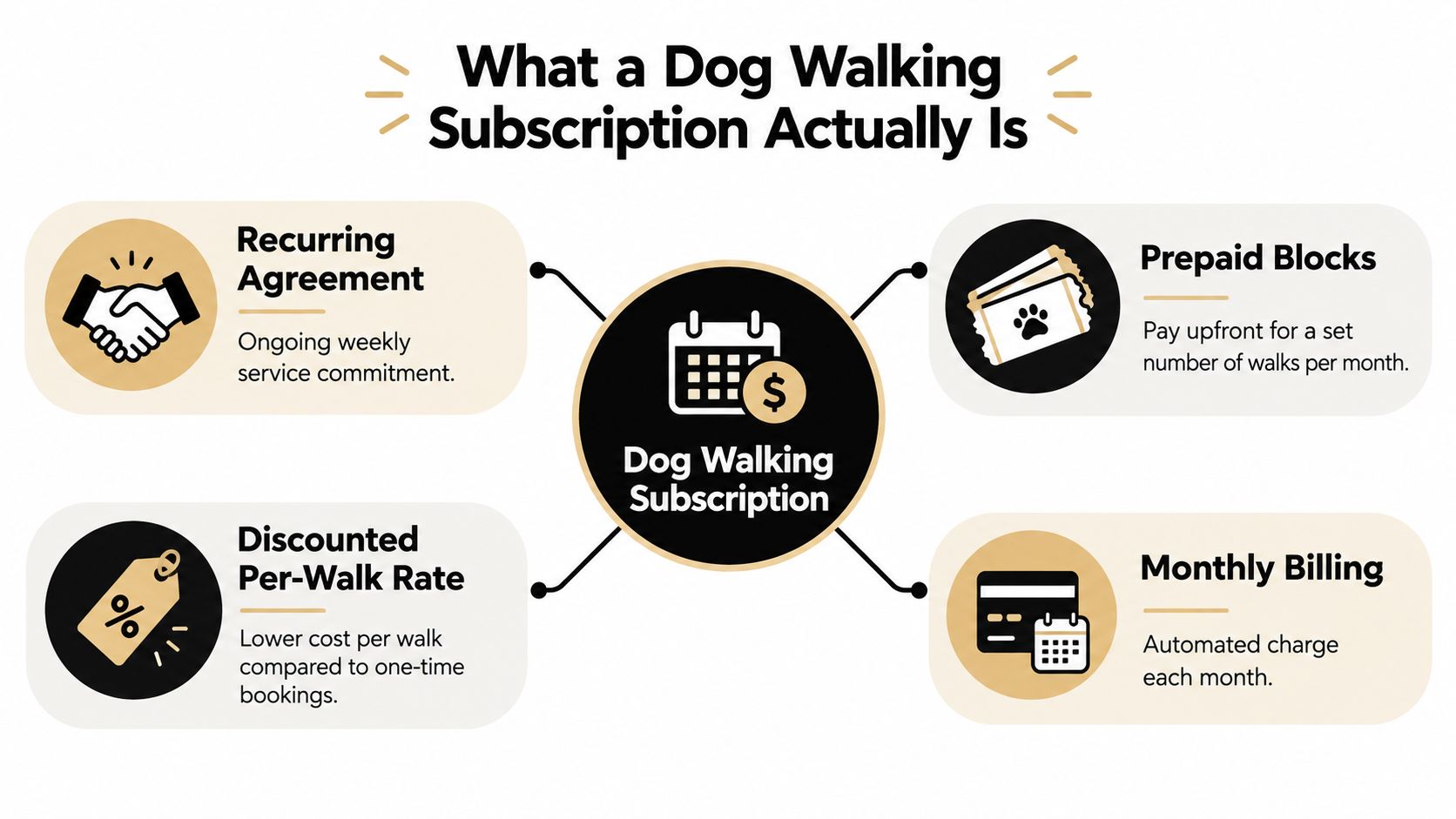
A dog walking subscription is a recurring service agreement. You reserve a block of walks, usually on a weekly pattern, and you're billed automatically on a monthly schedule. It's not the same as texting for a walk when you remember, and it's not the same as using an app that rotates you through whoever happens to be available.
The three parts that matter
Most recurring plans have three moving pieces:
- A fixed walk count . You commit to a pattern such as weekdays only, three walks per week, or a set monthly bundle.
- A standing time window . The walker comes on a predictable schedule instead of whenever you happen to request service.
- An assigned walker or small team . That consistency matters more than people think, especially for leash manners, shy dogs, rescues, and dogs with routine-sensitive behavior.
A separate business guide puts the mechanics plainly: a subscription dog walking business usually charges a fixed monthly fee for a reserved block of walks , collects automatic payment on the same date each month , and secures regular time slots , which also means the walker doesn't need to chase payment after service starts, according to Compare Vet Pricing's dog walking cost guide.
How it differs from one-off and marketplace booking
One-off booking is simple. You pay for one walk at a time. That works if your schedule is messy or you only need occasional help.
Marketplace apps are different. They help you find a walker, but they don't always create a stable service relationship. You may get recurring bookings, but not necessarily recurring handling standards, route familiarity, or the same person at the door.
By contrast, recurring plans are usually built as weekly packages of 3, 4, or 5 walks , monthly bundles of 10, 15, or 20 walks , or frequency tiers like daily, every-other-day, or weekdays-only . Many providers discount these plans by 5% to 20% versus pay-per-walk pricing, as outlined in Tailperks' recurring dog walking subscriptions guide.
Why owners keep moving this direction
The global dog walking subscription market is projected at $1.8 billion in 2025 and forecast to reach $4.1 billion by 2034 , implying a 9.6% CAGR , according to Dataintelo's dog walking subscription market report. The same report says monthly plans held 52.7% of subscription-model revenue in 2025 , and mobile-app bookings accounted for about 61% of dog walking subscription transactions globally in 2025 , up from 44% in 2021 .
That shift makes sense. Busy owners don't want to solve the same noon-walk problem every Tuesday.
How Recurring Walks Are Structured Around Your Dog
A good subscription should fit your dog first and your calendar second. A bad one does the opposite.
I see owners buy too much plan for a mellow senior, then too little plan for a young athletic dog. Both choices create headaches. The first wastes money. The second buys a quiet house for about three days, then the barking, pacing, shredding, and counter surfing come right back.
The four knobs you're really adjusting
Recurring walks are usually built around four practical variables:
- How many walks per week
- How long each visit lasts
- What time window you need
- Whether your dog needs the same handler and route routine
In practice, your dog doesn't care whether the plan sounds premium. Your dog cares whether the frequency is enough.
Subscription Tier Matching by Dog Profile
| Dog Profile | Energy Level | Recommended Walks/Week | Typical Walk Length |
|---|---|---|---|
| Senior dog or brachycephalic breed | Low | 2 to 3 | Shorter, gentle visits |
| Adult family dog with normal weekday alone time | Moderate | 3 to 5 | Standard mid-length walk |
| Herding, sporting, or working breed | High | 5 or more | Longer, more active sessions |
What this looks like in a normal Denver week
A lower-energy senior often does well on a Tuesday and Thursday plan, maybe with one more short visit if the owner works long office days. These dogs usually need consistency more than intensity.
A mid-energy adult dog often lands in the three-walk range. That's the owner who works full weekdays or hybrid but still has a few long office stretches. This tier keeps the dog from treating your furniture like an emotional support chew toy.
A high-drive dog is a different conversation. If you've got a young Lab, cattle dog, GSP, husky mix, or shepherd with real motor, the five-walk plan usually makes more sense than trying to patch together occasional help. Those dogs don't need a marketing tier. They need actual exercise.
Practical rule: Choose your plan by how your dog behaves at 6 p.m., not by how optimistic you feel at 6 a.m.
Scheduling matters more than people think
The best recurring setups usually include:
- A standing weekday window so your dog doesn't spend each day waiting on a random visit
- Route consistency that reinforces leash skills and lowers stress
- A familiar walker or small team instead of a rotating cast
- Clear weekend rules because many providers handle Saturday and Sunday differently than Monday through Friday
If a company can't explain exactly how they handle regular timing, substitutions, and route consistency, you're not buying a real routine. You're buying recurring billing.
Subscription Versus Pay-As-You-Go Pricing in 2026
Most providers get slippery.
They'll show you the discounted walk rate, but not the conditions attached to it. You need to know the full structure before you decide whether a subscription is smart or just tidy-looking.
What national pricing says first
A 2026 pricing guide frames recurring plans like this: 3 walks per week for 30 minutes may cost $200 to $300 per month , 5 walks per week may cost $300 to $500 per month , and daily Monday through Friday coverage may cost $350 to $700 per month . The same guide estimates savings of 10% to 15% for 3-times-weekly plans, 15% to 25% for 5-times-weekly plans, and 20% to 30% for daily weekday plans, according to Heidi Bob's 2026 dog walking prices guide.
That gives you a decent starting frame. It does not settle the decision.
Subscription vs Pay-As-You-Go 2026 Pricing Comparison
| Cost Component | Pay-As-You-Go | Weekly Subscription | Monthly Subscription |
|---|---|---|---|
| Billing style | One walk at a time | Recurring weekly commitment | Auto-billed recurring bundle |
| Best for | Erratic schedules | Predictable weekly needs | Stable weekday routine |
| Discount pattern | Usually none | Often lower per-walk rate | Often lower per-walk rate with stronger commitment |
| Main risk | Availability and higher unit cost | Minimum visits and add-ons | Fine print across the full month |
A Denver-style break-even example
Say you need five weekday 30-minute walks. If you book one-off help at $28 per walk , that's $140 per week . That number sits inside normal national pricing bands for urban service. Now compare that with a recurring plan priced around $115 to $135 weekly for a similar weekday pattern.
At that point, the subscription often wins. But only if the plan doesn't get padded with fees that erase the discount.
If you only need two walks most weeks, pay-as-you-go often wins. If your work schedule changes every other week, pay-as-you-go often wins again because you won't fully use the commitment you're paying for.
A good rule is simple:
- Three or fewer walks with frequent schedule changes . Stay flexible.
- Four or five predictable weekday walks . Start comparing subscriptions closely.
- Multiple dogs, occasional weekends, or late-day needs . Read every fee line before assuming the subscription is cheaper.
If you want local pricing context before you compare offers, review a detailed Denver dog walking rates and 2026 pricing guide.
Safety, Vetting, and What Separates a Real Subscription From a Roster
A real recurring service isn't just a monthly invoice. It's an operating system.
That sounds dramatic, but it's true. When someone enters your home and handles your dog on a standing schedule, the difference between a managed operation and a loose roster matters fast.
What to look for in the provider
Ask whether the company uses:
- Background checks for handlers
- Documented dog-handling training
- GPS-tracked visits with timestamps and photos
- Written report cards that show more than “walk completed”
- A local escalation path if a dog gets sick, spooked, injured, or locked out
One option in Denver is Denver Dog , which runs recurring walking and exercise services with assigned routes and scheduled service patterns rather than random marketplace matching. For any provider you consider, verify what they require from handlers and what owners should check by reviewing dog handler qualifications pet owners should verify.
Why consistency beats gig-style rotation
Dogs notice handler rotation even when owners pretend they don't. Nervous dogs especially notice it. So do door-sensitive dogs, pullers, and rescues still settling into home routine.
A small assigned team usually handles recurring service better than a broad app roster because someone knows your lock, your leash setup, your dog's threshold triggers, and what “normal” looks like for that dog. That's what you want in an emergency. Not a support chat.
If the provider can't tell you who covers your dog when the regular walker is out, they don't have a backup plan. They have a hope plan.
Three blunt questions to ask before committing
- Who exactly walks my dog on a recurring route, and how often will that person change?
- What proof do I get after each visit besides one photo?
- If my dog gets injured or sick on the walk, who calls me and who makes decisions locally?
For owners who spend time outdoors with their dogs or use trail-based services, it's also smart to review a practical field-readiness piece like dog first aid in Patagonia. It's not about Denver specifically. It is useful for understanding what prepared dog handling looks like when conditions get unpredictable.
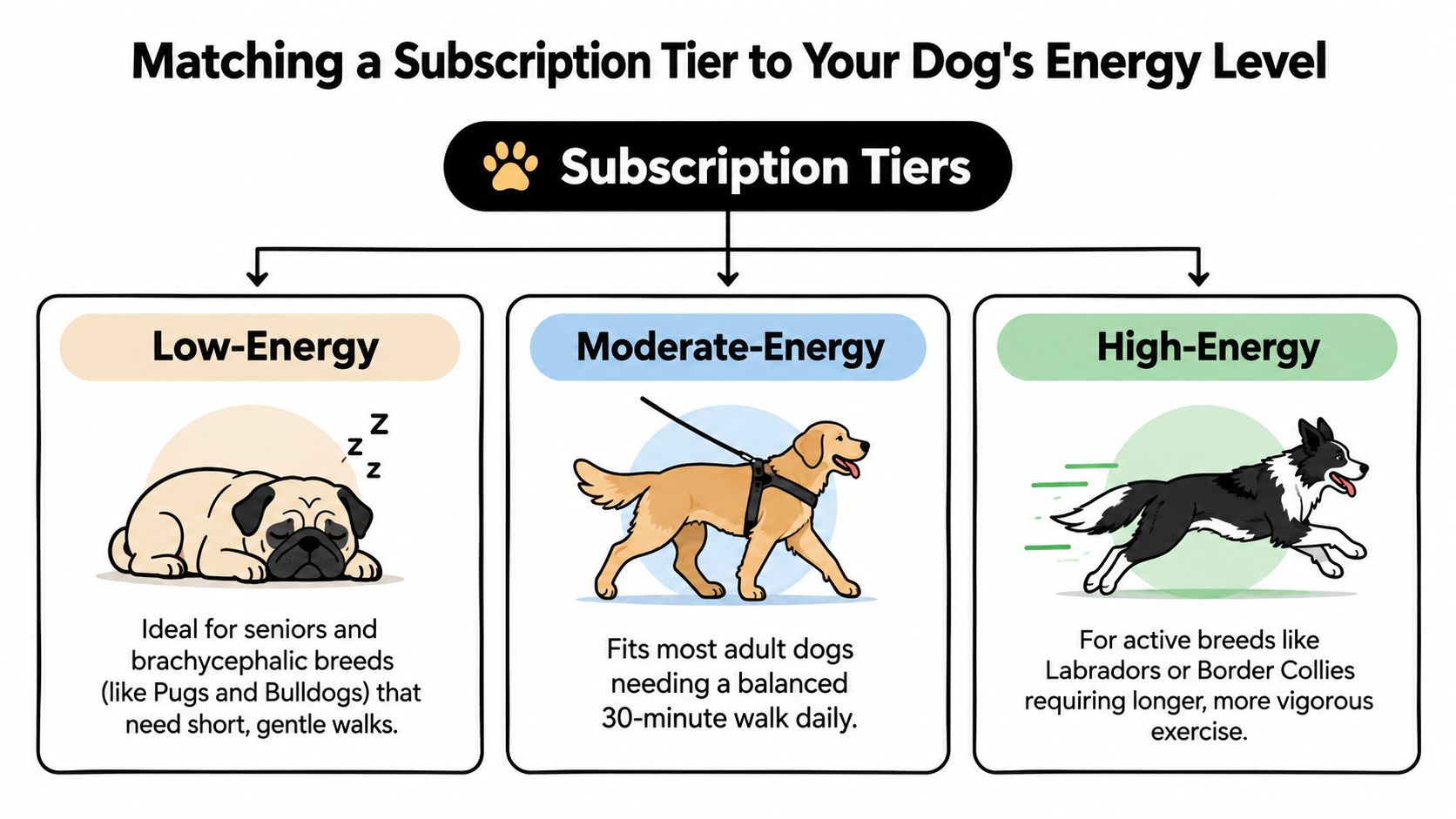
Matching a Subscription Tier to Your Dog's Energy Level
Most owners shop by budget first. I get why. But if you start there, you often buy the wrong plan.
Start with the dog in front of you. Then check whether your budget can support the right frequency.
Low-energy dogs
This group includes many seniors and brachycephalic breeds. They usually do better with two to three shorter outings per week than with longer, more demanding sessions. A slow, predictable neighborhood walk often beats a longer push they didn't ask for.
Moderate-energy dogs
This is the biggest group. Many adult family dogs need three to five standard walks each week to stay settled in the house. If your dog gets restless by late afternoon but isn't tearing your baseboards apart, this is probably your lane.
High-energy dogs
Working and sporting breeds usually need five or more recurring sessions , often with longer or more active formats. If your dog needs more than a casual loop around the block, read a practical guide to exercise for high-energy dogs before you choose a basic walking tier that won't touch the problem.
Quick self-check before you buy
- Your dog crashes after exercise and behaves better later. You probably need a stronger recurring schedule, not occasional rescue walks.
- Your dog is older, heat-sensitive, or breathing-limited. Buy shorter consistency, not longer intensity.
- You have two dogs. Add the extra-dog fee into your math before you call a plan affordable.
- You have a puppy or adolescent dog. Expect the right tier to change as the dog matures.
Hidden Costs and Fine Print That Change the Math
Subscription pricing goes from appealing to annoying.
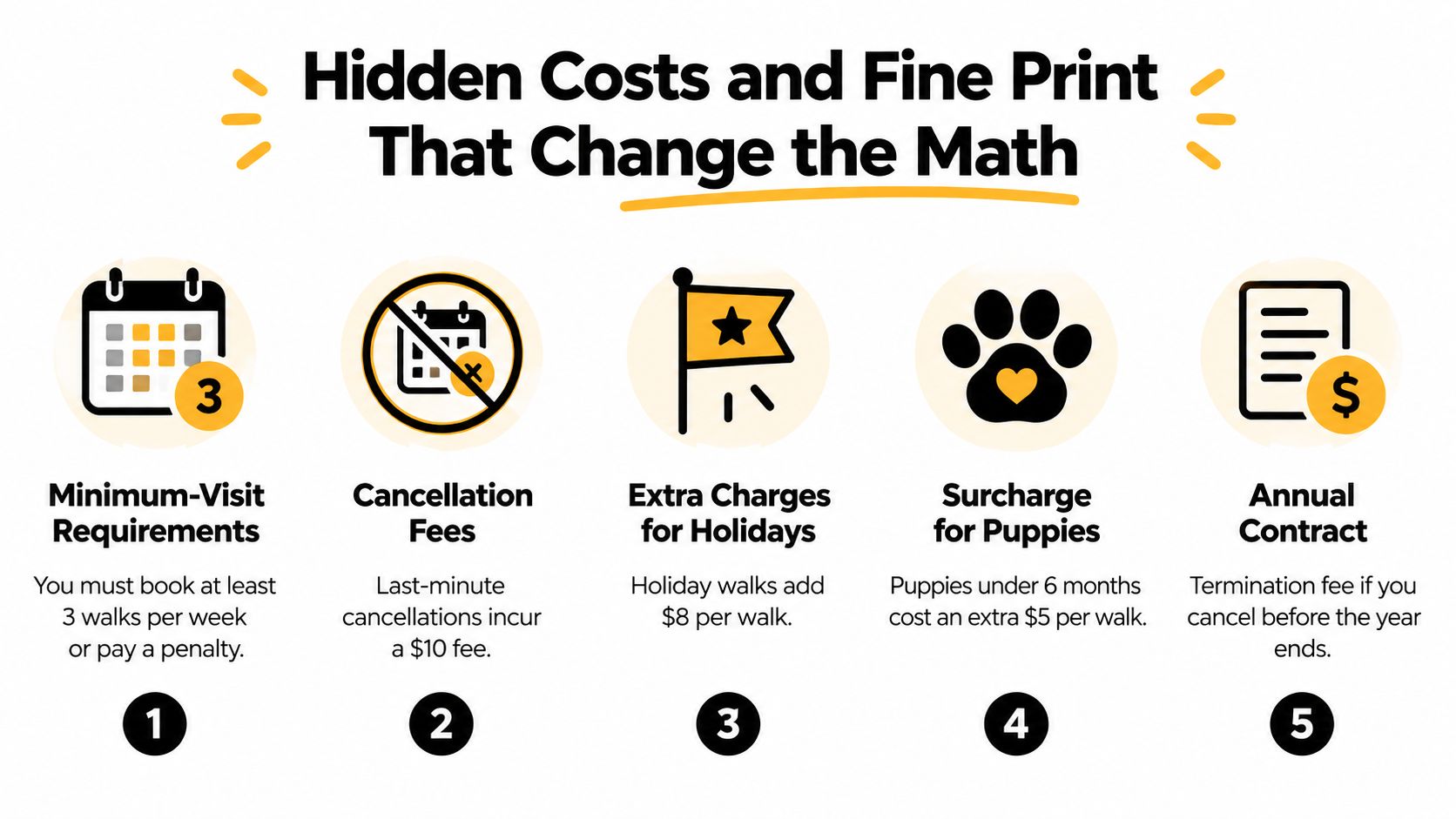
A lot of plans look fair at the headline rate. Then the fine print shows up. Minimum visits. Extra-dog fees. Weekend premiums. Same-day changes. Locked terms. Suddenly the “discounted” recurring plan costs about what one-off booking did, except now you're committed.
The fine print that changes the real total
One pricing discussion that deserves more attention is true subscription value versus flat advertised pricing . Independent examples show that some providers require at least two visits per week and add fees for after-4 p.m. visits, weekends, same-day bookings, and extra dogs , which can push the monthly cost well above the headline number, as shown in Blue Dog Pet Care's dog walking FAQ.
That matters because many recurring plans only discount modestly to begin with.
The specific fee lines to ask about
Don't sign up until you've asked about these:
- Minimum walk count . Some plans only make sense if you consistently use the full schedule.
- Extra-dog pricing . A second dog can change the value equation fast.
- Weekend and holiday surcharges . These are common, and they can wipe out the advertised savings.
- Cancellation windows . If your work travel shifts a lot, this line matters more than the base walk rate.
- Contract term and rate lock . Month-to-month flexibility is worth paying attention to.
Watch for this trap: a plan that looks cheaper per walk can still cost more overall if you're paying for visits you don't use or surcharges you assumed were included.
Why transparency matters
If you want a broader consumer-side view of why pet care pricing gets confusing, this pet sitting fee transparency guide is worth a read. It's not Denver-specific, but it does a good job explaining why clear pricing structure matters more than a catchy base rate.
The best operators don't dodge this conversation. They explain the terms in plain English.
Choosing the Right Plan and Getting Started
By the time you've compared rates, schedule stability, and fine print, the answer is usually pretty clear.
A dog walking subscription makes the most sense for owners with predictable weekday needs , dogs who benefit from routine, and households that are tired of solving the same midday problem over and over. It usually makes less sense if you need only occasional help or if your work calendar changes constantly.
The simple decision framework
Use this as your filter:
- Two walks a week often fits seniors and lower-energy dogs.
- Three walks a week works for many adult dogs in hybrid or moderately busy homes.
- Four to five walks a week is usually the right starting point for young, athletic, or high-energy dogs.
Then adjust for your life. If you're in the office full-time, buy for reality. If you work hybrid and are home more often, don't overbuy.
What to handle in the first week
Before service starts, get these details sorted:
- Meet-and-greet with the actual walker or assigned team
- Vet and emergency contacts shared in writing
- Home access instructions that are precise, not casual
- Backup coverage protocol for sick days, vacations, or weather issues
- Report format so you know whether you'll get GPS, notes, photos, or all three
You don't need a flashy onboarding process. You need a competent one.
My candid recommendation
If your dog needs regular weekday exercise, stop treating each walk like a separate purchase. That's usually the expensive way to buy a recurring need.
If you need fewer than three walks a week or your schedule is unpredictable, keep it flexible. If you need four or five walks most weeks, compare subscriptions carefully and read every fee line before you commit. For Denver-area owners, a local operator who knows the neighborhood routes, parking headaches, weather shifts, and breed patterns will usually build a better plan than an app template.
If you want a recurring setup that's built around weekday routine, energy level, and real neighborhood logistics, Denver Dog offers local walking and exercise services for busy pet owners across the Denver area. If your dog needs structure more than guesswork, start there and look at the plan through the lens that matters most: what your dog needs each week, and what you'll really pay for it.
The Run Down