You've found a dog walker who can fit your work schedule, but one phrase in the profile gives you pause: bonded and insured . You know it sounds reassuring, yet you're not sure whether it means your dog is protected from an injury, your home is protected from theft, or both. That uncertainty matters when a walker will hold your keys, enter your Denver home, and care for a family member while you're away.
A bonded dog walker may offer an important layer of financial accountability, but bonding isn't a substitute for insurance. Understanding the difference helps you ask better questions and choose care that matches the risks involved.
The Scenario That Reveals the Problem
Your workweek has started badly. Meetings fill the calendar, your energetic Golden Retriever is pacing by the door, and you need a dependable person for weekday exercise in Denver. A local walker says they're bonded and insured, so you feel close to making a decision.
Then you ask what those words mean. The answer might be vague: “You're covered.” But covered for what? If the walker accidentally leaves your front door open and your dog escapes, does the policy respond? If your dog slips on an icy sidewalk and needs veterinary treatment, is that included? If a key disappears or property is stolen, does insurance apply, or is that the purpose of the bond?
These aren't technical questions for their own sake. They describe different events with different protections. A bond generally addresses dishonest acts, while liability insurance addresses covered accidents, injuries, or property damage. A walker can have one without having the other, and the phrase “bonded and insured” doesn't tell you how broad either protection is.
The practical question: Don't ask only whether a walker is bonded. Ask what event would trigger the bond, what insurance covers, and which people or services the documents include.
Home access adds another layer. Your walker may receive a key, an alarm code, instructions about where supplies are kept, and responsibility for a dog who reacts differently to traffic, other animals, heat, or unfamiliar routes. The right choice protects more than your schedule. It supports your dog's safety and gives you a clear process if something goes wrong.
A professional weekday service can make demanding routines manageable, as explained in this guide to hiring a dog walker for a busy life. Still, convenience shouldn't replace basic credential checks. Before you hand over access, learn what the provider's promises mean.
What Bonding Really Means for Your Dog Walker
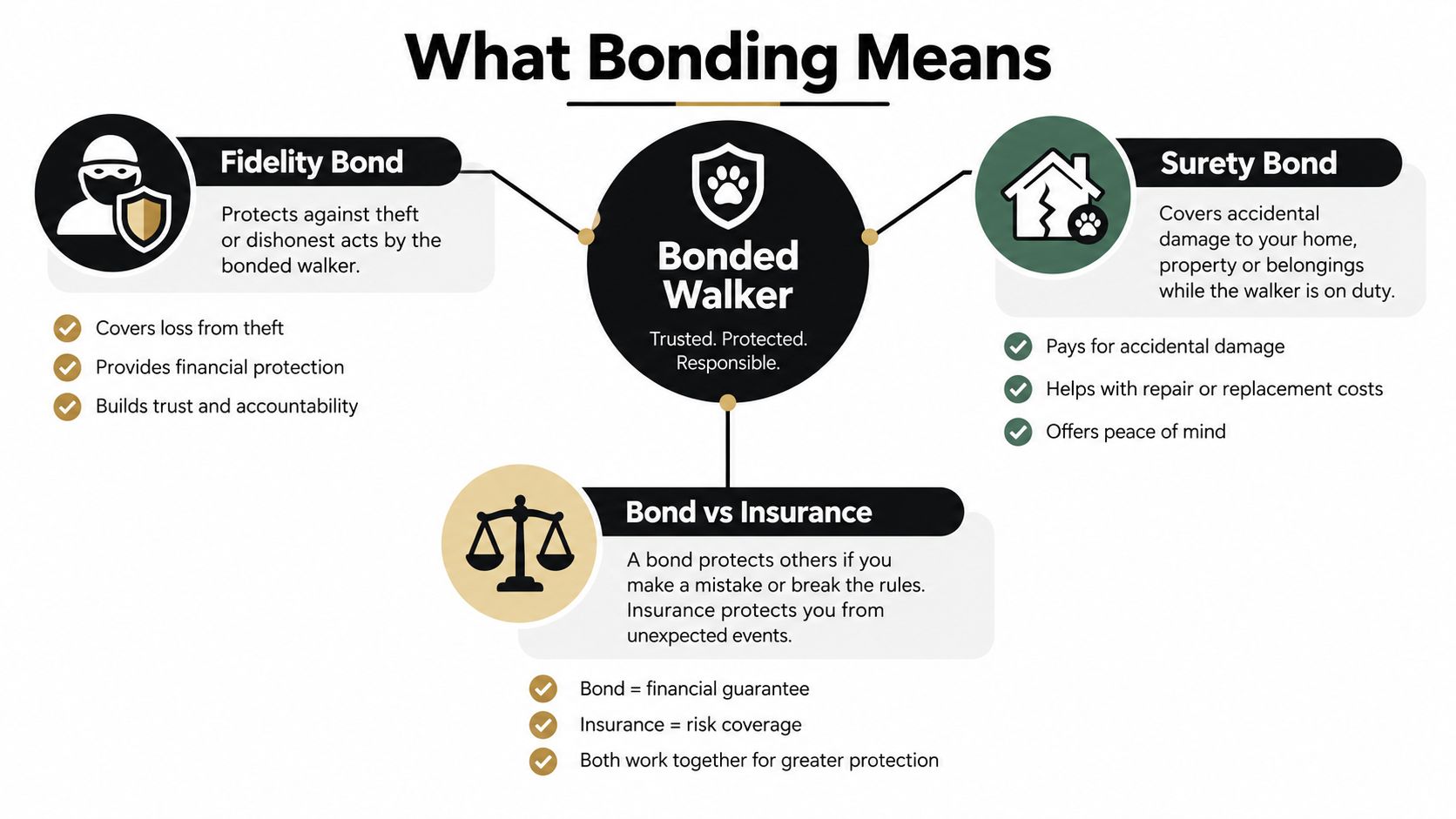
A fidelity bond , sometimes called a business services bond, protects against specified dishonest conduct. For a dog-walking business, it may respond if an employee or contractor steals, commits fraud, or causes another covered loss while entering your home or handling your property. The bond centers on trust and dishonesty, not routine accidents.
A surety-style bond works somewhat like a security deposit with conditions. The business purchases the bond, and if covered misconduct is proven, the client may receive reimbursement up to the bond limit. The bonding company can then seek repayment from the business or responsible party. Insurance generally works differently. It pays covered losses under policy terms without treating the payment as a debt the insured must repay.
The risk a bond addresses
Bonding matters most when a walker has unsupervised access to keys, alarm codes, valuables, or private rooms . If an employee takes jewelry during a scheduled visit, that may fit the dishonest conduct a fidelity bond is designed to address. The bond does not prevent theft. It provides a defined financial remedy when the claim satisfies its conditions.
Some industry guidance describes fidelity bonds for pet businesses as relatively affordable, with limits and annual costs varying by provider. Another guide describes a standard $10,000 fidelity bond as costing roughly $100 to $400 annually . These figures show why businesses may use bonding as a trust signal, yet the price alone cannot confirm that the bond suits your home, property, or service arrangement.
What bonding doesn't promise
A bond generally does not pay veterinary bills when a dog is injured during a walk. It is also not designed for a dog bite, a cyclist collision, damage to someone else's property, or a vehicle accident. Those situations require a separate review of liability insurance and other relevant coverage.
This distinction protects against a common misunderstanding. A dog walker can be bonded while still lacking insurance for injuries involving your pet. The bond may address theft, while insurance may address covered accidents. Ask for both protections rather than treating the phrase “bonded” as a complete safety guarantee.
Bonding is often voluntary rather than a universal legal requirement. Rules vary by state and municipality, with some locations requiring bonding for licensing and others not. In the United States, a pet-sitting fidelity bond is generally not federally required, although businesses may use one to build credibility with homeowners. Before you hand over access, learn what the provider's promises mean.
Bonding vs Insurance vs Licensing Explained
These three terms answer different questions. Bonding asks whether clients have protection against specified dishonest acts. Insurance asks whether covered accidents, injuries, or damage are addressed. Licensing asks whether the business meets a particular government requirement.
Consider a simple example. A walker enters your home, clips on your dog's leash, and accidentally knocks over a valuable lamp. That isn't automatically a bonding claim because there may be no dishonest conduct. If your dog is injured during a walk, the relevant question concerns pet-related liability or care, custody, and control coverage, not the existence of a fidelity bond.
| Protection Type | Covers Theft | Covers Injury | Legal Requirement |
|---|---|---|---|
| Bonding | Typically addresses covered theft or dishonest acts | Generally doesn't cover dog injuries, bites, or ordinary accidents | Requirements vary by state and municipality |
| Insurance | General liability doesn't replace theft protection | May address covered accidents, property damage, and relevant pet-care risks, depending on the policy | Requirements depend on the coverage and local rules |
| Licensing | Not primarily a theft safeguard | Not primarily an injury safeguard | Varies by jurisdiction and service type |
A dog walker may need a combination of protections because a single credential leaves gaps. Independent guidance from Pet Sitters International's insurance guide distinguishes bonding from liability and care, custody, and control coverage. That distinction is important if your dog is injured while under the walker's control.
Transport creates another question. If a provider drives your dog, you'll want to ask about the vehicle, the service agreement, and coverage that applies during transit. A separate resource on pet insurance while transporting can help owners think through transport-related protection without confusing it with a dog walker's fidelity bond.
Licensing also deserves careful treatment. A license can show that a provider has complied with a local rule, but it doesn't automatically confirm the scope of insurance, employee coverage, or theft protection. For a broader owner-focused explanation, review this dog-walking insurance guide before signing up.
Why These Distinctions Matter for Denver Pet Owners
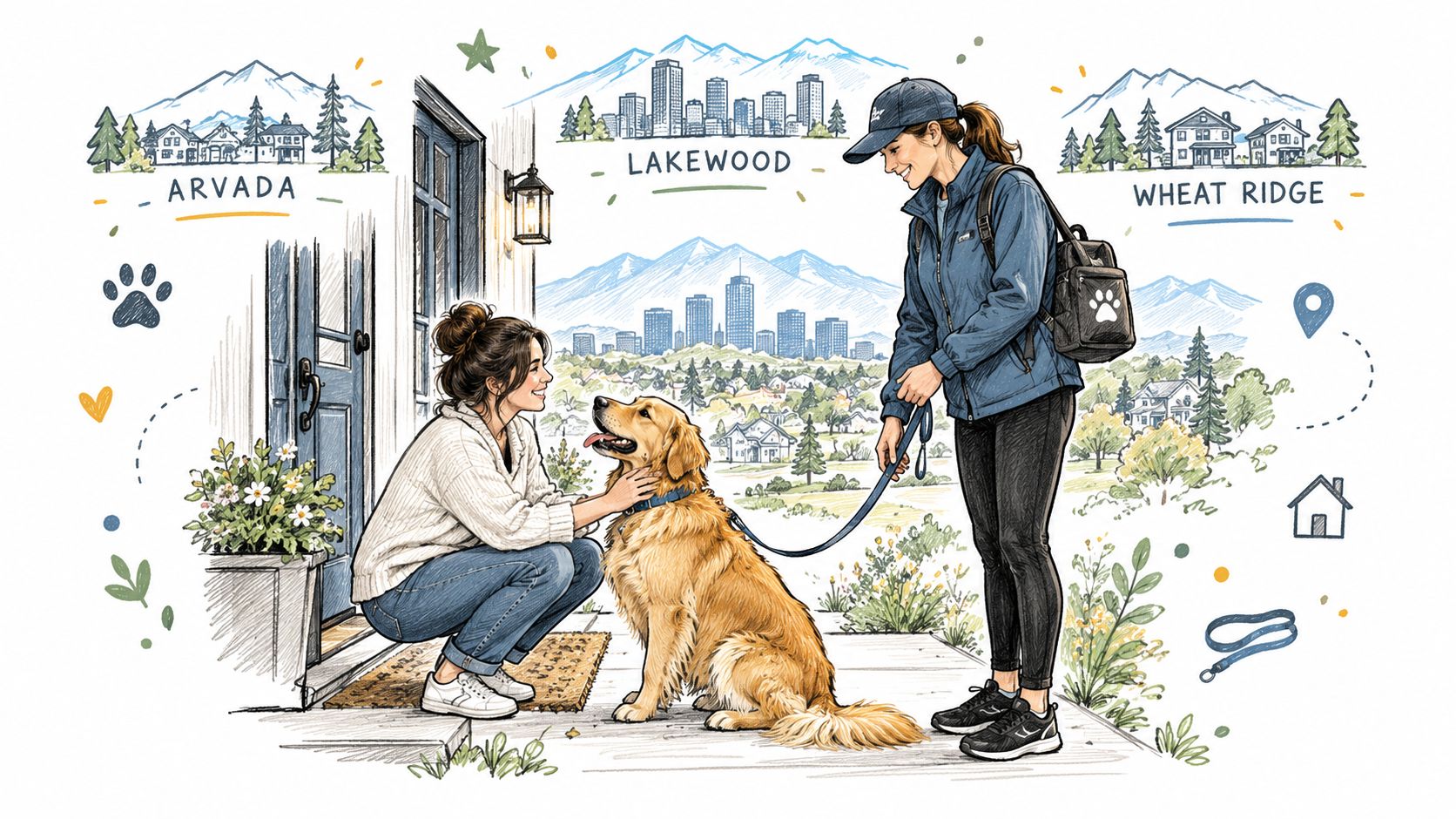
For a busy owner in Arvada, Denver, Englewood, Golden, Lakewood, Littleton, or Wheat Ridge , a dog-walking appointment often involves more than a leash and a neighborhood route. The provider may open the door, manage an alarm system, collect supplies, and handle your dog in public spaces. Each responsibility creates a different risk category.
A bond speaks most directly to property trust. Insurance addresses covered accidents and damage. Pet-specific coverage may matter when the dog is in the walker's care, custody, or control. Industry standards recommend combining general liability insurance with care, custody, and control coverage for pets, plus bonding or theft coverage where appropriate, as outlined by Pet Sitters International's professional standards.
Match the protection to the exposure
Start with the service itself. A solo neighborhood walk may involve public-space risks, handling risks, and access to your pet. A team that enters homes repeatedly may also create staffing and property-access questions. A service that transports dogs adds vehicle-related exposure.
Ask the provider to identify the relevant protection for each situation:
- Home access: Which coverage responds to theft or dishonest acts involving keys, property, or employees?
- Pet handling: What protection applies if the dog is injured, lost, or involved in an accident while under the provider's control?
- Public activity: Does liability coverage address covered injury or property damage involving other people, animals, or belongings?
- Staffing: Are employees, subcontractors, and substitute walkers included under the same structure?
Focus on controls, not just certificates
Insurance documents matter, but safe operations matter too. Ask how the team records incidents, trains handlers, reviews policies, and manages keys or alarm codes. Stronger controls can reduce the chance that a small mistake becomes a serious loss.
A provider who answers these questions clearly is giving you more useful information than a badge or slogan. You're evaluating how the business handles responsibility before an incident occurs.
How to Verify Your Dog Walker's Credentials
A Denver owner hires a bonded dog walker after seeing the reassuring label, then discovers that the dog is injured during a visit. The bond may address theft or dishonest conduct, while the injury claim depends on separate insurance. Verification should therefore test each protection against the event it is meant to handle.
Use a focused credential checklist
-
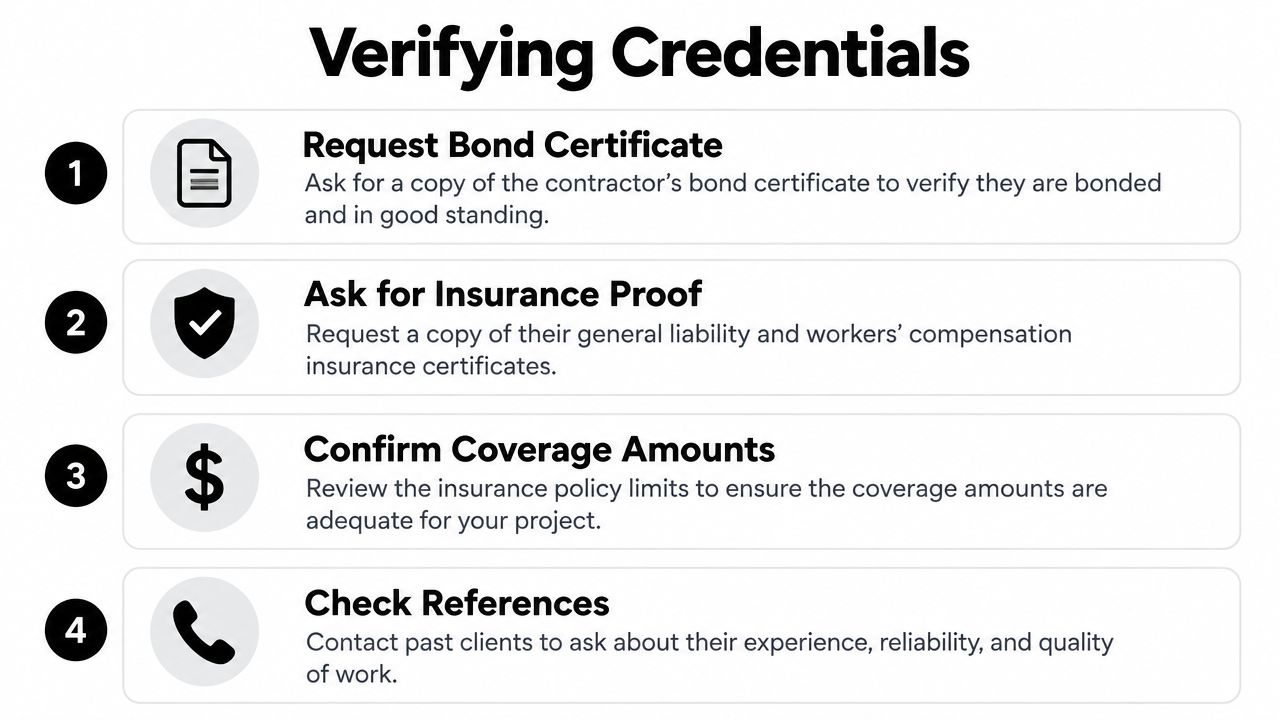
Request the bond certificate. Check the bond type, covered conduct, effective dates, limit, and named business. Coverage may apply by employee, position, or blanket arrangement. Ask which structure the walker has and whether it includes the people who may enter your home.
-
Ask for insurance proof. Review the insurer, policy dates, business name, and liability or pet-care coverage shown. A general liability certificate does not automatically cover theft, veterinary costs, or every injury involving an animal.
-
Ask about exclusions. Certificates summarize coverage and do not show every condition. Request plain-language answers about off-leash activity, transportation, subcontractors, aggressive behavior, veterinary expenses, and care, custody, and control.
-
Confirm who is covered. A solo walker, employee, and subcontractor may receive different treatment under the business's policies. Ask who performs visits, whether substitutes are allowed, and whether each person receives the same training and protection.
-
Validate the documents. Contact the issuing company through independently obtained contact details. Confirm that the bond or policy is active for the named business and matches the dog-walking service you are buying.
The size of a bond can reflect the business arrangement and the exposure the provider chooses to protect. A solo walker and a company sending several workers into clients' homes may not use the same limit or coverage structure. Requirements and verification practices can also differ by state, so ask the provider which local rules apply rather than treating one certificate format as universal. Cost alone cannot establish quality. Clear answers about limits, exclusions, and claims are more useful than a credential label.
Add identity and operating questions
Background checks matter because a business may screen workers before assigning them to homes. Ask how often new workers are screened and whether the person arriving matches the name in your service records. The PeopleFinder background check guide offers general context for questions applicants may have about this process.
Ask who holds your keys, how visits are recorded, how emergencies are communicated, and what happens if the assigned walker is unavailable. The useful answer is specific: who is covered, what event triggers protection, how claims work, and where exclusions apply . For a broader credential review, consult this guide to dog handler qualifications owners should verify.
Building Confidence in Your Pet Care Choice
The phrase “bonded dog walker” should give you a starting point, not a final answer. A bond can address specified theft or dishonest acts, but it doesn't automatically cover a dog's injury, an accident on a public route, property damage, or every employee who may visit your home. Insurance, pet-care coverage, operating procedures, and clear communication complete the picture.
Return to the Denver owner with the Golden Retriever. The strongest decision isn't based on the most reassuring phrase in an advertisement. It comes from matching the service to the risk, reviewing documentation, asking about exclusions, and confirming who will handle the dog.
A practical choice usually includes these elements:
- Defined responsibility: The provider explains who enters your home and who handles your dog.
- Relevant protection: Bonding and insurance address different events, and the provider can describe both without blending them together.
- Documented procedures: Key access, visit updates, incidents, emergencies, and substitutions follow a clear process.
- Appropriate handling: Staff understand the dog's temperament, energy level, route needs, and safety boundaries.
- Transparent communication: You know how to report a concern and what information the business will provide.
For owners comparing local options, Denver Dog's service area includes Arvada, Denver, Englewood, Golden, Lakewood, Littleton, and Wheat Ridge . Denver Dog describes on-leash walking, running, and hiking services, with trained staff and safety monitoring. That makes it an option for owners who want structured weekday exercise while also asking direct questions about business protections.
The central lesson is simple. Bonded doesn't mean fully insured, and insured doesn't mean protected against every form of theft or misconduct. Treat each credential as one part of a layered decision, then choose a provider that can explain the layers in plain English.
Denver Dog provides professional on-leash dog walking, running, and hiking services for busy Denver-area pet parents, with coverage for Arvada, Denver, Englewood, Golden, Lakewood, Littleton, and Wheat Ridge. If you're ready to discuss structured weekday exercise and ask informed questions about care and protections, visit Denver Dog to learn more and get started.
The Run Down