Navigating the world with a reactive dog can feel isolating and stressful. Every walk is fraught with tension as you scan the horizon for triggers like other dogs, cyclists, or even unfamiliar people. That sudden lunging, barking, and growling is not a sign of a 'bad dog'; it's a big, loud signal of overwhelming emotions such as fear, frustration, or over-excitement. The good news is that reactivity is manageable. With the right strategies, consistency, and a clear understanding of your dog's needs, you can transform stressful walks into enjoyable adventures.
This guide offers a comprehensive roundup of effective, humane, and practical reactive dog training tips . We'll move beyond generic advice and dive into the specific techniques that create real change. You will learn how to de-escalate intense situations, manage your environment to prevent reactions, and systematically build your dog’s confidence around their triggers. We will cover everything from foundational behavioral science, like desensitization, to immediate management tactics that you can implement on your very next walk.
Each tip is designed to be actionable, providing clear, step-by-step instructions to help you and your dog succeed. Whether you're just starting this journey or looking for new methods to overcome a training plateau, these proven strategies will help you build a stronger bond and find peace on the leash. Let's get started on the path to a calmer, happier walking experience for you both.
1. Desensitization and Counter-Conditioning
The cornerstone of virtually all successful reactive dog training tips is a two-part process: desensitization and counter-conditioning (DSCC) . Desensitization involves carefully exposing your dog to their trigger (another dog, a person, a skateboard) at a distance far enough away that they notice it but do not react negatively. This "sub-threshold" distance is key. Counter-conditioning is the process of changing your dog's emotional response to that trigger. You do this by pairing the sight of the trigger with something they absolutely love, like high-value treats.
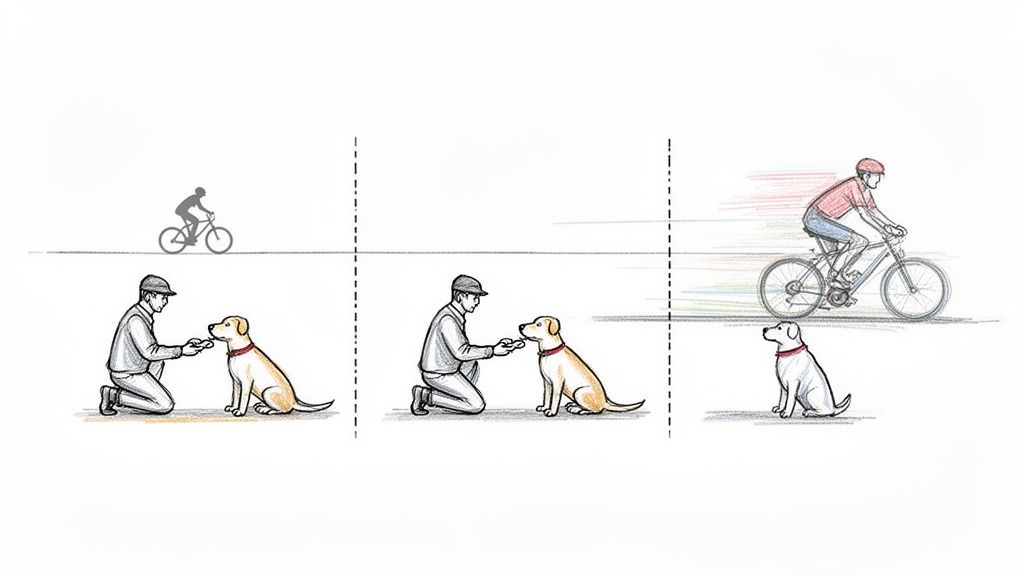
The goal is to teach your dog's brain to associate the once-scary thing with a positive feeling. Instead of thinking, "Cyclist equals danger!" they start to think, "Cyclist equals delicious chicken!" This foundational work is crucial for dogs participating in structured exercise programs like those offered by Denver Dog, where encounters with various triggers on trails are inevitable.
How to Implement DSCC
Properly implementing DSCC requires patience and a systematic approach. The process rewires your dog’s emotional response, transforming fear or frustration into calm anticipation.
-
Identify the Trigger and Threshold: First, pinpoint exactly what causes the reaction. Is it all dogs, or just large ones? Is it bikes, or just fast-moving ones? Next, find your dog’s reaction threshold, the exact distance at which they can see the trigger without reacting. This might be 100 feet, 50 feet, or even the length of a football field. This is your starting point.
-
Create Positive Associations: Once you are at a safe distance, the moment your dog notices the trigger, immediately start feeding them high-value treats (think boiled chicken, cheese, or freeze-dried liver). Stop the treats the second the trigger disappears from view. The trigger must predict the treat.
-
Gradually Decrease Distance: Over many sessions, as your dog remains calm and happy to see the trigger from afar, you can slowly decrease the distance. If your dog ever reacts (barks, lunges, stiffens), you have moved too close, too fast. Simply increase the distance again and work at that level until they are comfortable.
Key Insight: Progress is not linear. Some days will be better than others. The key is to end every session on a positive note and avoid pushing your dog over their threshold, an experience known as "trigger stacking," where multiple stressors build up and cause a reaction. A journal helps track distance improvements and identify patterns.
2. The 'Look At Me' Command (Watch Me/Focus Training)
A powerful tool in any reactive dog training tips toolkit is the ability to redirect your dog’s attention on command. Teaching a “Look at Me” or “Watch Me” cue creates an interruption mechanism that breaks the cycle of reactivity. When your dog starts to fixate on a trigger, this command prompts them to disengage from the stimulus and focus their attention back on you, their handler, creating a moment of calm and control.
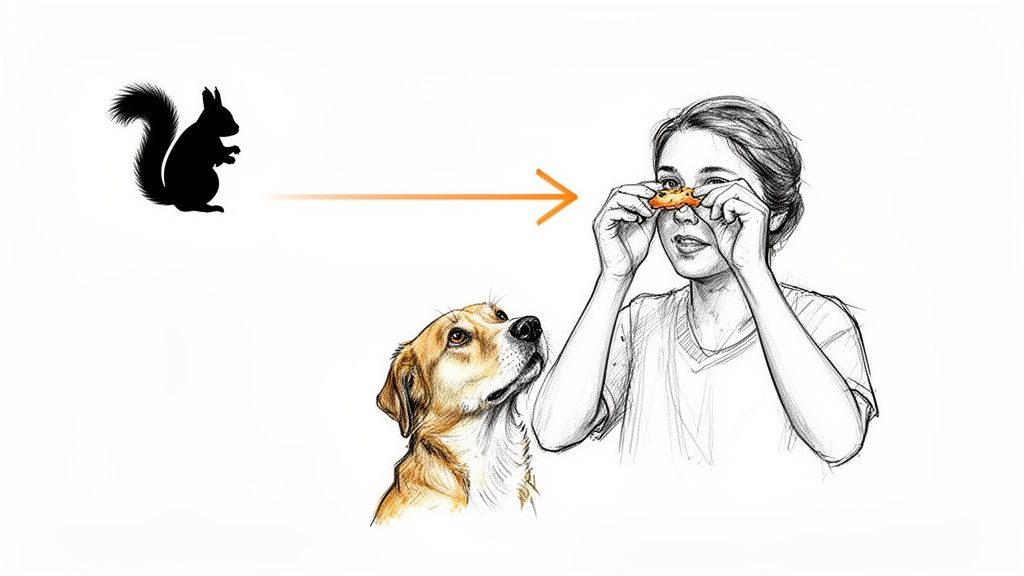
The goal of this focus exercise is to build a strong, positive history of your dog choosing to look at you instead of reacting to their environment. This skill is invaluable for dogs in structured exercise programs, where maintaining handler connection amidst distractions like other runners or wildlife is crucial for safety and success. It allows you to proactively manage situations before a reaction even begins.
How to Implement 'Look At Me'
Building a reliable focus cue requires starting in a controlled setting and gradually introducing more distractions. The key is making checking in with you more rewarding than fixating on a trigger.
-
Start in a Quiet Environment: Begin practicing at home with no distractions. Hold a high-value treat near your dog's nose, then slowly move it up to your eyes. The moment their eyes meet yours, say "Yes!" and give them the treat. Repeat this in short, fun sessions.
-
Add the Verbal Cue: Once your dog reliably follows the treat to your eyes, you can add the verbal cue. Say "Look at Me" just before you move the treat. Soon, your dog will associate the phrase with the action of making eye contact for a reward.
-
Increase Duration and Distractions: Gradually increase how long your dog must hold your gaze before getting the reward, starting with just a second. Once the cue is solid indoors, start practicing in your yard, then on quiet streets, slowly building up to more stimulating environments.
Key Insight: Consistency is everything. Use extremely high-value rewards that your dog only gets for this specific training. Practice in short, five-minute sessions daily to build a strong, reliable response. A strong "Look at Me" cue acts as a powerful management tool, allowing you to redirect your dog's focus before they go over threshold.
3. Controlled Leash Walking and Loose Leash Training
For a reactive dog, a tight leash can act as a direct line of tension, amplifying their anxiety, fear, or frustration. Controlled leash walking, specifically loose leash training, is a non-negotiable skill that teaches a dog that pulling gets them nowhere, while walking calmly by your side is rewarding. It fundamentally changes the dynamic of the walk from a constant battle of wills to a cooperative partnership, giving you better control when a trigger appears.
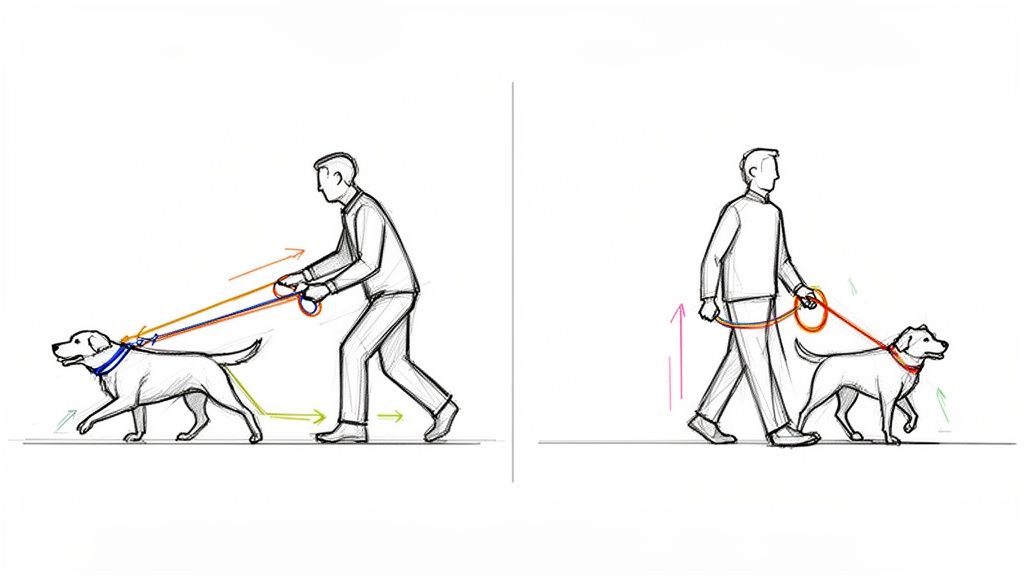
The goal is to eliminate the pulling behavior that often precedes a reaction. A dog that is already straining at the leash is in a heightened state of arousal and more likely to react. Services like those offered by Denver Dog build on this foundation, where proper leash manners are essential for safe and productive on-leash runs and hikes. Many of their clients see dramatic improvements in on-leash behavior after combining consistent training at home with professional sessions.
How to Implement Loose Leash Walking
Pioneered by trainers like Dr. Ian Dunbar, this method focuses on making walking politely more beneficial for the dog than pulling. It’s about teaching choice, not forcing compliance.
-
Start in a Low-Distraction Environment: Begin practicing in your house, backyard, or on a quiet street where triggers are minimal. The focus should be on the skill itself, not on navigating a stressful environment.
-
Reward the "Right" Position: The moment the leash is loose and your dog is beside you, mark the behavior with a "Yes!" and reward them with a treat. At first, you may be rewarding every single step.
-
Become a Tree: The instant your dog pulls and the leash tightens, stop moving completely. Stand still and silent. The forward motion they want only resumes when they release the tension, either by looking back at you or stepping closer.
-
Vary Your Pace and Route: Keep walks engaging by changing your speed and direction. This encourages your dog to pay attention to you rather than fixating on the environment ahead. If you're looking for new and exciting places to walk, you can explore a comprehensive guide to dog walking services in Denver for ideas and professional support.
Key Insight: Consistency is the most critical element of these reactive dog training tips. Every person who walks the dog must follow the same rules. Using a properly fitted front-clip harness can also provide better leverage and discourage pulling without causing discomfort.
4. Distance and Management (Creating Safe Space)
One of the most powerful and underrated reactive dog training tips is proactive management, which focuses on creating distance to prevent reactions before they start. Rather than forcing your dog to confront a trigger, this strategy involves actively managing their environment to keep them "sub-threshold," or far enough away from a stressor that they don't feel the need to react. This isn't about avoidance; it's about setting your dog up for success and building their confidence in a controlled manner.
Management is a crucial component of any behavior modification plan. It gives your dog's nervous system a break from practicing reactive behavior, which makes them more receptive to active training like Desensitization and Counter-Conditioning. For dogs in structured exercise programs, like those offered by Denver Dog, strategic management is key. Planners can choose routes and times that minimize exposure to known triggers, allowing the dog to enjoy the physical and mental benefits of the outing without stress.
How to Implement Management and Distance
Effective management requires you to become an expert observer of your environment and your dog's body language. The goal is to see the trigger before your dog does, or at least before they react, so you can calmly create space.
-
Become a Route Planner: Identify trigger "hotspots" in your neighborhood, such as busy intersections, popular dog walking paths, or homes with barking dogs behind fences. Plan your walks to avoid these areas, especially in the beginning. Choose quieter streets or less-trafficked trails to build a foundation of calm, successful walks.
-
Master the "Emergency U-Turn": One of the most essential management skills is the quick and casual U-turn. The moment you spot a trigger approaching, cheerfully say "This way!" and turn to walk in the opposite direction, rewarding your dog with a treat once you're moving away. This turns a potentially stressful encounter into a fun game.
-
Time Your Outings Strategically: If your dog reacts to other dogs, avoid walking during the peak "rush hour" times before and after the typical workday. Early morning or late evening walks are often much quieter. This is especially important during hot weather when you also need to consider temperature safety; you can learn more about keeping an outdoor dog cool while planning your schedule.
Key Insight: Management is not a lifelong crutch; it's a temporary tool that makes training possible. By preventing your dog from rehearsing unwanted behaviors, you create the mental space needed for them to learn new, calmer responses. Use the safety of distance to actively train alternative behaviors, like "look at that" games, from afar.
5. The 'Engagement' or 'Check-In' Protocol
A powerful, proactive strategy among reactive dog training tips is teaching an automatic 'check-in'. This protocol shifts the dynamic from you constantly managing your dog to your dog choosing to engage with you. The core idea is to build a strong habit where your dog voluntarily and frequently offers you their attention, such as making eye contact or orienting their body toward you, especially in distracting environments. Instead of fixating on potential triggers, their default behavior becomes looking to you for guidance.
This creates a constant communication loop, making your dog an active participant in your walks. By rewarding this unprompted attention, you teach them that staying connected to you is more valuable than investigating every stimulus. This is fundamental for dogs in exercise programs that involve dynamic environments, where a dog who naturally checks in is easier to guide past distractions like other hikers or wildlife on the trail.
How to Implement the Check-In Protocol
Building a reliable check-in behavior transforms a reactive dog’s mindset from outward-facing and worried to handler-focused and confident. The key is rewarding the dog’s choice to engage.
-
Start in a Low-Distraction Environment: Begin at home or in your quiet backyard. Any time your dog happens to look at you or turn toward you without being cued, mark the moment with a "Yes!" and give them a high-value treat. Keep sessions short and positive.
-
Reinforce Heavily and Variably: In the beginning, reward every single unprompted glance. As the behavior becomes more frequent, start using a variable reward schedule. Sometimes offer a super tasty treat, other times just verbal praise. This unpredictability, much like a slot machine, keeps the dog engaged and trying.
-
Generalize to New Environments: Once the check-in is reliable in a quiet setting, gradually practice in slightly more distracting places, like a quiet street or a park during off-hours. The goal is to build the habit so it becomes second nature, even when a trigger appears at a distance. If they disengage, you've moved too fast; return to an easier environment.
Key Insight: This protocol is not about demanding attention with "look at me" cues. It’s about capturing and reinforcing the dog's choice to offer it. This empowers the dog and builds a stronger partnership, as they learn that checking in with their handler is always a safe and rewarding decision.
6. Threshold Management and Gradual Progression
Understanding and managing your dog’s threshold is a fundamental part of any effective reactive dog training plan. A dog's reactivity threshold is the specific point where they switch from being calm and able to think, to being emotionally overwhelmed and reactive. This concept involves precisely identifying that threshold and then systematically and gradually decreasing the distance or intensity of the trigger over time through controlled, positive exposure.
The goal is to always keep your dog "sub-threshold," meaning they are aware of the trigger but not reacting to it. Working within this zone allows them to learn new, calmer associations without becoming too stressed. For dogs participating in structured exercise, this means starting with activities they can handle confidently, like solo runs on quiet trails, and only increasing the difficulty as their confidence grows, preventing setbacks.
How to Implement Threshold Management
Proper threshold management is about setting your dog up for success. It requires keen observation and a commitment to moving at your dog's pace, not your own.
-
Establish a Baseline: Your first task is to find the starting line. Carefully determine the exact distance or intensity at which your dog notices a trigger but remains calm. Document this with specific observations, such as "Can see a leashed dog at 75 feet and remains relaxed, but at 60 feet, ears go forward and body stiffens." This is your baseline.
-
Progress One Variable at a Time: To avoid overwhelming your dog, only increase the difficulty of one variable at a time. For instance, you might decrease the distance to the trigger, or stay at the same distance but on a slightly busier trail. Don't do both at once. Wait for three to four consecutive calm responses at the current level before making things slightly harder.
-
Plan for Regressions: Progress is rarely a straight line. Have a clear plan for what to do if your dog has a reactive episode. The answer is simple: you’ve moved too fast. Increase the distance or decrease the intensity back to the previous level where they were successful and work there a bit longer before trying to advance again.
Key Insight: Celebrating small victories is crucial for maintaining motivation for both you and your dog. A successful walk where you saw a trigger from 100 feet away and your dog remained calm is a huge win. Acknowledge these moments and remember that slow, steady progress is the key to lasting behavioral change.
7. Exercise and Mental Stimulation as Behavior Management
A frequently overlooked yet highly effective approach to managing reactivity is ensuring your dog receives adequate physical exercise and mental enrichment. Many reactive behaviors stem from pent-up energy, boredom, or a low threshold for arousal. A dog that is physically tired and mentally satisfied is naturally calmer, has better impulse control, and is less likely to react out of frustration or overstimulation.
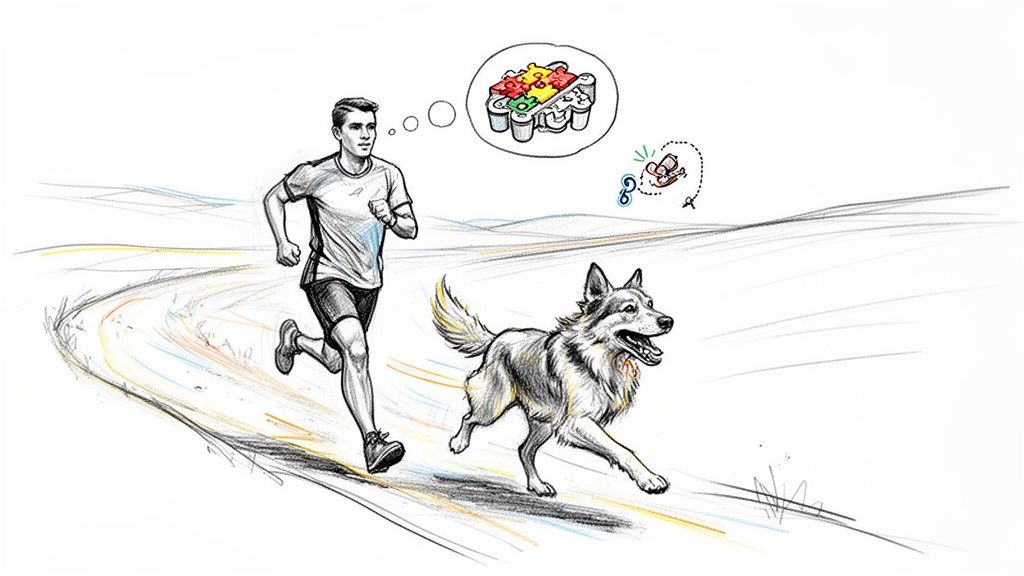
This principle is a core reason that structured exercise programs, like those offered by Denver Dog, are so impactful. High-energy working breeds such as Border Collies and German Shepherds often show a dramatic reduction in reactivity after consistent, vigorous exercise. Similarly, newly reactive puppies can transform from exhibiting excessive jumping and nipping to displaying calm, focused behavior once their energy needs are properly met.
How to Implement an Enrichment and Exercise Plan
A balanced routine addresses your dog’s needs holistically, lowering their baseline stress levels and making them more receptive to other reactive dog training tips. This approach tackles the root cause of the behavior, not just the symptoms.
-
Establish a Consistent Physical Routine: Aim for regular, structured exercise that suits your dog’s breed, age, and energy level. For many reactive dogs, scheduling consistent sessions with a service like Denver Dog at least 3-4 times per week provides the necessary outlet to burn off excess energy safely. Consistency is crucial for building a calmer default state.
-
Incorporate Mental Enrichment: Physical exercise alone is not enough. Mental stimulation is equally important for tiring out a dog's brain. Combine physical activity with home enrichment like puzzle toys, snuffle mats, or "find it" games. Varying running or hiking routes also provides mental novelty.
-
Track Behavioral Changes: Pay close attention to your dog’s behavior on days they receive structured exercise versus days they do not. This will help you understand their specific needs and adjust the frequency or intensity of their activities. Does their reactivity decrease for 24 hours post-hike? Use this data to optimize their schedule.
Key Insight: Exercise should reduce stress, not add to it. A frantic hour at a busy dog park can make reactivity worse. Opt for structured, focused activities like a trail run, a long-leash hike in a quiet area, or a dedicated sniffing walk. Even during colder months, it's vital to maintain a routine; find out how to exercise your dog safely in winter to keep their progress on track year-round.
8. Handler Confidence and Calm Assertiveness
Your dog is an expert at reading your body language. When you anticipate a reaction, your body tenses, your heart rate increases, and your breathing changes. Your dog picks up on these subtle cues, which can confirm their belief that an approaching trigger is indeed a threat. One of the most impactful reactive dog training tips involves shifting focus from the dog to the handler's state of mind: cultivating handler confidence and calm assertiveness .
This principle is about managing your own emotions to positively influence your dog's. A calm, confident handler communicates safety and control, while a tense, anxious handler communicates danger. The energy you project travels right down the leash. This is a core competency demonstrated by professional handlers, who manage encounters with calm body language and clear, quiet direction, effectively de-escalating a dog’s stress before it starts.
How to Cultivate Calm Assertiveness
Developing a calm and confident mindset is a trainable skill that directly counters your dog’s reactivity. It requires self-awareness and practice to replace old, anxious habits with new, reassuring behaviors.
-
Master Your Body Language: Before and during walks, consciously relax. Drop your shoulders, take deep, even breaths, and keep your grip on the leash relaxed yet secure. Avoid tensing up and holding your breath when you spot a trigger. A loose, neutral posture tells your dog there is nothing to worry about.
-
Use a Calm, Neutral Voice: Your tone matters immensely. Speak to your dog in a calm, matter-of-fact voice. Avoid high-pitched, frantic reassurances ("It's okay, it's okay!") or frustrated, angry commands, as both can escalate your dog's arousal and anxiety.
-
Practice Proactive Handling: Instead of waiting for a reaction, be proactive. If you see a trigger, confidently create space by calmly turning and walking the other way or moving behind a parked car. This decisive action shows your dog you are in control and will keep them safe, building their trust in your leadership.
Key Insight: Your goal is to become the "calm in the storm" for your dog. When you stop reacting to the trigger, you give your dog a powerful model for how they should behave. This mental shift is often the missing piece for owners who have tried everything else, as your own anxiety can inadvertently sabotage your training efforts.
Reactive Dog Training: 8-Point Comparison
| Technique | 🔄 Complexity | ⚡ Speed | 📊 Expected Outcomes (⭐) | Resource Requirements | 💡 Ideal Use Cases / Key Advantages |
|---|---|---|---|---|---|
| Desensitization and Counter-Conditioning | 🔄 High — precise distance control, systematic exposure | ⚡ Slow — weeks to months | 📊 Lasting reduction in trigger reactivity; ⭐⭐⭐⭐ | Professional guidance often helpful; consistent sessions and tracking | Best for root-cause change during structured runs/hikes; creates durable calm responses |
| "Look At Me" (Focus Training) | 🔄 Moderate — timing and consistency required | ⚡ Fast — 1–3 weeks for basics | 📊 Reliable short-term interrupt of reactivity; ⭐⭐⭐ | Daily short practice, high-value treats, handler timing | Ideal for leash-based redirection on runs; quick, real-time control tool |
| Controlled Leash Walking / Loose Leash | 🔄 Moderate — repetitive practice and technique | ⚡ Moderate — 2–3 weeks for noticeable gains | 📊 Improved safety, reduced pulling and lunging; ⭐⭐⭐⭐ | Consistent practice, proper harness, handler physical ability | Critical for safe on-leash running/walking; reduces handler fatigue and injuries |
| Distance and Management (Safe Space) | 🔄 Low — planning and avoidance strategies | ⚡ Immediate — reduces incidents right away | 📊 Immediate stress reduction but not a long-term cure; ⭐⭐ | Route planning, scheduling flexibility, knowledge of local areas | Use for immediate safety and confidence-building; complements active training |
| Engagement / Check-In Protocol | 🔄 Moderate — builds voluntary behavior over time | ⚡ Slow–Moderate — longer to become habitual | 📊 Increased voluntary attention and partnership; ⭐⭐⭐ | Initial consistent rewards, handler reinforcement across sessions | Best for sustained handler-dog communication during runs; reduces need for corrections |
| Threshold Management & Gradual Progression | 🔄 High — requires accurate assessment and staging | ⚡ Slow — incremental progress over weeks/months | 📊 Measurable, low-risk improvement with fewer setbacks; ⭐⭐⭐⭐ | Data tracking, patience, handler/coach expertise | Ideal for sensitive dogs—prevents overwhelm and supports steady advancement |
| Exercise & Mental Stimulation | 🔄 Low–Moderate — routine scheduling and variety | ⚡ Immediate (post-session) and cumulative over time | 📊 Significant reduction in arousal-driven reactivity; ⭐⭐⭐⭐ | Regular structured sessions (3–4+/wk), enrichment activities | Core for high-energy dogs; addresses root cause and improves overall behavior |
| Handler Confidence & Calm Assertiveness | 🔄 Moderate — human behavior change and self-regulation | ⚡ Immediate effect possible; mastery takes time | 📊 Quick calming influence on dogs when applied; ⭐⭐⭐ | Coaching, feedback from professionals, practice in real situations | Universally applicable; models calm leadership and enhances other methods |
Putting It All Together for Lasting Success
Navigating the world with a reactive dog is not a simple problem with a single solution. It is a complex journey that requires a thoughtful, multi-layered approach, blending proactive management with consistent training. The reactive dog training tips outlined in this guide are not standalone fixes but interconnected components of a holistic strategy designed to build your dog’s confidence and reshape their emotional responses to triggers.
Success isn't about finding a magic bullet. It’s about understanding that each element, from desensitization and counter-conditioning to threshold management, plays a crucial role. One day, the focus might be on maintaining a safe distance and preventing reactions. The next, it might be dedicated to short, successful training sessions reinforcing the 'Look at Me' command or practicing loose-leash walking skills in a low-distraction environment.
Your Integrated Training Blueprint
Think of these strategies as tools in your toolbox. The true art of managing and improving reactivity lies in knowing which tool to use and when. Your role is to become a skilled handler who can read your dog's body language, advocate for their needs, and create an environment where they can succeed.
Here’s a summary of the core principles to integrate into your daily routine:
- Proactive Management First: Always prioritize setting your dog up for success. This means managing distances, avoiding trigger-stacking situations, and using tools like U-turns to prevent a reaction before it starts. Management is not a failure; it’s a foundational part of effective training.
- Combine Skills with Purpose: Don't just practice commands in a vacuum. Use the 'Look at Me' command to help your dog disengage from a distant trigger. Pair loose-leash walking skills with your 'Check-In' protocol to create a powerful feedback loop of positive reinforcement and engagement.
- Balance Physical and Mental Needs: A tired dog is often a more trainable dog, but an over-tired dog can be more reactive. Ensure your dog receives a healthy balance of structured physical exercise and enriching mental stimulation, like puzzle toys or scent work, to reduce overall stress and anxiety.
- You Are Half of the Equation: Your confidence, or lack thereof, travels right down the leash. By practicing calm assertiveness and predictable handling, you provide the security your dog needs to feel safe. Your calm presence is one of the most powerful reactive dog training tips you can implement.
The Path Forward: Patience, Persistence, and Partnership
Remember that progress is rarely a straight line. You will have breakthrough moments followed by setbacks. The key is to celebrate the small wins, a calm glance away from a trigger, a loose leash for ten extra seconds, and to learn from the challenging days without becoming discouraged. Each interaction is a data point that helps you better understand your dog’s thresholds and needs.
For many owners, especially those with busy schedules in a bustling city like Denver, providing consistent, controlled exposure and exercise is a significant challenge. This is where professional support can become an invaluable part of your plan. Partnering with experienced handlers ensures your training is reinforced correctly, even when you can't be there. It provides your dog with safe, structured, and positive outings that build on the foundation you’ve worked so hard to create. Committing to this comprehensive journey transforms you from just a dog owner into your dog's most trusted advocate, guide, and teammate, ultimately leading to a more peaceful and joyful life together.
Ready to give your dog the consistent, expert-led exercise that reinforces good behavior? Denver Dog offers professional dog walking and running services designed to provide the structured, positive outlets that are crucial for reactive dogs. Let our experienced handlers help you on your training journey. Learn more and book your service at Denver Dog.
The Run Down